
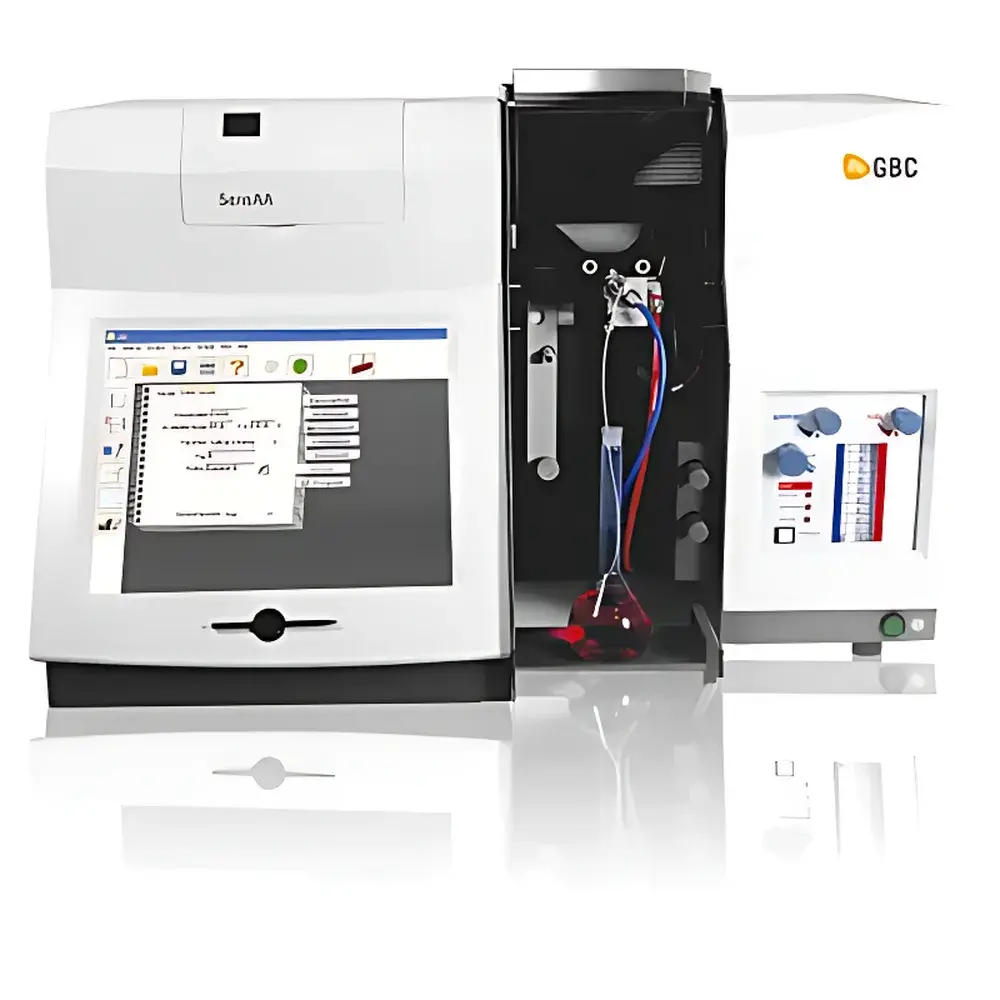
GBC SensAA Flame and Graphite Furnace Atomic Absorption Spectrometer
| Brand | GBC |
|---|---|
| Origin | Australia |
| Model | SensAA |
| Instrument Type | Flame-Graphite Furnace Hybrid AAS |
| Monochromator | Plane Grating |
| Optical System | Double-Beam |
| Detector | Photomultiplier Tube (PMT) |
| Background Correction | Deuterium Lamp |
| Resolution | 0.1 nm |
| Sensitivity | >0.8 Abs for 5 mg/L Cu solution |
| Precision (RSD) | ≤0.5% |
| Detection Limit | Cu ≤ 0.005 mg/L |
| Light Source Configuration | 6-target hollow cathode lamp turret enabling up to 13 element combinations |
| Integrated Control | Built-in 15″ Windows-based touchscreen PC |
Overview
The GBC SensAA Flame and Graphite Furnace Atomic Absorption Spectrometer is a dual-mode analytical platform engineered for high-precision elemental quantification across diverse sample matrices. Based on the fundamental principle of atomic absorption spectroscopy—where ground-state free atoms in a flame or graphite furnace absorb characteristic radiation emitted by a hollow cathode lamp—the SensAA delivers trace-level detection through controlled atomization and highly selective wavelength isolation. Its double-beam optical architecture compensates for source intensity drift and lamp aging, ensuring long-term photometric stability essential for regulated laboratory environments. Designed and manufactured in Australia, the system integrates a fully embedded 15-inch Windows-based touchscreen computer, eliminating external PC dependencies and streamlining method development, data acquisition, and instrument diagnostics within a single, validated interface.
Key Features
- Hybrid atomization capability: seamless switching between air-acetylene flame and electrothermal graphite furnace modes—enabling both rapid routine analysis and ultra-trace detection down to sub-ppt levels.
- 6-position hollow cathode lamp turret with “Application Source” configuration: supports simultaneous mounting of up to six lamps; intelligent lamp selection logic allows automated combination of multi-element lamp pairs (e.g., Ca/Mg, Fe/Mn), delivering up to 13 distinct element-specific emission lines without manual reconfiguration.
- High-fidelity optical train: plane grating monochromator with 0.1 nm spectral resolution ensures optimal line separation for complex matrices, while the double-beam design maintains baseline integrity during extended run times.
- Deuterium arc background correction: dynamically compensates for structured molecular absorption and light scattering across the UV–VIS range (190–900 nm), critical for samples containing high salt content or organic solvents.
- Robust flame system architecture: optimized burner head geometry and gas flow control deliver exceptional signal-to-noise ratio and reproducibility—validated at ≤0.5% RSD for repeated measurements of 5 mg/L Cu standard under identical instrumental conditions.
- Modular expandability: factory-certified upgrade path to graphite furnace atomization or hydride generation systems, preserving original calibration history and software licensing integrity.
Sample Compatibility & Compliance
The SensAA accommodates aqueous solutions, digested environmental and biological samples, diluted industrial effluents, and mineral acid extracts—compatible with standard ASTM D1688 (copper in water), ISO 11171 (metal impurities in fuels), and USP heavy metals testing protocols. Its hardware and firmware architecture support audit-ready operation under GLP and GMP frameworks: full electronic logbook, user access levels, method versioning, and raw-data immutability. Optional 21 CFR Part 11 compliance packages include digital signature enforcement, encrypted audit trails, and secure electronic records retention—meeting FDA, EMA, and TGA regulatory expectations for pharmaceutical and clinical laboratories.
Software & Data Management
SensAA operates on GBC’s proprietary AAS Control Suite v5.x, deployed natively on the integrated Windows OS. The software provides real-time spectral visualization, multi-point calibration (linear, quadratic, and weighted least-squares), QC flagging per ICH Q2(R2) guidelines, and automated report generation in PDF/XLSX formats. All raw absorbance/time data, lamp alignment logs, and background correction traces are stored with metadata (operator ID, timestamp, method name, instrument serial number). Data export adheres to ASTM E1382 and ISO/IEC 17025 requirements for traceability, with optional LIMS integration via ASTM E1482-compliant XML schema.
Applications
- Environmental monitoring: quantification of Pb, Cd, As, and Cr(VI) in soil leachates and drinking water per EPA Method 7000B and ISO 17294-2.
- Clinical toxicology: measurement of serum Zn, Cu, and Se using graphite furnace mode with Zeeman background correction (optional upgrade).
- Food safety: determination of Ni and Co in infant formula following AOAC 984.27 and EU Commission Regulation (EU) No 836/2012.
- Geochemical assay: multi-element analysis of rock digests via flame-AAS with sequential lamp switching and internal standard normalization.
- Pharmaceutical excipient testing: verification of catalyst residues (Pd, Pt, Rh) in active pharmaceutical ingredients per ICH Q3D.
FAQ
Is the SensAA compliant with 21 CFR Part 11 for electronic records and signatures?
Yes—when equipped with the optional GxP Compliance Module, the system supports role-based authentication, electronic signatures with biometric or token-based verification, and immutable audit trails meeting FDA and EMA requirements.
Can the instrument be upgraded from flame-only to flame-graphite furnace configuration in the field?
Yes—GBC-certified service engineers can install the graphite furnace module, recalibrate optical alignment, and validate performance against NIST SRM 3136a (Cu standard) without requiring full system replacement.
What is the typical detection limit for lead (Pb) in graphite furnace mode?
Using standard platform-assisted atomization and deuterium background correction, the validated detection limit for Pb is ≤0.01 µg/L (pptr) in aqueous matrix—achievable with certified GBC GF-35 graphite tubes and argon purge optimization.
Does the 6-lamp turret support simultaneous multi-element analysis?
No—atomic absorption is inherently single-element; however, the turret enables rapid, software-controlled lamp switching with automatic wavelength and slit width reconfiguration, reducing inter-element analysis time by up to 60% compared to manual lamp changes.
Is routine maintenance documented within the software?
Yes—the Maintenance Log module records lamp usage hours, burner head cleaning events, graphite tube cycles, and PMT voltage adjustments, generating scheduled alerts and exportable service reports aligned with ISO/IEC 17025 Clause 6.4.10.




