
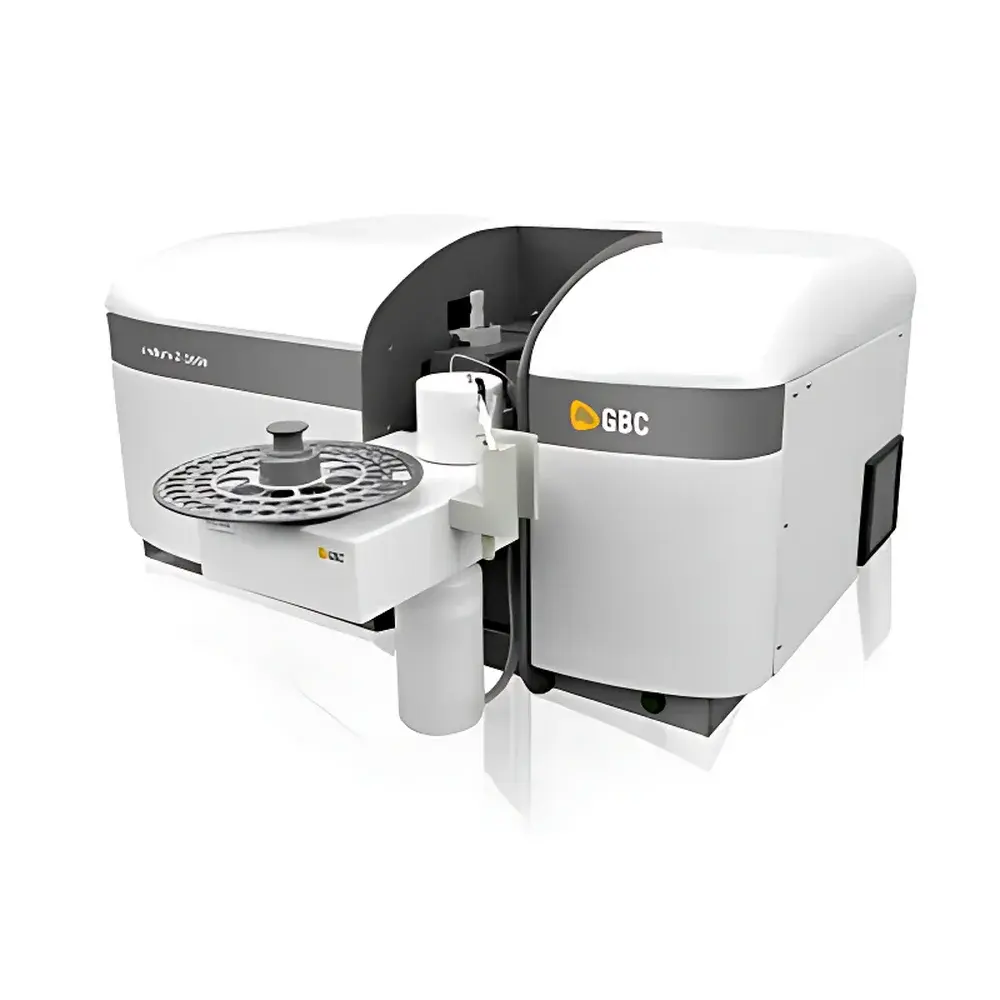
GBC enduro Z-1000 Zeeman Graphite Furnace Atomic Absorption Spectrometer
| Brand | GBC |
|---|---|
| Origin | Australia |
| Model | enduro Z-1000 |
| Instrument Type | Graphite Furnace AAS |
| Optical System | Dual-beam |
| Monochromator | Plane Grating |
| Detector | Photomultiplier Tube (PMT) |
| Background Correction | Zeeman Effect |
| Adjustable Magnetic Field Strength | 0.6–1.0 T (0.1 T increments) |
| Lamp Holder | 8-position Auto-aligning |
| Wavelength Selection | Automatic |
| Slit Width | 0.1–2.0 nm (0.1 nm increments) |
| Hollow Cathode & Electrodeless Discharge Lamp Recognition | Encoded |
| Ultra-Lamp Power Supply | 10 V (1 standard, up to 4 optional) |
| Resolution | <0.2 nm |
| Sensitivity | ≤0.003 absorbance units for Cu at 324.8 nm |
| Detection Limit | ≤0.5 pg for Cd in graphite furnace mode |
Overview
The GBC enduro Z-1000 is a high-performance, Zeeman-effect-based graphite furnace atomic absorption spectrometer engineered for trace elemental analysis in demanding laboratory environments. It operates on the fundamental principle of atomic absorption spectroscopy—where ground-state free atoms in a graphite furnace absorb characteristic radiation emitted by element-specific hollow cathode or electrodeless discharge lamps. The integrated Zeeman background correction system employs a variable magnetic field (0.6–1.0 Tesla, adjustable in 0.1 T steps) applied directly to the graphite tube, enabling precise separation of atomic absorption signals from broadband and structured molecular background absorption. This architecture eliminates the need for deuterium or continuum-source correction, delivering superior accuracy and stability in complex matrices such as biological fluids, environmental digests, and high-salt industrial samples.
Key Features
- Variable-strength Zeeman magnet system with digital control (0.6–1.0 T, 0.1 T resolution), optimized for maximum signal-to-noise ratio across diverse analytes and matrix types.
- 8-position automated lamp turret with motorized alignment and real-time beam centering—ensures reproducible optical coupling without manual intervention.
- Motorized slit width adjustment (0.1–2.0 nm, 0.1 nm increments) combined with automatic wavelength scanning, supporting both high-resolution quantitation and broad-band screening protocols.
- Encoded lamp recognition technology compatible with both hollow cathode lamps (HCLs) and electrodeless discharge lamps (EDLs), eliminating manual lamp identification errors and streamlining method setup.
- Dedicated 10 V ultra-lamp power supply (1 standard, expandable to 4) designed for low thermal load and enhanced radiance output—improving detection limits while extending lamp lifetime.
- Dual-beam optical path with real-time reference beam monitoring, compensating for source drift and ensuring long-term photometric stability over extended analytical runs.
Sample Compatibility & Compliance
The enduro Z-1000 supports direct solid, liquid, and slurry sample introduction via programmable graphite furnace temperature ramping (drying, pyrolysis, atomization, cleaning). Its robust platform accommodates ASTM D5762, ISO 11170, USP , and EPA Method 7000B workflows. All furnace programs comply with GLP/GMP documentation requirements, including full audit trail logging, user authentication, and electronic signature support per FDA 21 CFR Part 11. Optional autosampler integration enables unattended multi-sample analysis with matrix-matched calibration and internal standard addition capabilities.
Software & Data Management
Controlled by GBC’s proprietary WinAAS software, the system provides intuitive method development, real-time spectral visualization, and automated calibration curve generation (linear, quadratic, or weighted least-squares). Data files are stored in vendor-neutral formats (CSV, XML) and include complete metadata: instrument parameters, furnace program logs, lamp usage history, and background correction diagnostics. Software modules support IQ/OQ/PQ validation templates, electronic lab notebook (ELN) export, and LIMS connectivity via ASTM E1384-compliant interfaces.
Applications
The enduro Z-1000 delivers reliable sub-picogram detection for regulated and research applications including: heavy metal quantification in drinking water (Pb, Cd, As per EPA 200.9), toxic element screening in pharmaceutical excipients (ICH Q3D), nutritional mineral profiling in food and feed (Fe, Zn, Se per AOAC 984.27), and speciation-supporting analysis in geochemical leachates. Its Zeeman architecture ensures minimal interferences in high-chloride or high-phosphate samples—common challenges in clinical serum and wastewater testing.
FAQ
What magnetic field strength range does the Zeeman system support?
The enduro Z-1000 features digitally controlled variable magnetic field strength from 0.6 to 1.0 Tesla, adjustable in precise 0.1 Tesla increments.
Is lamp identification fully automated?
Yes—encoded lamp bases enable automatic recognition of both hollow cathode and electrodeless discharge lamps, including manufacturer, element, and recommended operating parameters.
Can the system be validated for regulated environments?
Yes—the instrument and WinAAS software support full 21 CFR Part 11 compliance, including role-based access control, electronic signatures, and immutable audit trails for IQ/OQ/PQ documentation.
What slit width options are available during analysis?
Slit width is continuously adjustable from 0.1 nm to 2.0 nm in 0.1 nm increments, allowing optimization for sensitivity versus spectral resolution based on elemental line profiles and matrix complexity.
Does the system support internal standardization?
Yes—when configured with an optional autosampler and dual-channel detection module, the enduro Z-1000 supports simultaneous analyte/internal standard measurement for enhanced precision in variable-matrix samples.






