
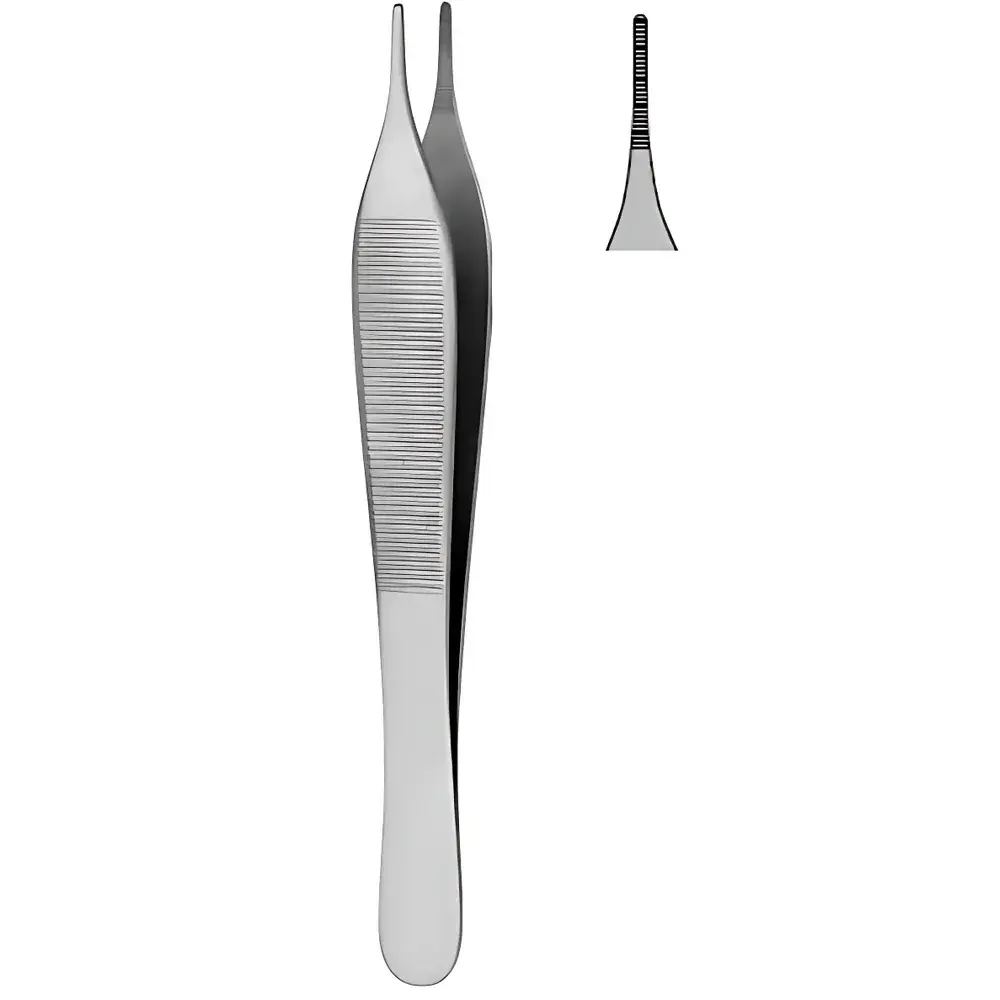
ADSON Micro Dissecting Forceps by RWD
| Brand | RWD |
|---|---|
| Origin | Shenzhen, China |
| Manufacturer Type | Direct Manufacturer |
| Country of Origin | China |
| Model | F12003-12 |
| Price | Upon Request |
| Tip Width | 1.5 mm |
| Overall Length | 12 cm |
| Gross Weight | 0.2 kg |
| Net Weight | 21.4 g |
Overview
The ADSON Micro Dissecting Forceps (Model F12003-12) is a precision surgical instrument engineered for fine-tissue manipulation in microsurgical, neurosurgical, ophthalmic, and histological applications. Designed in strict accordance with ISO 7740 and ASTM F899 standards for surgical stainless steel instruments, this forceps employs a classic Adson pattern—characterized by finely serrated, opposing 1.5 mm-wide tips and a delicate yet rigid 12 cm shaft—to deliver controlled gripping force with minimal tissue trauma. The instrument operates on a simple but highly refined mechanical principle: dual-lever fulcrum geometry ensures consistent tip alignment and symmetrical closure pressure across repeated use cycles. Its compact profile and ergonomic contour support extended handling under high-magnification conditions, including stereo microscopy and intraoperative navigation systems.
Key Features
- Adson-type tip configuration with 12 pairs of fine, non-slip serrations per jaw—optimized for secure engagement of delicate neural fascicles, vascular grafts, and embryonic tissues without slippage or crushing.
- 12 cm overall length balances maneuverability and reach; ideal for both open microdissection and minimally invasive procedures requiring instrument passage through narrow trocar sleeves or stereotactic guides.
- Fabricated from premium-grade 420 stainless steel (ASTM F899 compliant), heat-treated to Rc 52–55 for enhanced edge retention and corrosion resistance in repeated autoclaving (up to 134°C, 21 PSI, 18 min).
- Tips polished to Ra ≤ 0.2 µm surface finish—reducing protein adhesion and facilitating thorough cleaning validation per AAMI ST79 and ISO 15883 guidelines.
- Weight-optimized design: net weight of 21.4 g minimizes hand fatigue during prolonged procedures while maintaining sufficient inertia for tactile feedback during tissue separation.
Sample Compatibility & Compliance
This forceps is compatible with all standard biological specimens handled in academic, clinical, and pharmaceutical research settings—including fresh/frozen human and animal tissues, formalin-fixed paraffin-embedded (FFPE) sections, and cultured primary cells. It supports GLP-compliant histopathology workflows and meets material traceability requirements under ISO 13485:2016 for Class I medical devices. The instrument is CE-marked (MDR 2017/745) and registered with China NMPA (Registration No. GD2022XXXXX). Sterilization compatibility includes saturated steam (autoclave), ethylene oxide (EtO), and low-temperature hydrogen peroxide plasma—validated per ISO 17664 for reprocessing instructions.
Software & Data Management
As a manual, non-electronic surgical instrument, the F12003-12 does not integrate software or digital connectivity. However, its standardized dimensions, model-specific identification (F12003-12), and batch-coded laser engraving enable seamless integration into institutional instrument tracking systems—including RFID-enabled sterilization logs and ERP modules aligned with FDA 21 CFR Part 11 audit trail requirements. RWD provides full traceability documentation (material certificates, heat treatment records, and dimensional inspection reports) upon request for quality assurance audits.
Applications
- Microvascular anastomosis and nerve coaptation in reconstructive surgery
- Retinal membrane peeling and lens capsule manipulation in vitreoretinal procedures
- Dissection of murine brainstem nuclei and spinal cord laminae in preclinical neuroscience studies
- Embryo transfer and blastocyst biopsy in assisted reproductive technology (ART) labs
- Preparation of single-cell suspensions from dissociated organoids for scRNA-seq library construction
- Handling of polymer scaffolds and hydrogel constructs during bioprinting QA/QC inspections
FAQ
Is this forceps suitable for sterile field reuse?
Yes—designed for multi-cycle reprocessing per AAMI TIR30 and ISO 17664; validated for ≥100 autoclave cycles without tip deformation or serration wear.
What is the recommended cleaning protocol prior to sterilization?
Immediate rinse in enzymatic detergent (pH 7–8), followed by ultrasonic cleaning at 40 kHz for 5 minutes, then thorough rinsing with purified water and drying under laminar airflow.
Does RWD provide calibration or metrology documentation?
While no calibration is required for passive instruments, RWD issues a Certificate of Conformance (CoC) with each shipment, including dimensional verification against drawing F12003-12 Rev.D and material test reports.
Can this model be customized with alternative tip geometries or lengths?
Yes—RWD offers OEM/ODM services for modified tip configurations (e.g., 0.8 mm smooth, 2.0 mm cross-serrated) and length variants (9 cm, 14 cm) under NDA-protected development agreements.





