
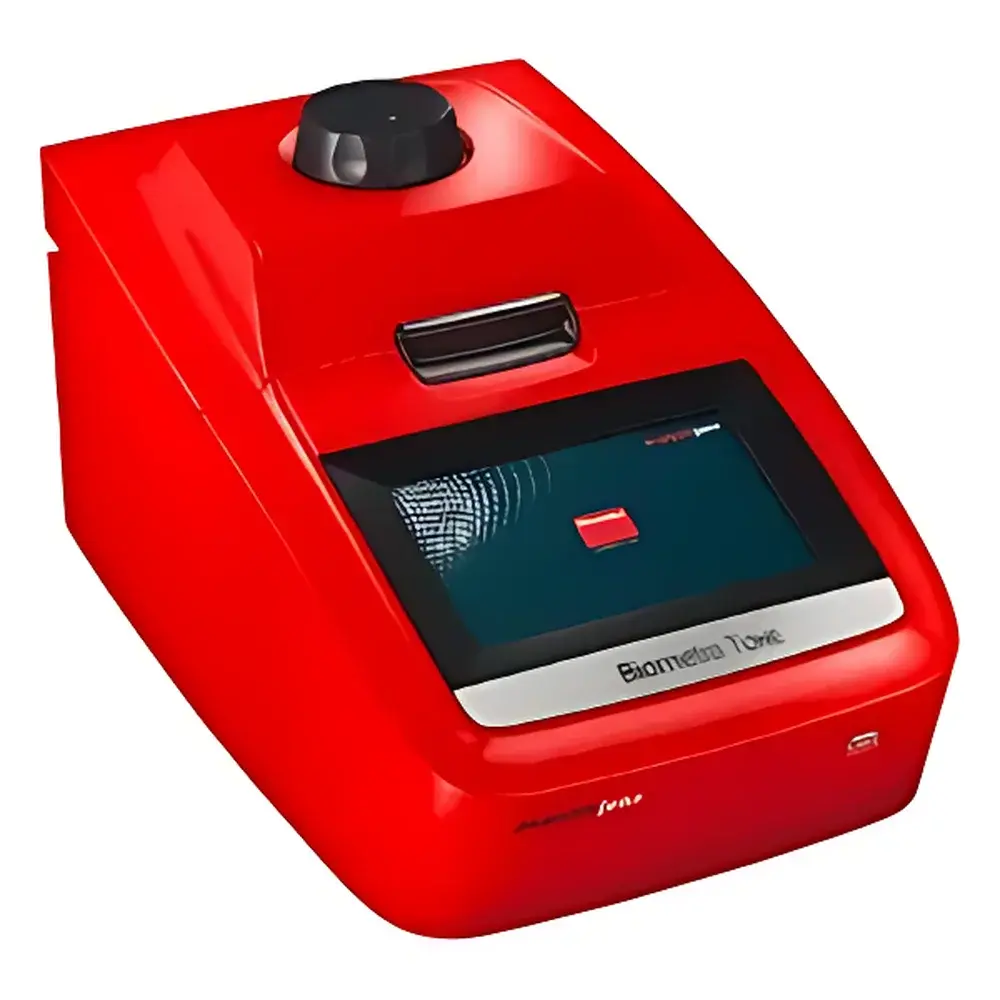
Analytik Jena TOne 96 G Gradient PCR Cycler
| Brand | Analytik Jena |
|---|---|
| Origin | Shanghai, China |
| Manufacturer Type | Authorized Distributor |
| Instrument Type | Gradient PCR Thermal Cycler |
| Sample Capacity | 96-well format (compatible with standard 96-well plates, 0.2 mL tubes, and 8-tube strips) |
| Heating Rate | 4 °C/s |
| Temperature Accuracy | < ±0.1 °C |
| Well-to-Well Temperature Uniformity | < ±0.2 °C |
| Gradient Range | 12-column linear temperature gradient (spanning up to 30 °C across columns) |
| Display | 7-inch full-color capacitive touchscreen |
| Cooling Method | Passive convection with bottom-intake / rear-exhaust airflow architecture |
| Construction | Anodized aluminum block with corrosion-resistant alloy coating |
Overview
The Analytik Jena TOne 96 G Gradient PCR Cycler is a high-precision thermal cycler engineered for reproducible nucleic acid amplification under tightly controlled thermal conditions. Based on Peltier-driven solid-state thermoregulation and a monolithic anodized aluminum heating block with proprietary alloy coating, the system delivers rapid thermal transitions and exceptional spatial and temporal temperature fidelity—critical for demanding applications including multiplex PCR, qPCR assay development, genotyping, and primer optimization. Its gradient functionality enables simultaneous evaluation of 12 distinct annealing temperatures across the 96-well plate, significantly accelerating empirical protocol refinement without requiring multiple instrument runs. Designed and validated in accordance with ISO 13485–aligned quality management systems, the TOne 96 G supports laboratories operating under GLP, CLIA, and ISO/IEC 17025 frameworks where traceable thermal performance and audit-ready operation are mandatory.
Key Features
- High-fidelity thermal control: Achieves temperature accuracy better than ±0.1 °C and well-to-well uniformity within ±0.2 °C across the entire 96-well footprint—validated per ASTM E2757-21 guidelines for thermal cycler verification.
- 12-column linear gradient capability: Independently programmable temperature ramping across columns allows systematic annealing temperature screening from 30 °C to 100 °C, with user-defined gradient span (up to 30 °C), supporting robust optimization of primer binding conditions.
- Rapid thermal response: 4 °C/s average heating rate minimizes cycle time without compromising denaturation or extension efficiency—particularly advantageous for high-throughput screening and time-sensitive diagnostic workflows.
- Human-centered interface: 7-inch capacitive touchscreen with intuitive icon-based navigation, multi-language support (English, German, Chinese, Spanish), and context-sensitive help overlays reduces training overhead and operator error.
- Acoustically optimized enclosure: Low-noise fanless passive cooling combined with vibration-dampened mounting ensures sound pressure levels below 35 dB(A) at 1 m—suitable for open-lab environments and shared core facilities.
- Space-efficient thermal architecture: Asymmetric airflow path (bottom intake / rear exhaust) permits side-by-side placement with adjacent instrumentation, enabling dense benchtop configuration without thermal cross-talk or airflow obstruction.
Sample Compatibility & Compliance
The TOne 96 G accommodates standard 96-well PCR plates (full-skirted, semi-skirted, unskirted), 0.2 mL thin-wall PCR tubes, and 8-tube strips—ensuring compatibility with major reagent and consumables suppliers. All thermal profiles are stored with timestamped metadata, including block calibration history, ambient temperature logs, and user ID (when integrated with network authentication). The system meets IEC 61010-1 safety requirements and complies with electromagnetic compatibility standards EN 61326-1 and EN 61000-6-3. For regulated environments, optional firmware modules support 21 CFR Part 11–compliant electronic signatures, audit trails, and role-based access control—fully documented in the instrument’s Validation Support Package (VSP).
Software & Data Management
Controlled via the standalone TOne Control Software (v3.2+), the system enables method creation, real-time monitoring, remote status polling via Ethernet/Wi-Fi, and export of raw thermal data in CSV and XML formats. Data integrity safeguards include automatic checksum validation upon file transfer and SHA-256 hash generation for all saved protocols. Integration with LIMS platforms is supported through HL7 and RESTful API endpoints. All software updates undergo rigorous regression testing and are distributed with signed digital certificates to ensure authenticity and version traceability.
Applications
- Optimization of annealing temperature in conventional and hot-start PCR
- Development and validation of multiplex PCR assays targeting SNPs, indels, or copy-number variants
- Preparation of templates for Sanger sequencing, NGS library construction, and CRISPR guide RNA validation
- Quality control of extracted DNA/RNA in clinical microbiology and food safety testing
- Teaching laboratory instruction in molecular biology techniques requiring visual thermal profiling and parameter iteration
FAQ
Does the TOne 96 G support external computer control via USB or Ethernet?
Yes—it features both USB 2.0 host/device ports and a 10/100 Mbps Ethernet interface for local network integration and remote command execution using the provided SDK.
Is the heating block user-replaceable or field-calibratable?
The block is not user-serviceable; however, on-site calibration and verification services are available globally through Analytik Jena’s certified service network, with NIST-traceable reference thermistors used for block mapping.
Can gradient profiles be saved and recalled as part of a full protocol?
Yes—gradient parameters (start/end temperatures, column assignment) are embedded within each saved protocol file and persist across power cycles and software sessions.
What consumables require special ordering for optimal thermal coupling?
No specialty consumables are required; however, use of low-profile, optically clear 96-well plates with uniform wall thickness (< 0.2 mm) is recommended to maximize heat transfer consistency across all wells.
Is there a service contract option covering preventive maintenance and calibration?
Yes—Analytik Jena offers tiered service agreements (Basic, Premium, Platinum) including annual thermographic verification, firmware updates, priority technical support, and guaranteed 48-hour onsite response for critical failures.




