
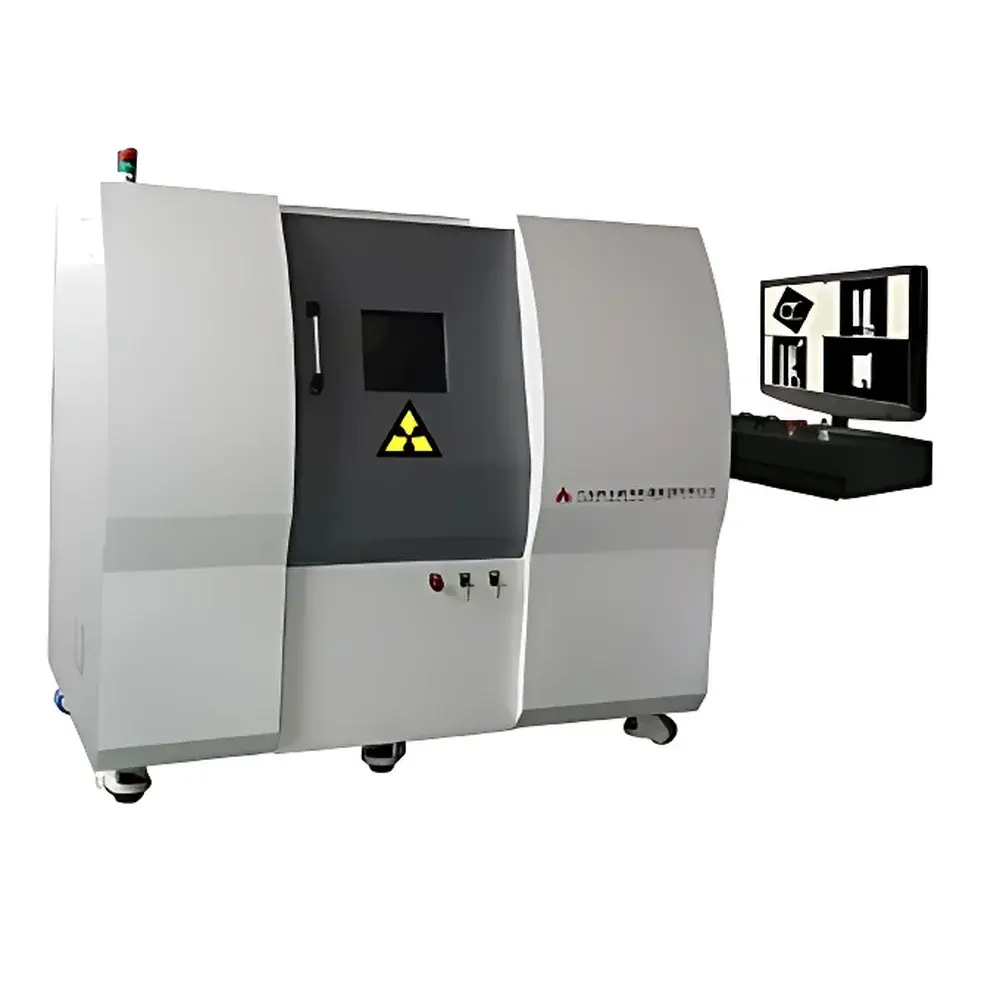
Aolong AL-CT1010 Industrial Micro-Computed Tomography System for Cultural Heritage Conservation
| Brand | Aolong |
|---|---|
| Origin | Liaoning, China |
| Manufacturer Type | OEM Manufacturer |
| Country of Origin | China |
| Model | AL-CT1010 |
| X-ray Source | Reflected-anode microfocus tube |
| Max. Tube Voltage | 225 kV |
| Focal Spot Size | ≤3 µm |
| Max. Anode Power | 350 W |
| Max. Target Power | 300 W |
| Spatial Resolution (Detail Detectability) | ≤2 µm |
| Detector | Amorphous silicon flat-panel detector |
| Pixel Count | 1536 × 1920 |
| Pixel Pitch | 127 µm |
| Active Area | 250 mm × 200 mm |
| Gray Scale Resolution | 16-bit |
| Limiting Resolution | 3.94 lp/mm |
| Cooling Method | Air-cooled |
| Filament Design | Plug-and-play, user-replaceable |
| X-ray Tube Lifetime | >8 years |
Overview
The Aolong AL-CT1010 is a high-resolution industrial micro-computed tomography (micro-CT) system engineered specifically for non-destructive, three-dimensional structural analysis of cultural heritage objects. Operating on the principle of cone-beam X-ray computed tomography, the system acquires hundreds to thousands of digital radiographic projections as the sample rotates through 360°, enabling reconstruction of volumetric datasets with sub-micron feature detectability. Unlike conventional macro-CT or 2D radiography, the AL-CT1010 delivers true isotropic voxel resolution—critical for quantifying internal porosity, casting seams, corrosion depth, joinery methods, and material heterogeneity in archaeological metals, ceramics, wood composites, and composite artifacts. Its design prioritizes preservation integrity: no surface preparation, chemical treatment, or physical sectioning is required. The system meets foundational requirements for scientific documentation under UNESCO’s Principles for the Recording and Documentation of Cultural Heritage and aligns with ICOMOS guidelines for minimally invasive analytical protocols.
Key Features
- Microfocus X-ray source with ≤3 µm focal spot size and stable 225 kV output, optimized for high-contrast imaging of dense metallic and mineral-based artifacts.
- Large-format amorphous silicon flat-panel detector (250 mm × 200 mm active area) with 1536 × 1920 pixels and 127 µm pitch, supporting high dynamic range (16-bit grayscale) acquisition at low quantum noise.
- Precision rotary scanning stage with angular repeatability <0.005° and axial runout <1 µm—essential for artifact-centric metrology and repeatable longitudinal studies.
- Air-cooled X-ray tube architecture with plug-and-play filament replacement, minimizing operational downtime during extended conservation campaigns.
- Integrated geometric calibration workflow compliant with ISO 15788:2022 (Non-destructive testing — Computed tomography — Calibration procedures).
Sample Compatibility & Compliance
The AL-CT1010 accommodates irregularly shaped, fragile, and historically sensitive objects up to Ø300 mm × H400 mm (customizable chamber extensions available). It supports scanning of bronze, iron, leaded glass, lacquered wood, ceramic glazes, parchment, and composite ritual objects without vacuum requirements or conductive coating. All acquisitions comply with ISO/IEC 17025:2017 general requirements for competence of testing and calibration laboratories. Reconstructed volumes are stored in DICOM 3.0 format—ensuring interoperability with PACS-based archival systems used by national museums and research institutes. The system architecture supports audit trails and user access control, facilitating alignment with GLP (Good Laboratory Practice) documentation standards for conservation science reporting.
Software & Data Management
The AL-CT1010 ships with proprietary reconstruction and visualization software featuring GPU-accelerated Feldkamp-Davis-Kress (FDK) and iterative SART algorithms. Post-processing modules include: (1) segmentation tools based on adaptive thresholding and region-growing for multi-material separation; (2) quantitative morphometry (porosity %, wall thickness mapping, void connectivity analysis); (3) dimensional metrology with NIST-traceable uncertainty estimation per ASME B89.4.22–2020; and (4) mesh generation (STL/OBJ export) for archival 3D printing or finite element modeling. All processing steps are logged with timestamped metadata—including exposure parameters, detector gain settings, and reconstruction kernel selection—to satisfy FDA 21 CFR Part 11 electronic record integrity requirements where applicable in federally funded conservation projects.
Applications
- Joinery & Manufacturing Analysis: Identification of soldered, riveted, or cast-on components (e.g., differentiation between monolithic vs. assembled sword hilts via interface discontinuity mapping).
- Corrosion & Degradation Mapping: Quantification of subsurface pitting, chloride-induced cracking, and oxide layer thickness in ferrous artifacts using attenuation coefficient histograms.
- Structural Metrology: Non-contact measurement of blood grooves, engraving depth, tool mark orientation, and laminar layering in damascene steel—without surface contact or stylus probing.
- Density Variability Assessment: Discrimination of alloy segregation, sintering density gradients, or organic filler distribution in composite sculptures using calibrated Hounsfield-unit-equivalent scaling.
- Reverse Engineering & Digital Archiving: Generation of FAIR (Findable, Accessible, Interoperable, Reusable) 3D models for virtual restoration simulation, museum exhibition rendering, and collaborative scholarly annotation platforms.
FAQ
What is the maximum object weight the AL-CT1010 can accommodate without compromising rotational stability?
The standard sample stage supports loads up to 15 kg with maintained angular accuracy; heavier artifacts require optional reinforced rotation mounts.
Does the system support phase-contrast or dual-energy CT modes?
No—the AL-CT1010 operates in absorption-contrast mode only. Phase-contrast capability requires synchrotron or grating-based hardware not integrated into this benchtop configuration.
Can reconstructed data be exported to third-party analysis platforms such as Avizo or Dragonfly?
Yes—volume data exports in TIFF stack, NIfTI, and raw binary formats with header files containing voxel dimensions and intensity scaling factors.
Is radiation shielding included as part of the standard installation?
Yes—the system integrates lead-lined enclosure with interlocked safety door and real-time dose monitoring per IEC 61331-1:2014 requirements.
How is long-term calibration stability verified?
A traceable tungsten carbide step wedge and glass bead phantom are supplied for quarterly geometric and contrast sensitivity verification per ASTM E2737-21.



