
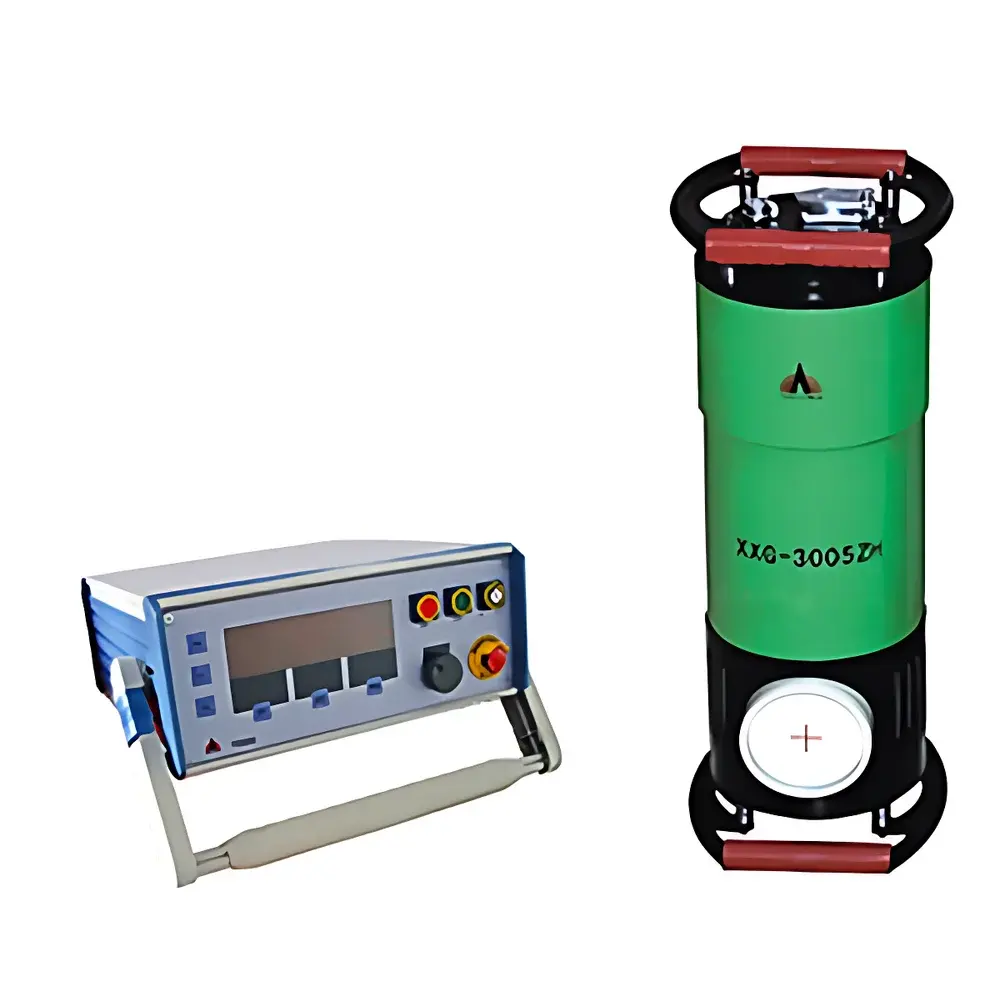
Aolong MF-2505 Medium-Frequency Portable X-ray Radiographic Inspection System
| Brand | Aolong |
|---|---|
| Origin | Liaoning, China |
| Manufacturer Type | Direct Manufacturer |
| Country of Origin | China |
| Model | MF-2505 |
| Price Range | USD 14,000–28,000 |
| Input Voltage | 220 V ±10% |
| Input Power | 3.5 kW |
| Tube Voltage Range | 50–250 kV (continuously adjustable) |
| Tube Current | 5 mA |
| Max. Penetration Thickness (A3 steel) | 48 mm |
| Film Density | D = 1.5 ±0.1 |
| Cooling Method | Forced Air Cooling |
Overview
The Aolong MF-2505 Medium-Frequency Portable X-ray Radiographic Inspection System is an engineered solution for field-deployable non-destructive testing (NDT) of metallic and composite structures. Unlike conventional 50/60 Hz portable X-ray units, the MF-2505 employs medium-frequency inverter technology—operating the high-voltage transformer at frequencies between 400 Hz and 2 kHz—to significantly reduce magnetic core size, weight, and thermal losses. This architecture enables a compact, lightweight generator head (≤22 kg) while delivering enhanced beam stability and dose efficiency. The system operates on the principle of radiographic attenuation: X-ray photons generated via bremsstrahlung in a tungsten-target tube penetrate materials; differential absorption creates contrast on film or digital detectors, revealing internal discontinuities such as voids, inclusions, lack of fusion, or porosity. Designed for compliance with ISO 5579:2019 (Non-destructive testing — Radiographic examination of metallic materials using film and X- or gamma-rays — Basic rules), the MF-2505 supports both film-based and computed radiography (CR) workflows under controlled exposure conditions.
Key Features
- Medium-frequency inverter design reduces generator volume by ~40% and weight by ~35% versus legacy 50 Hz units, enabling single-operator portability across scaffolding, pipelines, and confined industrial spaces.
- Continuously adjustable tube voltage (50–250 kV) provides precise energy control for optimizing contrast-to-noise ratio across material thicknesses—from thin-walled tubing (1 mm A3 steel) to heavy-section weldments (up to 48 mm A3 steel).
- Stable 5 mA tube current output ensures reproducible exposure times and consistent image density (D = 1.5 ±0.1), critical for meeting ASTM E94/E1742 acceptance criteria for radiographic quality.
- Forced-air cooling system maintains thermal equilibrium during extended duty cycles—even when powered by external generators—eliminating downtime due to overheating.
- Integrated safety interlocks comply with IEC 61331-1:2014 (Protective devices against diagnostic medical X-ray radiation) and feature dual-key emergency shutdown, real-time kV/mA monitoring, and automatic beam cutoff upon cable disconnection.
- Patented electromagnetic shielding minimizes stray radiation, facilitating compliance with local regulatory dose limits (e.g., OSHA 29 CFR 1910.1096 or EU Directive 2013/59/Euratom) during on-site inspections.
Sample Compatibility & Compliance
The MF-2505 is validated for radiographic inspection of ferrous and non-ferrous alloys—including carbon steel (A3, ASTM A106), stainless steels (304, 316), aluminum (5083, 6061), and titanium (Grade 2, Grade 5)—as well as fiber-reinforced polymer composites. It meets essential requirements of EN 462-1 (Image quality indicators), EN 1435 (Radiographic examination of welded joints), and ASME BPVC Section V, Article 2. All operational parameters are traceable to NIST-traceable calibration standards. The system supports GLP/GMP-aligned documentation when paired with compliant CR readers and DICOM-conformant PACS integration.
Software & Data Management
While the MF-2505 functions as a hardware-centric analog/digital hybrid platform, its exposure parameters (kV, mA, time, FFD) are programmable via front-panel membrane keypad with EEPROM retention. Optional USB-C interface enables firmware updates and export of exposure logs (CSV format) for audit trails. When used with certified CR systems (e.g., Fuji FCR Pro or Agfa CR 30-X), the unit integrates seamlessly into FDA 21 CFR Part 11-compliant workflows—supporting electronic signatures, audit logs, and data integrity controls required for regulated manufacturing environments.
Applications
- Field inspection of pipeline girth welds, offshore platform structural joints, and refinery pressure vessels where fixed radiography facilities are inaccessible.
- In-service evaluation of railcar underframes, locomotive axle shafts, and wind turbine tower base plates per AWS D1.1 and API RP 2X protocols.
- Quality assurance of castings and forgings in aerospace subcontracting—particularly for landing gear components and engine mounts requiring full-volume coverage.
- Emergency response NDT during infrastructure failure investigations, including bridge cable anchorages and dam penstock welds.
- Educational use in NDT training academies for hands-on instruction in exposure parameter optimization, IQI selection, and geometric unsharpness calculation.
FAQ
Can the MF-2505 be operated from a diesel generator?
Yes—the system accepts 220 V ±10% input with surge tolerance up to 4.2 kW, making it compatible with standard industrial-grade 5–8 kVA generators.
Does it support digital detector arrays (DDAs)?
The MF-2505 delivers stable pulsed or continuous X-ray output suitable for indirect-conversion DDAs (e.g., PerkinElmer XRD 1611 or Varex XRD 1611); however, synchronization with external triggering requires third-party pulse conditioning hardware.
What is the minimum focal spot size?
The tungsten anode tube features a nominal focal spot of 2.0 mm × 2.0 mm (IEC 60336), optimized for geometric unsharpness ≤0.2 mm at 600 mm FFD.
Is type testing certification available?
Aolong provides CE-marked technical documentation and ISO 9001:2015 manufacturing certification; independent type testing per EN 12543-2 can be arranged through accredited laboratories upon request.
How often does the X-ray tube require replacement?
Under typical field use (≤3 h/day, 5 days/week), the tube exhibits a service life exceeding 1,500 hours before performance degradation exceeds ISO 17636-2 sensitivity thresholds.



