
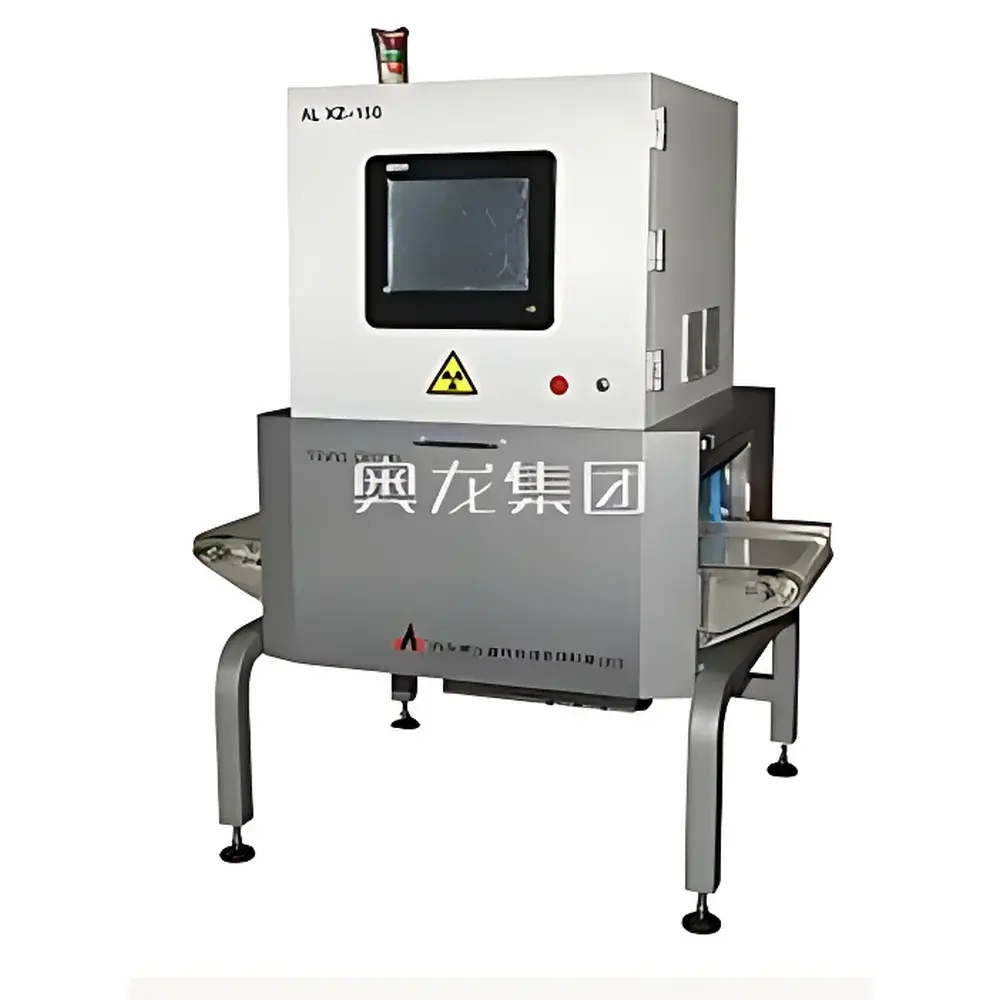
Aolong Multi-Function X-ray Foreign Object Detection System
| Brand | Aolong |
|---|---|
| Origin | Liaoning, China |
| Manufacturer Type | Manufacturer |
| Country of Origin | China |
| Model | Multi-Function X-ray Foreign Object Detection System |
| Quotation | Upon Request |
| Voltage | 150 kV |
| Power | 300 W |
| Display | 21-inch color LCD monitor |
| Max Sample Width | 380 mm |
| Max Sample Height | 220 mm (customizable) |
| Conveyor Belt Width | 410 mm |
| Conveyor Speed | 3–10 m/min |
| Max Load Capacity | 5 kg |
| Standard Detection Functions | Seal integrity check, missing item detection, shielding function |
| Power Supply | AC 220 V ±10%, 50/60 Hz |
| Operating Environment | 0–35 °C |
| Housing Material | Steel + stainless steel |
| Radiation Leakage | ≤1 µSv/h |
| Safety Features | Multi-level interlock system |
| Optional Detector | Dual-energy digital X-ray detector for material discrimination |
Overview
The Aolong Multi-Function X-ray Foreign Object Detection System is an industrial-grade non-destructive testing (NDT) platform engineered for high-reliability foreign object identification and quality assurance in regulated production environments. Based on transmission X-ray imaging physics—where differential X-ray attenuation across materials generates contrast in real-time radiographic projections—the system delivers consistent, quantitative inspection of packaged and unpackaged products. Operating at a nominal tube voltage of 150 kV and 300 W power output, it produces high-resolution grayscale images suitable for automated defect classification. The system complies with international radiation safety standards, including WHO-recommended occupational exposure limits and IEC 61000-6-3/6-4 electromagnetic compatibility requirements. Its structural housing—fabricated from welded steel and food-grade stainless steel—ensures mechanical stability under continuous conveyor operation and meets hygiene design principles for food and pharmaceutical applications.
Key Features
- Real-time dual-energy imaging capability (optional dual-energy digital detector) enabling material decomposition and differentiation between organic/inorganic substances—critical for distinguishing calcified bone fragments from soft-tissue contaminants or identifying high-Z plastics amid low-density matrices.
- 21-inch high-brightness color LCD display with adjustable contrast, gamma correction, and multi-level image enhancement algorithms to optimize signal-to-noise ratio for sub-millimeter anomaly detection (e.g., ≥Φ0.3 mm stainless steel, glass, or mineral inclusions).
- Modular conveyor architecture supporting variable throughput: adjustable speed range of 3–10 m/min and maximum load capacity of 5 kg per item, with belt width of 410 mm and customizable sample envelope (up to 380 mm width × 220 mm height).
- Integrated safety architecture featuring redundant hardware interlocks (door switches, beam shutter sensors, emergency stop circuits) and continuous radiation leakage monitoring (<1 µSv/h at 5 cm from cabinet surface), certified per GBZ 138–2022 and aligned with ISO 15708-2 for industrial X-ray equipment.
- Standardized inspection logic modules: seal integrity verification (via density gradient analysis across closure zones), missing component counting (using template matching and region-of-interest thresholding), and user-definable shielding masks to exclude fixed fixtures or packaging features from analysis.
Sample Compatibility & Compliance
The system accommodates diverse packaging formats—including rigid containers (glass, metal, ceramic), flexible pouches, cartons, Tetra Pak®-style laminates, trays, and bulk bags—without requiring manual reorientation. Detection performance has been validated against ASTM F1973 (Standard Guide for X-ray Inspection of Food Products) and ISO 22000–2018 process control benchmarks. For pharmaceutical use, the system supports audit-ready operation under FDA 21 CFR Part 11-compliant software configurations (when equipped with optional electronic signature and audit trail modules). All mechanical and electrical designs conform to CE Machinery Directive 2006/42/EC and RoHS 2011/65/EU material restrictions.
Software & Data Management
Embedded Linux-based inspection software provides intuitive GUI-driven setup, including ROI definition, sensitivity calibration via reference phantoms, and pass/fail threshold configuration per product SKU. Image data is stored in DICOM 3.0-compliant format with embedded metadata (timestamp, operator ID, product code, exposure parameters). Batch-level reporting exports CSV/Excel logs containing detection event timestamps, anomaly coordinates, confidence scores, and reject actuation status. Optional network integration enables OPC UA connectivity for MES/SCADA synchronization and centralized database archiving compliant with GMP Annex 11 and EU GMP Chapter 4 documentation requirements.
Applications
- Food Manufacturing: Detection of metal shards, glass splinters, calcified bone, dense rubber/gasket fragments, and mineral contaminants in ready-to-eat meals, dairy products, baked goods, confectionery, seafood, meat processing lines, and infant formula.
- Pharmaceutical Production: Verification of tablet/capsule integrity, fill-level consistency in blister packs, presence of desiccants or silica gel packets, and absence of metallic tooling residues in primary packaging.
- Beverage Industry: Identification of foreign bodies in PET bottles, aluminum cans, and composite cartons; seal inspection of cap liners and induction seals.
- Consumer Packaged Goods: Component counting in multi-part kits, verification of tamper-evident band integrity, and detection of manufacturing debris in assembled electronics housings or cosmetic compacts.
FAQ
What regulatory standards does this system meet for food safety compliance?
It aligns with FDA Food Safety Modernization Act (FSMA) preventive controls, HACCP critical control point validation protocols, and Codex Alimentarius CAC/RCP 1–1969 guidelines for physical hazard detection.
Can the system integrate with existing factory automation infrastructure?
Yes—via standard Ethernet/IP, Modbus TCP, or optional PROFINET gateways; I/O signals support direct interfacing with PLCs for automatic reject sorting and line stoppage triggers.
Is source-to-image distance (SID) adjustable for different product thicknesses?
No—SID is fixed at optimized geometry for uniform magnification and geometric unsharpness minimization; however, tube current (mA) and exposure time are dynamically adjusted per product profile to maintain consistent image quality.
Does the system support remote diagnostics or firmware updates?
Yes—through secure HTTPS-based web interface with role-based access control; updates require authenticated digital signatures and rollback capability per IEC 62443-3-3 cybersecurity framework.
How is measurement traceability ensured for routine performance verification?
Calibration is performed using NIST-traceable step wedges and wire mesh phantoms; daily operational checks follow ISO/IEC 17025-aligned internal procedures documented in the system’s electronic logbook.



