
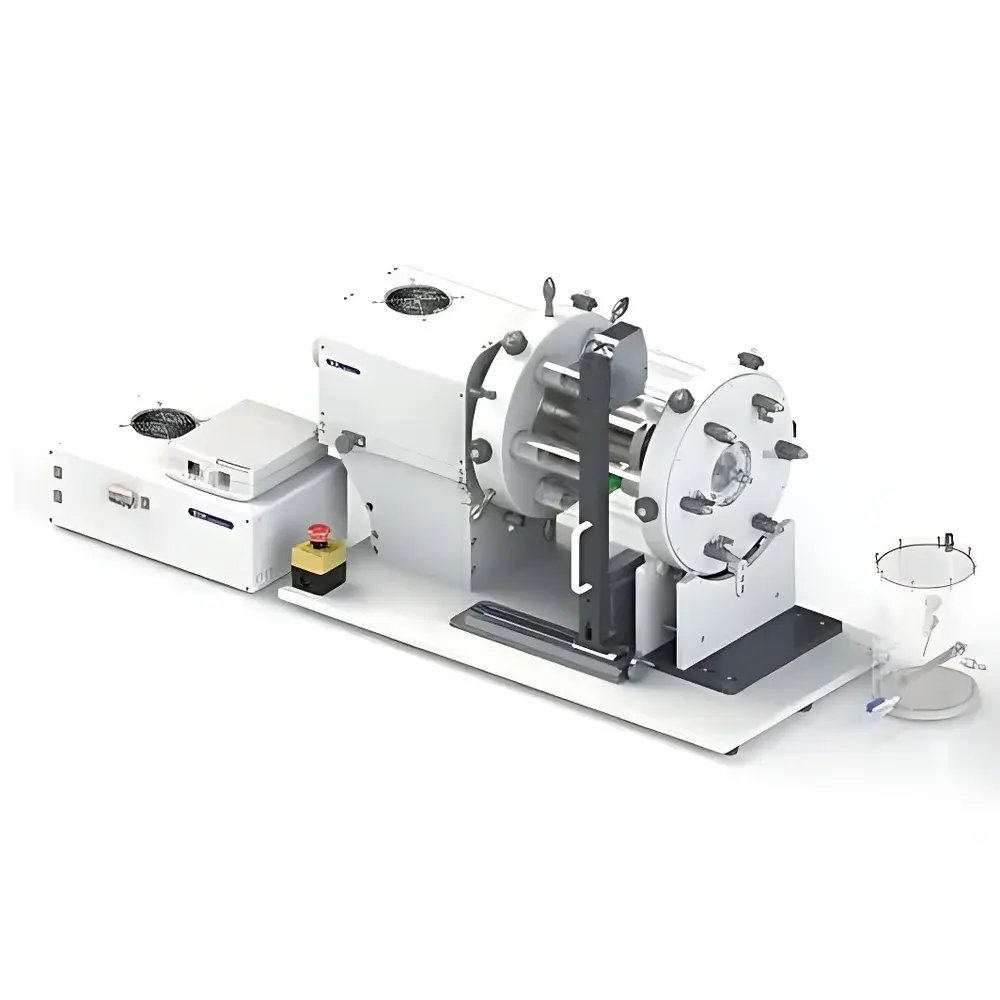
BDC RDTL-0200 Radial Fatigue Testing System for Vascular Stents
| Brand | BDC |
|---|---|
| Origin | Germany |
| Model | RDTL-0200 |
| Maximum Test Force | 5000 kN |
| Frequency Range | 80 Hz |
| Host Weight | 150 kg |
| Compliance | ASTM F2477, ISO 25539, CE/EMC Certified |
| Sample Diameter Range | 2.5–50 mm |
| Max Simulated Vessel Length | 400 mm |
| Configurable Fixture Capacity | up to 12 specimens (dependent on geometry) |
| Operating Fluid Temperature | up to 50 °C |
| Power Supply | 240 V |
Overview
The BDC RDTL-0200 Radial Fatigue Testing System is a purpose-built, high-fidelity platform engineered for the physiologically relevant evaluation of vascular stent durability under pulsatile radial loading conditions. Designed in strict accordance with ASTM F2477 (“Standard Practice for Determining the Fatigue Resistance of Vascular Stents”) and aligned with ISO 25539-2 (Cardiovascular implants — Vascular stents — Part 2: Methodology for fatigue testing), the system replicates hemodynamic pressure waveforms to assess long-term structural integrity across hundreds of millions of cycles. Its core architecture employs a dual-electromagnetic actuator configuration—distinct from conventional single-motor systems—to generate synchronized, phase-matched pressure pulses at both ends of the simulated vessel. This eliminates standing wave formation and ensures uniform circumferential strain distribution along the entire stent length, a critical requirement for regulatory-grade validation of radial recoil, fatigue crack initiation, and strut-level deformation behavior.
Key Features
- Dual-motor synchronized actuation system enabling independent, time-aligned pressure waveform generation at proximal and distal ends of the simulated vessel—eliminating acoustic resonance and ensuring homogeneous radial displacement.
- TrueSwap™ modular manifold system: Four interchangeable manifold configurations (supporting 4-, 6-, 8-, or 12-specimen layouts) accommodate stent diameters from 2.5 mm to 50 mm without reconfiguration of actuators, sensors, or control hardware.
- Rubber-bellows fluid interface technology—replacing traditional metal bellows—to prevent gas entrapment, corrosion, leakage, and particulate contamination; enables rapid de-aeration and supports extended unattended operation.
- Integrated environmental control: Precision temperature-regulated water bath (up to 50 °C), calibrated pressure transducers (±0.25% FS), and optional non-contact laser diameter measurement for real-time outer diameter monitoring during cycling.
- Robust mechanical design: 150 kg reinforced frame with vibration-damped base; rated for continuous operation at up to 80 Hz (frequency dependent on specimen geometry and fluid inertia); maximum radial force capacity of 5000 kN.
Sample Compatibility & Compliance
The RDTL-0200 accommodates a broad spectrum of vascular implant geometries—including straight tubes, U-shaped bifurcated vessels, curved segments, 90° arches, and aneurysm models—up to 400 mm in length. Its modular manifold system allows simultaneous testing of overlapping stents or multi-segment deployments without fixture redesign. All operational parameters—including pressure amplitude, waveform shape (sinusoidal, triangular, physiological pulse), frequency, and dwell time—are programmable and traceable per test protocol. The system meets essential requirements of ISO 13485 quality management systems and is CE-marked with full EMC compliance. It supports audit-ready documentation per FDA 21 CFR Part 11 when paired with Statys RDTL software’s electronic signature and audit trail functionality.
Software & Data Management
Statys RDTL is a closed-loop, Windows-based control and analysis suite built specifically for vascular fatigue testing. Its intuitive workflow guides users from system initialization and calibration through test execution, real-time monitoring, and post-cycle reporting. All sensor data—including pressure, temperature, cycle count, and optional optical diameter readings—are timestamped, sampled at ≥1 kHz, and stored in vendor-neutral HDF5 format. The software enforces protocol adherence via parameter locking, version-controlled method templates, and automatic pass/fail evaluation against user-defined thresholds (e.g., pressure decay >5%, diameter deviation >±25 µm). Export options include CSV, PDF reports compliant with GLP/GMP documentation standards, and direct integration with LIMS environments via OPC UA.
Applications
- Regulatory submission testing for IDE, PMA, and CE Mark applications under ASTM F2477 and ISO 25539-2.
- Comparative fatigue performance assessment of nitinol, cobalt-chromium, and bioresorbable polymer stents.
- Evaluation of stent–graft interfaces, overlapping stent configurations, and bifurcation-specific deployment mechanics.
- Accelerated aging studies correlating cyclic life with material microstructure evolution (e.g., SEM post-test analysis).
- Method development and validation for novel stent designs, including drug-eluting platforms and dynamic scaffolds.
FAQ
What regulatory standards does the RDTL-0200 comply with?
ASTM F2477, ISO 25539-2, ISO 13485, and EU MDR Annex I essential requirements. CE marking includes EMC Directive 2014/30/EU and Low Voltage Directive 2014/35/EU.
Can the system test stents larger than 50 mm in diameter?
No—the validated operational range is 2.5–50 mm. Larger diameters require custom manifold engineering and recalibration, subject to feasibility review.
Is the 80 Hz maximum frequency achievable across all sample sizes?
No—maximum sustainable frequency depends on fluid column inertia, vessel compliance, and manifold volume. Typical operating range for 3–12 mm stents is 5–30 Hz; higher frequencies apply to smaller-diameter, low-compliance setups.
Does the system support third-party data acquisition or automation integration?
Yes—Statys RDTL provides RESTful API endpoints and LabVIEW-compatible drivers for external control, robotic sample handling, and enterprise data lake ingestion.
What maintenance intervals are recommended for the rubber bellows and electromagnetic actuators?
Rubber bellows: replacement every 12 months or after 200 million cycles (whichever occurs first). Actuators: annual calibration and bearing inspection; no scheduled coil replacement under nominal load conditions.



