
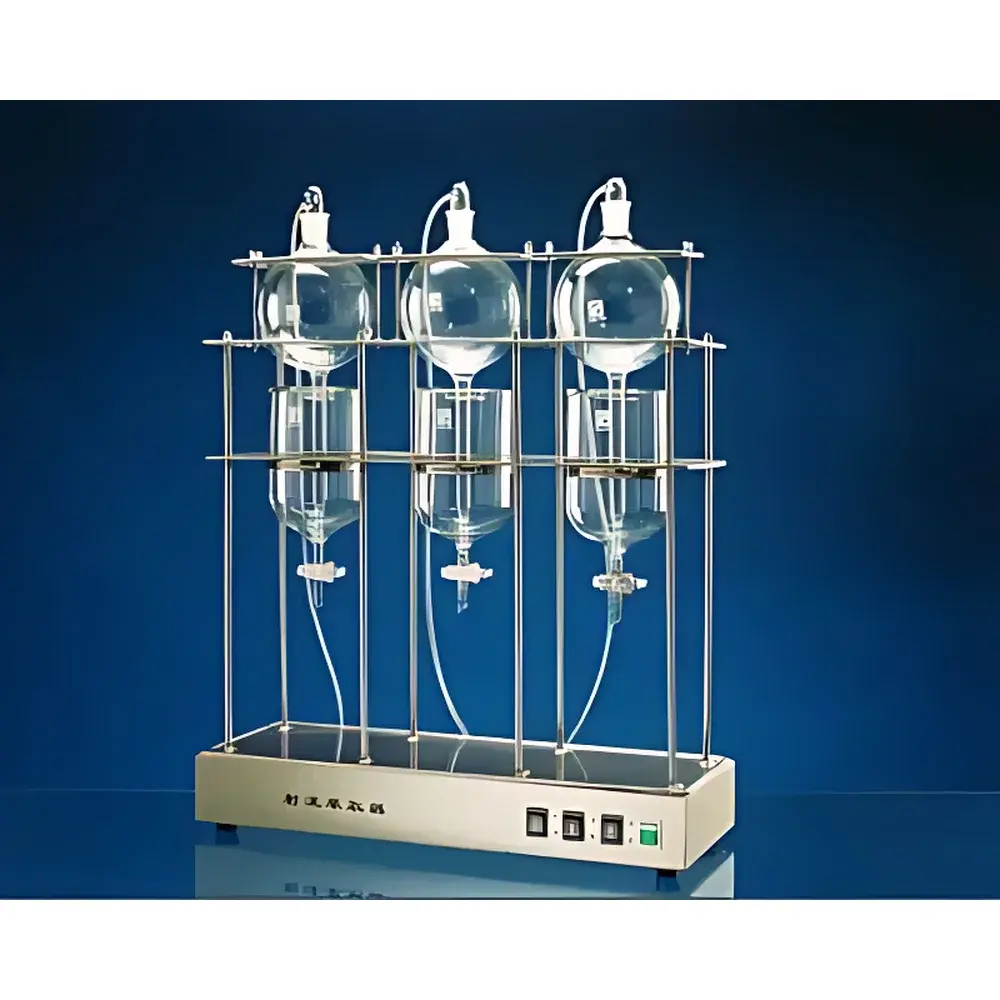
Beiguang CQQ-1000×3 Jet-Stream Liquid-Liquid Extractor
| Brand | Beiguang |
|---|---|
| Origin | Jilin, China |
| Model | CQQ-1000×3 |
| Sample Volume | 1000 mL per chamber |
| Extraction Time | <2 min |
| Extraction Efficiency | >95% |
| Spike Recovery | 95–105% |
| Power Supply | 220 V AC, 10 VA |
| Capacity | Triple-channel (3 independent extraction units) |
| Compliance | Designed for ASTM D3764, ISO 11348, and EPA Method 1664/525.3 workflows |
Overview
The Beiguang CQQ-1000×3 Jet-Stream Liquid-Liquid Extractor is an engineered benchtop system designed for rapid, reproducible liquid-liquid extraction (LLE) in environmental, industrial hygiene, and quality control laboratories. Unlike conventional separatory funnel or continuous extraction methods, this instrument employs hydrodynamic jet-stream mixing—where aqueous and organic phases are accelerated through calibrated nozzles into a shared mixing chamber, generating intense turbulent shear and transient interfacial area expansion. This principle enables near-instantaneous mass transfer equilibrium, significantly reducing diffusion-limited kinetics. The device is purpose-built for standardized analyses including petroleum hydrocarbons (oil & grease), phenolic compounds (e.g., volatile phenols per EPA 420.1), and priority pollutants in wastewater, surface water, and soil leachates. Its triple-channel architecture supports parallel processing without cross-contamination, aligning with GLP-compliant workflow requirements for batched sample throughput.
Key Features
- Triple independent extraction modules (CQQ-1000×3 configuration), each accommodating up to 1000 mL total phase volume with dedicated flow-path isolation
- Jet-driven mixing mechanism achieving >95% extraction efficiency within ≤120 seconds per cycle, validated against reference standard solutions
- Passive phase separation post-extraction via gravity-driven settling in integrated conical collection chambers
- Tool-free disassembly of mixing nozzles and chamber liners; all wetted parts constructed from borosilicate glass and PTFE-sealed stainless steel for chemical resistance and trace-metal inertness
- Low acoustic emission (<55 dB(A) at 1 m), compliant with ISO 7779 for laboratory noise environments
- Stable mechanical repeatability: relative standard deviation (RSD) of spike recovery ≤3.2% across 20 consecutive runs under identical matrix conditions
- No moving parts in fluid path—eliminating pump wear, seal degradation, or solvent-induced motor corrosion
Sample Compatibility & Compliance
The CQQ-1000×3 accommodates aqueous matrices ranging from clarified effluents to turbid industrial wastewater and sediment pore water. Compatible extractants include n-hexane, dichloromethane, ethyl acetate, and methyl tert-butyl ether (MTBE), with maximum solvent vapor pressure tolerance up to 12 kPa at 25 °C. System design conforms to key regulatory frameworks: extraction performance meets the precision and recovery criteria specified in EPA Method 1664A (oil & grease), EPA Method 420.1 (phenols), and ISO 11348-3 (toxicity testing using luminescent bacteria). All structural materials comply with USP Class VI biocompatibility standards, and the unit operates within ambient temperature ranges (10–30 °C) typical of certified environmental testing labs.
Software & Data Management
This is a hardware-only extractor with no embedded microprocessor or digital interface. Operation is fully manual—users initiate extraction via momentary toggle switch, monitor phase separation visually through calibrated borosilicate viewing ports, and collect fractions using standard volumetric glassware. Consequently, it requires no firmware updates, network connectivity, or electronic audit trails. For laboratories operating under 21 CFR Part 11 or ISO/IEC 17025, all procedural steps—including sample ID, solvent lot number, operator initials, and elapsed extraction time—are documented externally in paper-based or LIMS-integrated logbooks. Its simplicity ensures uninterrupted operation during power fluctuations and eliminates cybersecurity vulnerabilities associated with connected instrumentation.
Applications
- Determination of total petroleum hydrocarbons (TPH) in wastewater per ASTM D3764 and EPA 1664
- Quantification of phenolic compounds—including phenol, cresols, and xylenols—in drinking water and industrial discharges per EPA 420.1 and ISO 6439
- Extraction of chlorinated pesticides (e.g., DDT, HCB) and PCB congeners from aqueous environmental samples prior to GC-ECD analysis
- Pre-concentration of polar micropollutants (e.g., bisphenol A, alkylphenols) in surface water for LC-MS/MS detection
- Routine QC/QA testing in municipal wastewater treatment plants for compliance monitoring under national discharge permits
FAQ
Does the CQQ-1000×3 require calibration certificates or annual verification?
No formal calibration is required—the system has no adjustable transducers, sensors, or flow meters. Verification is performed empirically using certified reference materials (CRMs) and spike-recovery protocols per ISO/IEC 17025 Section 7.7.
Can it handle emulsion-prone matrices such as oily wastewater?
Yes; the high-shear jet mixing followed by controlled settling (≥5 min recommended for viscous emulsions) enables effective phase demulsification. Optional addition of sodium chloride or magnesium sulfate may be applied pre-extraction per EPA guidelines.
Is the unit compatible with automated fraction collectors?
Not directly—it lacks electrical triggers or TTL outputs. However, its gravity-fed outlet ports accept standard 19/22 mm hose barbs, permitting integration with third-party timed collectors via passive tubing manifolds.
What maintenance is required beyond routine cleaning?
Annual inspection of nozzle orifice integrity (using optical comparator) and replacement of PTFE gaskets every 500 cycles or when compression set exceeds 15%, per manufacturer’s service bulletin SB-CQQ-2023-01.
Related Products



