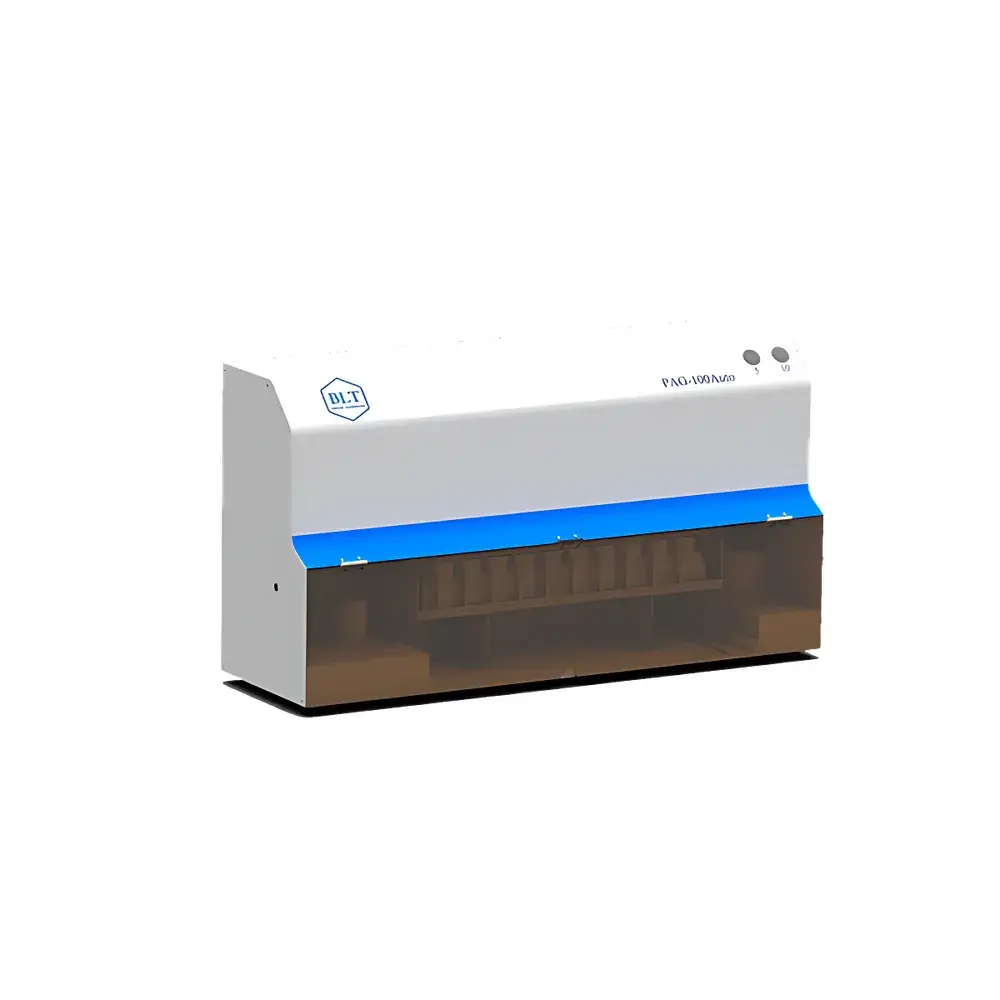
BioLight PAG-100Auto Automated Polyacrylamide Gel Casting System
| Brand | BioLight |
|---|---|
| Origin | Guangdong, China |
| Manufacturer Type | Authorized Distributor |
| Country of Origin | China |
| Model | PAG-100Auto |
| Automation Level | Fully Automated Gel Casting System |
| Gel Throughput | 5 or 10 gels per batch |
| Gel Polymerization Time | ≤10 min |
| Ready-for-Electrophoresis Time | ≤15 min from reagent addition |
| Protein Separation Range | 10–200 kDa |
| Storage Stability | Up to 14 days at 4 °C |
| Acrylamide System | Low-toxicity acrylamide formulation with optimized APS-initiated polymerization |
| Precision Delivery | Dual magnetic stirrers + dual automated dispensing channels (separating & stacking gels) |
| Compatibility | Standard vertical electrophoresis tanks (e.g., Mini-PROTEAN®, SE600, Hoefer Mighty Small) |
Overview
The BioLight PAG-100Auto Automated Polyacrylamide Gel Casting System is an engineered solution for high-reproducibility, benchtop-scale preparation of SDS-PAGE gels in life science laboratories. Unlike conventional manual casting or commercially pre-cast gels, the PAG-100Auto implements a precisely synchronized, two-channel liquid handling architecture to simultaneously dispense separating and stacking gel solutions into standard cassette molds—eliminating human variability in volume, layer alignment, and polymerization timing. The system operates on a validated low-acrylamide chemistry platform, utilizing a proprietary ammonium persulfate (APS)-initiated polymerization pathway that achieves complete gel solidification within 10 minutes while maintaining uniform pore structure across the 10–200 kDa molecular weight range. This enables consistent resolution of both low-abundance and high-molecular-weight proteins without empirical optimization of monomer:bis ratios or buffer pH adjustments. Designed for integration into routine Western blotting workflows, the PAG-100Auto reduces total gel preparation time to under 15 minutes—from reagent reconstitution to ready-to-load cassettes—while supporting full traceability through batch-limited reagent kits.
Key Features
- Dual independent dispensing modules with gravimetric feedback control ensure ±1.5% volumetric accuracy for both separating and stacking gel layers—critical for sharp band definition and inter-gel reproducibility.
- Integrated dual magnetic stirring stations maintain homogeneous monomer dispersion prior to injection, minimizing air entrapment and gradient formation during polymerization.
- Low-toxicity acrylamide formulation complies with OSHA permissible exposure limits (PELs) for laboratory personnel; eliminates need for fume hood use during routine operation.
- Modular reagent packaging supports flexible throughput: 5-gel or 10-gel kits with pre-measured, lyophilized components—no weighing, no pipetting errors.
- Gel cassettes remain stable for up to 14 days when stored at 4 °C in sealed humidity-controlled containers, enabling just-in-time preparation without compromise to electrophoretic performance.
- Compact footprint (32 × 38 × 28 cm) fits standard lab benches; compatible with common vertical electrophoresis systems including Bio-Rad Mini-PROTEAN Tetrad, C.B.S. Scientific SE600, and GE Healthcare Hoefer Mighty Small units.
Sample Compatibility & Compliance
The PAG-100Auto is validated for use with standard SDS-PAGE sample loading buffers (Laemmli-type), reducing agents (DTT or β-mercaptoethanol), and common protein stains (Coomassie Brilliant Blue R-250, Silver Nitrate, SYPRO Ruby). Gel matrices are compatible with downstream immunoblotting procedures, including electrotransfer to PVDF or nitrocellulose membranes using standard wet or semi-dry transfer protocols. All reagents meet ISO 9001-certified manufacturing standards; acrylamide content is verified per ICH Q5C guidelines for residual monomer levels (<0.1 ppm post-polymerization). The system supports GLP-compliant documentation via optional barcode-scanned reagent lot tracking and timestamped operation logs.
Software & Data Management
The embedded microcontroller runs firmware v2.1 with USB-C connectivity for configuration backup and audit trail export (CSV/TSV). Each gel batch generates a unique ID linked to reagent lot numbers, ambient temperature, and polymerization duration—exportable for inclusion in electronic lab notebooks (ELN) or LIMS integration. No cloud dependency; all data remains on-device unless explicitly exported. Firmware updates are delivered via signed .bin files compliant with NIST SP 800-193 guidelines for firmware integrity verification.
Applications
- Routine SDS-PAGE for protein expression profiling in mammalian, bacterial, and insect cell lysates.
- Quality control of purified recombinant proteins prior to HPLC or mass spectrometry analysis.
- Preparative gel electrophoresis for excision and in-gel digestion in bottom-up proteomics workflows.
- Validation of CRISPR/Cas9 gene editing efficiency via detection of truncated or frameshifted protein isoforms.
- Teaching laboratory implementation where reproducibility, safety, and time efficiency are pedagogical priorities.
FAQ
Does the PAG-100Auto require calibration before first use?
No—factory-calibrated dispensing modules ship with NIST-traceable certificate of conformance; only routine cleaning of fluid paths is recommended after every 50 batches.
Can I use third-party acrylamide or APS reagents?
No—the system is validated exclusively with BioLight-certified reagent kits; off-label reagents invalidate performance guarantees and void warranty coverage.
Is the system compatible with gradient gels?
Not natively; the PAG-100Auto delivers uniform percentage gels only (8%, 10%, 12%, 15%). Gradient casting requires manual intervention or alternative instrumentation.
What maintenance is required beyond daily wiping?
Quarterly replacement of silicone tubing in dispensing manifolds and annual verification of stirrer RPM stability using handheld tachometer (procedure documented in Maintenance Manual Rev. 3.2).
Does the system support 2D electrophoresis gel preparation?
No—it is designed solely for one-dimensional SDS-PAGE; IPG strip rehydration and second-dimension gel casting fall outside its operational scope.