
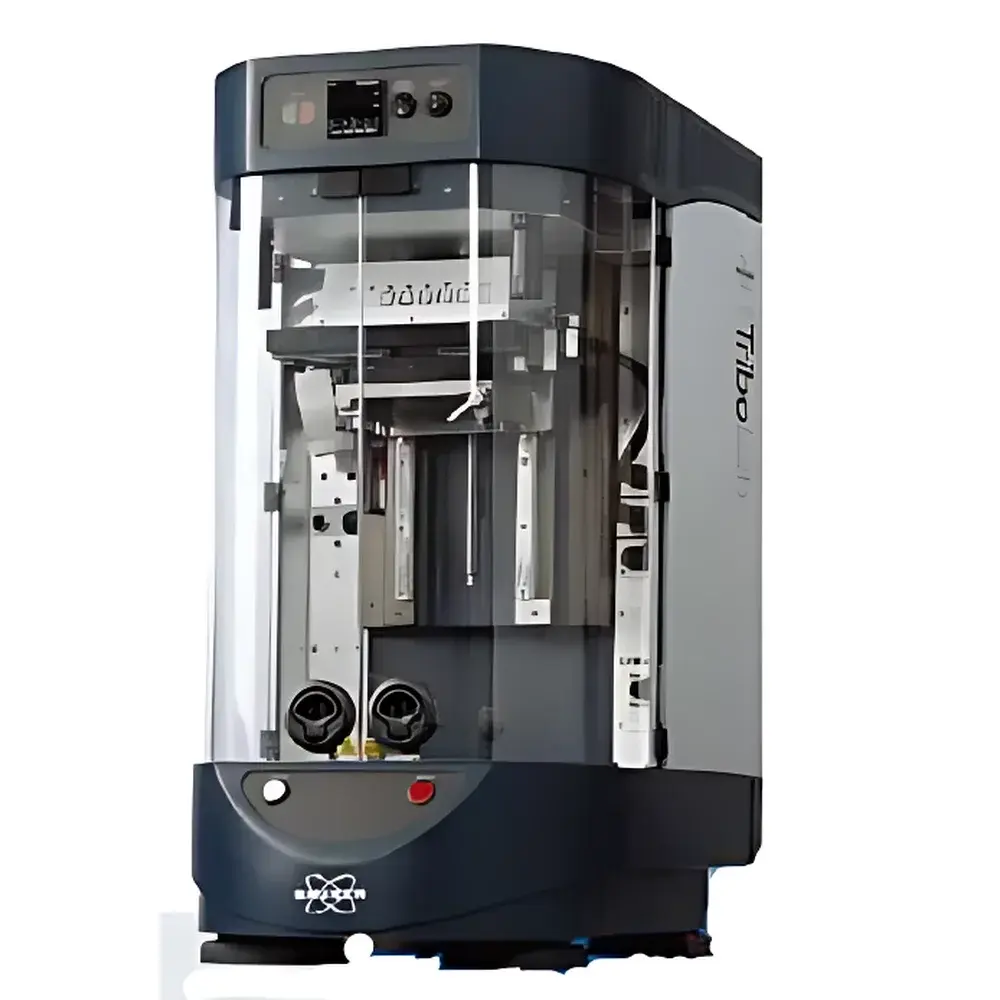
Brookfield CETR-UMT Universal Tribometer
| Brand | Bruker |
|---|---|
| Origin | USA |
| Manufacturer Type | Authorized Distributor |
| Origin Category | Imported |
| Model | CETR-UMT |
| Instrument Type | Nanoindentation and Scratch Tester |
| Maximum Indentation Depth | 75 mm |
| Effective Load Range | 1 mN to 1000 N |
| Load Resolution | 1 µN |
| Displacement Range | ±75 mm |
| Displacement Resolution | 0.1 nm |
| Maximum Friction Force | 1000 N |
| Indenter Types | Conical, Berkovich, Spherical, Cube-Corner, Flat Punch, Custom Tips |
| Thermal Drift | <0.1 nm/min (at 25 °C, stabilized) |
Overview
The Brookfield CETR-UMT Universal Tribometer is a high-precision, multi-functional platform engineered for quantitative tribological and mechanical surface characterization under controlled environmental conditions. Built upon the Couette-based friction measurement principle and integrated force-displacement metrology, the UMT enables simultaneous acquisition of normal load, frictional force, displacement, acoustic emission, temperature, and environmental parameters during dynamic contact events. First introduced in 2000, the system has evolved into an industry-standard instrument across academic, industrial, and regulatory laboratories—currently deployed in over 400 installations worldwide. Its architecture supports both quasi-static nanoindentation and dynamic tribological testing (e.g., reciprocating, linear sliding, rotational, and scratch), making it uniquely suited for evaluating wear mechanisms, interfacial adhesion, coating integrity, and time-dependent viscoelastic response at micro- to macro-scales.
Key Features
- Modular mechanical platform enabling rapid reconfiguration between indentation, scratch, pin-on-disk, ball-on-flat, and reciprocating configurations—switching completed in under 5 minutes without realignment.
- High-fidelity dual-axis servo control system with closed-loop feedback for synchronized motion and load actuation; position resolution of 0.1 nm and force resolution of 1 µN across a 1 mN–1000 N dynamic range.
- Integrated environmental chambers supporting operation from –25 °C to 1000 °C, relative humidity control (5–95% RH), and ultra-high vacuum (down to 10–6 Torr) with bake-out capability.
- Multi-signal acquisition engine capturing up to 16 synchronized analog channels—including piezoresistive friction force, capacitive displacement, thermocouple voltage, acoustic emission (AE), and optical encoder data—at sampling rates up to 1 MHz.
- Rigid granite base with active vibration isolation and thermal mass stabilization, ensuring sub-nanometer positional stability and long-term measurement reproducibility (RSD < 1.2% across repeated indentations on fused silica).
Sample Compatibility & Compliance
The CETR-UMT accommodates samples ranging from 1 mm × 1 mm wafers to 150 mm diameter substrates, including brittle ceramics, metallic alloys, polymer films, biomedical implants, optical coatings, and layered composites. All mechanical modules conform to ASTM G133 (Standard Test Method for Linearly Reciprocating Ball-on-Flat Sliding Wear), ASTM D785 (Rockwell Hardness), ISO 20502 (Nanoindentation), and ISO 27307 (Scratch Testing of Coatings). Data acquisition and reporting workflows support audit-ready compliance with FDA 21 CFR Part 11 (electronic records/signatures), GLP, and GMP requirements through optional software validation packages and full audit-trail logging.
Software & Data Management
TRIBOVIEW™ software provides real-time instrument control, scriptable test sequencing (via Python API), and synchronized multi-parameter visualization. Predefined test templates cover ISO/ASTM-compliant protocols for coefficient of friction (COF) mapping, wear volume quantification (via profilometry integration), critical load determination (Lc), and creep/recovery analysis. Raw data are stored in HDF5 format with embedded metadata (user, timestamp, environmental setpoints, calibration IDs). Export options include CSV, MATLAB .mat, and universal ASCII for third-party statistical or finite-element post-processing. Optional IQ/OQ/PQ documentation kits facilitate laboratory qualification under ISO/IEC 17025.
Applications
- Automotive & aerospace: Evaluation of lubricant film breakdown, bearing material scuffing resistance, and thermal barrier coating delamination at elevated temperatures.
- Microelectronics: Nanoscale wear mapping of Cu/low-k interconnect stacks, MEMS stiction analysis, and probe tip degradation studies.
- Bioimplants: Quantitative assessment of UHMWPE wear against CoCr femoral heads under simulated synovial fluid environments.
- Optics & photonics: Scratch resistance of anti-reflective coatings, laser-damage threshold correlation with subsurface fracture initiation.
- Energy materials: Solid electrolyte–cathode interfacial shear stability in all-solid-state batteries under electrochemical bias (with optional potentiostat integration).
- Packaging & paper: Coefficient of friction profiling across humidity gradients, micro-roughness–adhesion relationships in laminated films.
FAQ
What types of indenter geometries are supported?
Standard interchangeable tips include Berkovich, conical (2–100 µm radius), spherical (10–500 µm), cube-corner, flat-punch, and custom-fabricated geometries—all mounted on calibrated cantilevers with traceable NIST-certified stiffness values.
Can the UMT perform tests under inert or reactive gas atmospheres?
Yes—optional gas manifold integration allows continuous purging with N2, Ar, O2, or forming gas (5% H2/95% N2) within the environmental chamber, with mass flow controllers and residual gas analysis compatibility.
Is third-party sensor integration possible?
The system features eight programmable analog I/O ports and a dedicated TTL trigger bus, enabling synchronization with external Raman spectrometers, high-speed cameras (≥100 kfps), or in situ XRD stages via hardware-level triggering.
How is thermal drift compensated during long-duration creep or relaxation tests?
Real-time thermal drift correction employs dual-sensor referencing: a reference capacitor monitors base-plate expansion, while a secondary capacitive gap sensor tracks indenter–sample thermal offset—applied algorithmically to displacement data streams with <0.05 nm/min residual drift.
Does the system support automated hardness mapping?
Yes—grid-based nanoindentation arrays (up to 100 × 100 points) can be programmed with variable load/displacement targets, dwell times, and spacing; hardness and modulus maps are auto-generated using Oliver–Pharr methodology with depth-of-penetration correction.



