
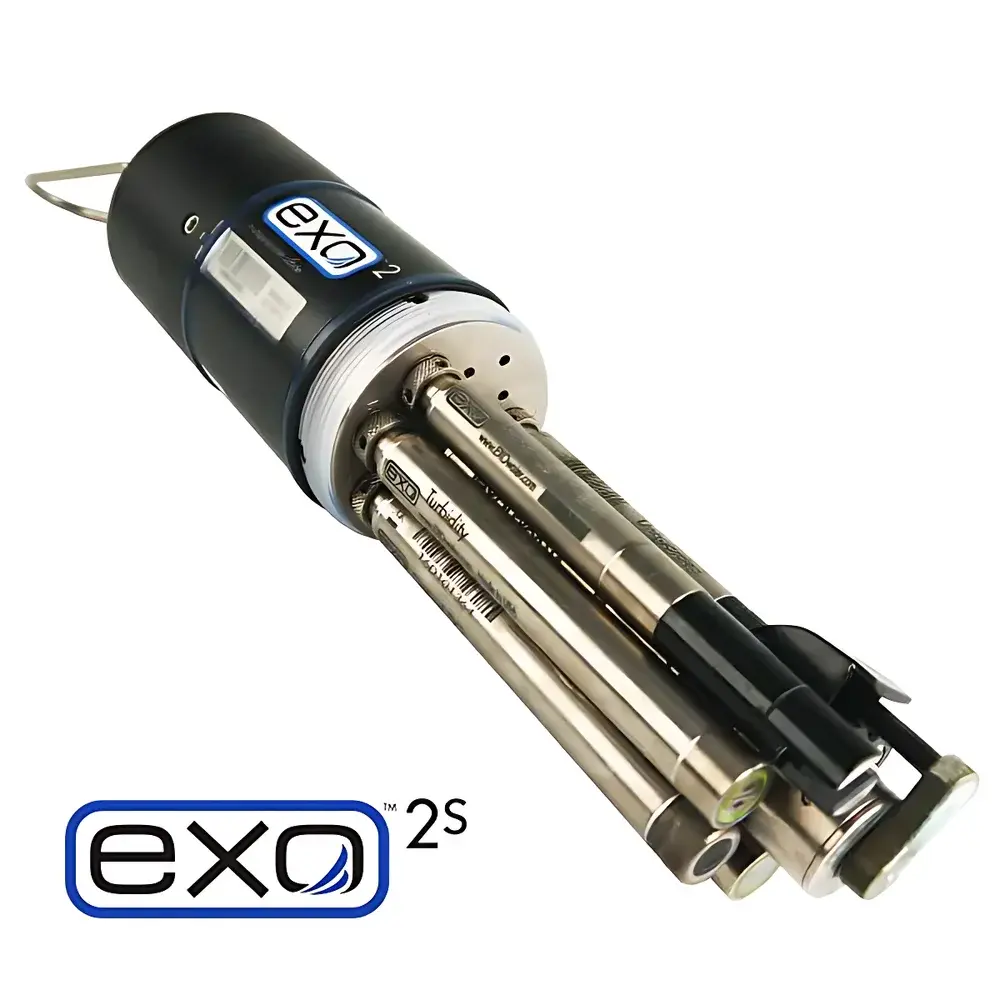
YSI EXO2s Multiparameter Water Quality Monitoring Platform
| Brand | YSI |
|---|---|
| Origin | USA |
| Model | EXO2s |
| Instrument Type | In-situ, Real-time Multiparameter Water Quality Analyzer |
| Measured Parameters | Dissolved Oxygen (DO), pH, Conductivity, Temperature, Turbidity, Chlorophyll-a, and Additional Sensor Ports for Expansion |
| Weight Reduction | 30% vs. EXO2 |
| Length Reduction | 33% vs. EXO2 |
| Power | Rechargeable Lithium-ion Battery (No Alkaline Batteries) |
| Deployment Platforms | AUVs, USVs, ROVs, Submersible Samplers, Moored Buoys, Integrated Environmental Monitoring Systems |
Overview
The YSI EXO2s is a compact, high-performance multiparameter water quality monitoring platform engineered for rigorous in-situ environmental assessment across marine, freshwater, and estuarine systems. Built upon YSI’s proven EXO sensor architecture, the EXO2s implements a modular, field-deployable design optimized for constrained-space integration—particularly in autonomous underwater vehicles (AUVs), unmanned surface vessels (USVs), remotely operated vehicles (ROVs), and low-profile buoyancy-controlled mooring systems. Its measurement principle relies on calibrated electrochemical, optical, and thermistor-based sensing technologies compliant with standard methods for environmental water analysis (e.g., ASTM D888 for dissolved oxygen, ISO 7888 for conductivity, and EPA Method 180.1 for turbidity). Unlike laboratory-based analyzers, the EXO2s delivers real-time, high-temporal-resolution data directly from the water column—enabling dynamic profiling of vertical and horizontal gradients in parameters including dissolved oxygen, pH, specific conductivity, temperature, turbidity, and chlorophyll-a fluorescence. The platform’s robust titanium housing (IP68 rated) ensures long-term submersion stability under pressures up to 250 m, while its anti-fouling sensor caps and wiper mechanisms support extended unattended operation in biologically active environments.
Key Features
- 30% lighter and 33% shorter than the standard EXO2 platform—enabling deployment in space-constrained platforms such as micro-AUVs and compact sediment traps.
- Lithium-ion rechargeable battery system eliminates reliance on disposable alkaline batteries, reducing long-term operational cost and logistical burden during multi-month deployments.
- Modular sensor bays support up to seven simultaneous measurements, with factory-calibrated sensors traceable to NIST standards; optional sensors include nitrate, CDOM, depth, and ORP.
- Integrated GPS time synchronization and internal tilt/compass compensation ensure georeferenced, orientation-corrected data acquisition—even during dynamic vehicle maneuvers.
- Ruggedized titanium body with corrosion-resistant wet-end materials certified for continuous immersion in seawater, brackish water, and freshwater matrices.
- Onboard memory (8 GB) with automatic data logging at user-defined intervals (1 sec to 24 hr), plus real-time telemetry via RS-485, SDI-12, or optional cellular/Iridium satellite uplink.
Sample Compatibility & Compliance
The EXO2s is validated for direct in-water measurement across natural and engineered aquatic systems—including rivers, lakes, reservoirs, coastal zones, tidal estuaries, and open-ocean transects. It meets functional requirements outlined in ISO 5667-22 (water quality sampling—field instrumentation), ASTM D3370 (sampling water wells and springs), and EPA Guidance for Ambient Water Monitoring Networks. Sensor outputs comply with data integrity frameworks required under GLP and GMP-aligned environmental monitoring programs. While not a medical device, its DO, pH, and conductivity modules are routinely referenced in regulatory reporting for NPDES permits, TMDL assessments, and USGS NWIS submissions. All firmware and calibration logs maintain audit trails compatible with FDA 21 CFR Part 11–compliant data management workflows when integrated with YSI’s EcoWatch software suite.
Software & Data Management
Data acquisition, visualization, and QA/QC are managed through YSI’s EcoWatch Desktop and EcoWatch Cloud platforms. EcoWatch Desktop provides offline calibration validation, sensor drift correction algorithms, and customizable report generation aligned with ISO/IEC 17025 documentation requirements. EcoWatch Cloud enables role-based access control, automated alerting (e.g., DO < 2 mg/L thresholds), and API-driven integration with third-party GIS (ArcGIS Online, QGIS) and SCADA systems. Raw binary files (.exd) are convertible to CSV, NetCDF, and OGC SensorML-compliant formats—ensuring interoperability with NOAA IOOS, EU Copernicus Marine Service, and national hydrological databases. All calibration events, firmware updates, and metadata edits are timestamped and digitally signed to satisfy traceability mandates in federally funded research and regulatory compliance contexts.
Applications
- High-resolution vertical profiling of hypolimnetic oxygen depletion in stratified reservoirs.
- Real-time eutrophication monitoring via concurrent chlorophyll-a fluorescence and nutrient proxy signals (e.g., CDOM + turbidity).
- Baseline characterization and impact assessment for offshore wind farm construction and dredging operations.
- Autonomous mapping of acid mine drainage plumes using pH-conductivity-temperature anomaly detection.
- Long-term sentinel monitoring of coral reef resilience indicators (e.g., diel DO cycling, thermal stress indices).
- Integration into smart watershed networks where edge-computed metrics (e.g., saturation deficit, salinity intrusion front location) trigger adaptive management responses.
FAQ
What is the maximum operating depth for the EXO2s?
The EXO2s is rated for continuous operation at depths up to 250 meters, with pressure-compensated sensor housings and titanium structural components.
Can the EXO2s be used in ice-covered lakes?
Yes—its low-temperature rating (−5 °C to +40 °C) and anti-icing sensor cap design support winter deployments beneath seasonal ice cover when mounted on ice-penetrating moorings or ice-tethered profilers.
Is sensor recalibration required in the field?
Field recalibration is not mandatory but recommended every 3–6 months depending on biofouling exposure; onboard diagnostics flag sensor drift exceeding ±2% full scale for pH and DO modules.
Does the EXO2s support external power inputs?
Yes—it accepts 9–30 VDC external power via the auxiliary port, enabling indefinite operation when paired with solar-charged battery banks or vessel power systems.
How does the EXO2s handle biofouling in tropical marine environments?
It integrates mechanical wipers for turbidity and chlorophyll sensors, copper-alloy anti-fouling rings around the housing, and optional UV-C cleaning modules for extended deployments beyond 60 days.







