
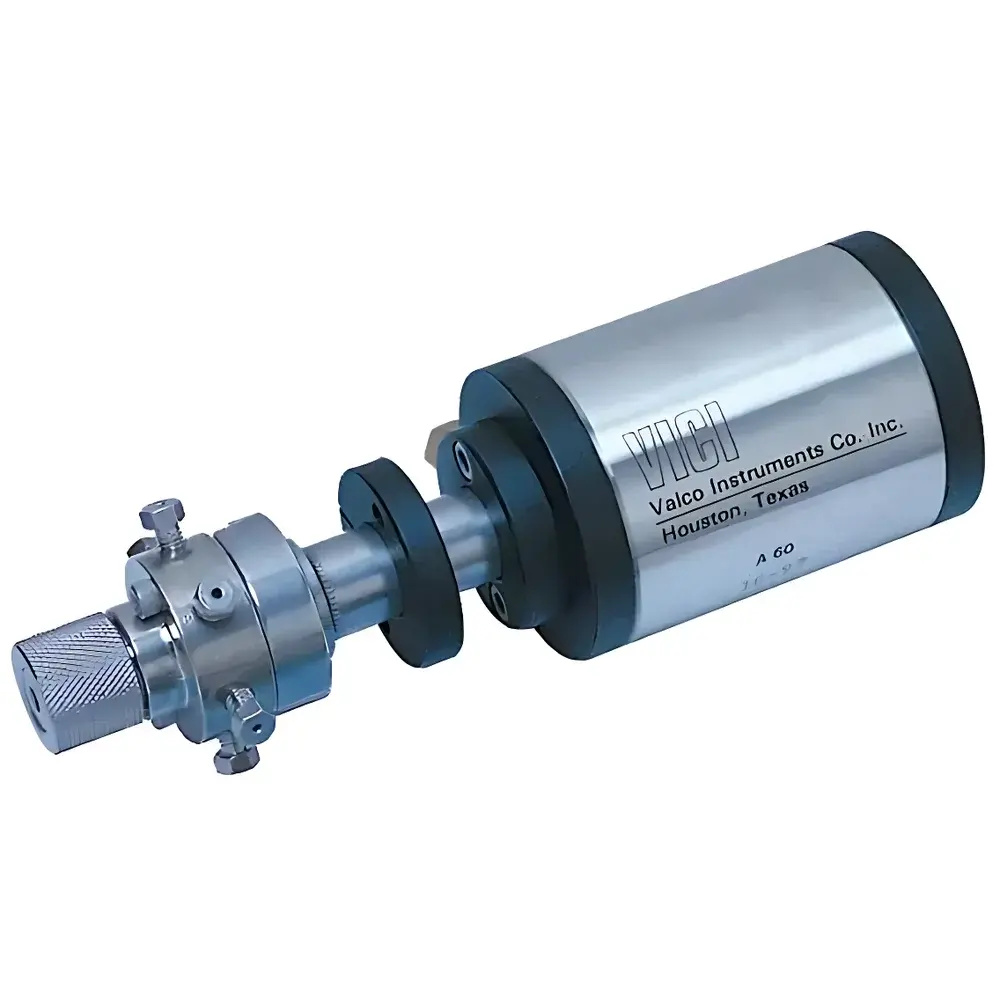
VICI Valco Full Series Injection & Switching Valves for Chromatography
| Brand | VICI |
|---|---|
| Origin | USA |
| Manufacturer Type | Authorized Distributor |
| Product Origin | Imported |
| Model | Valco |
| Pricing | Available Upon Request |
Overview
VICI Valco injection and switching valves represent the benchmark in precision fluidic control for analytical chromatography systems. Engineered for high reproducibility, leak-tight operation, and long-term stability under demanding pressure and chemical exposure conditions, these valves are integral components in gas chromatography (GC), high-performance liquid chromatography (HPLC), ultra-high-performance liquid chromatography (UHPLC), and process chromatography applications. The core design philosophy centers on minimizing dead volume, maximizing flow path integrity, and ensuring mechanical consistency across millions of actuation cycles. Valco valves operate on multiple actuation principles—including rotary, multi-position cone-seal, diaphragm-based pneumatic, and high-pressure UHPLC-specific ceramic/metal hybrid sealing—each optimized for specific pressure regimes (up to 20,000 psi), thermal environments (–60 °C to +200 °C), and chemical compatibility requirements. With over four decades of field-proven deployment, Valco valves comply with foundational instrumentation standards referenced in ASTM D3699 (GC calibration), ISO 17025 (testing laboratory competence), and FDA 21 CFR Part 11 (electronic records and signatures) when integrated into validated chromatographic workflows.
Key Features
- Multi-port configurations: 3-, 4-, 6-, 8-, 10-, 12-, 14-, and 16-position valves available; select models support up to 34 flow paths via modular stacking or custom manifold integration
- Standard port sizes: 1/32″, 1/16″, 1/8″, and 1/4″ stainless steel, PEEK, or titanium fittings with zero-dead-volume (ZDV) compression ferrules
- Internal bore options: 0.25 mm (0.010″) to 4.0 mm (0.156″) for optimal laminar flow control and minimal band broadening
- Material versatility: Valve bodies and rotors fabricated from 316 stainless steel, Hastelloy C-276, Monel, titanium, PEEK, polyetherimide (PEI), and chemically inert fluoropolymers to withstand aggressive solvents, acids, bases, and supercritical fluids
- Actuation flexibility: Manual, pneumatic (single- or double-acting), solenoid-driven, and stepper-motor-controlled variants—each supporting TTL, RS-232, or Ethernet/IP interface protocols for system-level automation
- UHPLC-grade sealing: Cheminert® series features hardened ceramic-coated rotor surfaces and precision-lapped sapphire or tungsten carbide stators, enabling reliable operation at pressures up to 140 MPa (20,000 psi)
- Nanoflow compatibility: Nanovolume UHPLC valves feature 100 µm internal flow paths and direct fusion-capable terminations for 360 µm OD fused silica, PEEK, or nickel capillaries
Sample Compatibility & Compliance
Valco valves maintain compatibility with all common chromatographic mobile phases—including aqueous buffers, acetonitrile, methanol, THF, chlorinated solvents, supercritical CO₂, and hydrogen carrier gas—without swelling, leaching, or surface degradation. All wetted materials conform to USP Class VI biocompatibility testing and meet ISO 10993-5 cytotoxicity requirements where applicable. For regulated pharmaceutical and clinical laboratories, Valco valve assemblies support GLP/GMP-compliant validation protocols through documented material traceability, batch-specific certificates of conformance, and optional audit-trail-enabled firmware (for motorized variants). Valve designs adhere to ISO 8503-2 surface roughness specifications (<0.2 µm Ra) on sealing surfaces to prevent analyte adsorption and carryover.
Software & Data Management
Motorized Valco valves integrate seamlessly with major chromatography data systems (CDS) including Thermo Fisher Chromeleon®, Agilent OpenLab CDS, Waters Empower®, and Shimadzu LabSolutions via standard instrument drivers (e.g., IVI-COM, NI-VISA). Firmware supports configurable dwell times, position memory retention during power loss, and real-time status reporting (valve position, actuation count, error codes). For automated method development and column-switching sequences, Valco’s Valve Control Software (VCS) provides drag-and-drop sequence programming, event-triggered logic, and CSV-based method export/import—fully compliant with 21 CFR Part 11 for electronic signature capture and audit trail generation.
Applications
- GC sample introduction and multidimensional column switching (MDGC), including heart-cutting and comprehensive 2D-GC
- HPLC/UHPLC gradient delay management, column regeneration, and parallel column screening
- Preparative and process-scale chromatography with solvent recycling, fraction collection, and loop injection
- Online solid-phase extraction (SPE) coupling, trapping-column desorption, and derivatization reactor interfacing
- Nanoflow LC-MS and microfluidic assay platforms requiring sub-nL dead volume and picoliter-level precision
- Environmental monitoring systems for automated multi-analyte EPA Method 8270/8082 compliance
FAQ
What pressure ratings are supported across Valco valve families?
Standard GC/HPLC valves are rated to 6000 psi (414 bar); Cheminert UHPLC valves are certified to 20,000 psi (1379 bar); diaphragm valves operate reliably up to 10,000 psi with extended cycle life.
Can Valco valves be used in corrosive or high-temperature GC applications?
Yes—Hastelloy C-276 and Monel-bodied valves are routinely deployed in sulfur analysis, petrochemical cracking streams, and high-temp pyrolysis-GC interfaces up to 200 °C.
Do motorized Valco valves support remote diagnostics and predictive maintenance?
All stepper- and solenoid-driven models log cumulative actuation cycles and thermal history; optional firmware enables SNMP-based network alerts and integration with CMMS platforms.
Is there documentation available for IQ/OQ/PQ validation?
Yes—Valco provides vendor-supplied qualification templates, material certifications, dimensional inspection reports, and pressure-test validation protocols upon request.
How is dead volume minimized in nanoflow UHPLC valve designs?
Through monolithic 100 µm-bore flow channels, laser-welded capillary terminations, and ZDV ferrule geometries eliminating threaded adapters or epoxy joints.





