
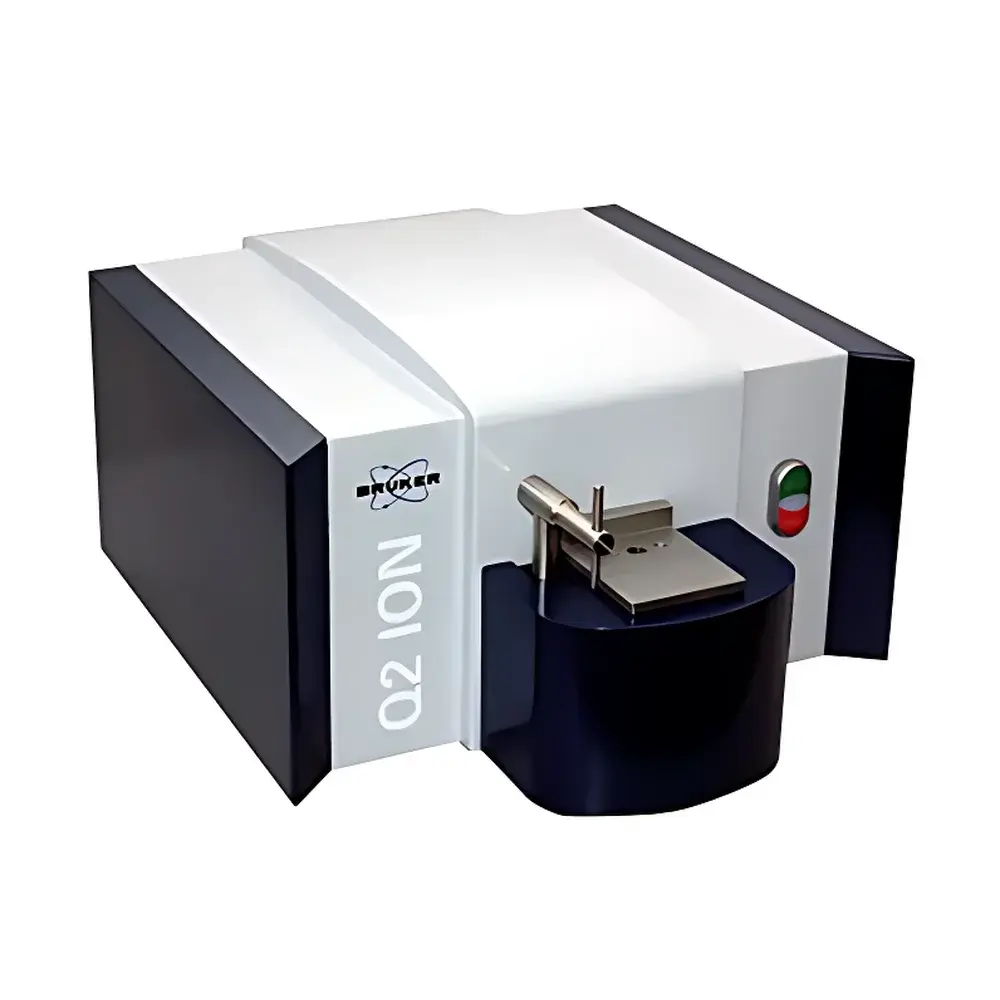
Bruker Q2 ION Benchtop Spark Optical Emission Spectrometer
| Brand | Bruker |
|---|---|
| Origin | Germany |
| Instrument Type | Benchtop |
| Excitation Source | Spark |
| Detector Configuration | Dual Detector (PMT + CCD) |
| Focal Length | 400 mm |
| Grating Groove Density | 3600 lines/mm |
| Wavelength Range | 170–685 nm |
| Number of Analytical Channels | 32 |
Overview
The Bruker Q2 ION is a compact, benchtop spark optical emission spectrometer (OES) engineered for high-precision elemental analysis of metallic samples in industrial and quality control environments. Based on the fundamental principle of atomic emission spectroscopy, the instrument generates controlled spark discharges on conductive metal surfaces, exciting atoms to higher energy states; upon relaxation, characteristic photons are emitted across the UV-VIS spectrum (170–685 nm). These emissions are dispersed via a high-resolution Czerny-Turner optical system with a 400 mm focal length and a 3600 lines/mm holographic grating, enabling accurate wavelength separation and quantitative multi-element determination. Designed specifically for routine metallurgical analysis, the Q2 ION delivers laboratory-grade performance without requiring dedicated infrastructure—making it suitable for foundries, metal recycling facilities, QC labs, and mobile service applications where space, portability, and operational simplicity are critical constraints.
Key Features
- Ultra-compact benchtop architecture weighing under 45 kg—engineered for rapid relocation between production lines, warehouses, or field inspection sites.
- Dual-detector optical design integrating photomultiplier tubes (PMTs) for high-sensitivity trace element detection and a high-resolution CCD array for simultaneous spectral acquisition across the full 170–685 nm range.
- Robust spark source with optimized argon-flushed excitation chamber, ensuring stable plasma generation and minimal electrode wear across diverse base matrices (Fe, Al, Cu, Ni, Zn, Ti, Mg).
- Flat-field CCD optical system eliminates astigmatism and curvature of field, delivering uniform spectral resolution and signal-to-noise ratio across all wavelengths—critical for precise alloy grade identification and low-concentration element quantification.
- Integrated industrial-grade Linux controller with touchscreen interface and hardware-accelerated ElementalSuite software platform—designed for deterministic real-time data acquisition, calibration management, and audit-compliant reporting.
- User-role-based access control and modular application templates allow independent configuration of analytical workflows for different operators (e.g., incoming inspection vs. final product release), supporting GLP/GMP-aligned operational discipline.
Sample Compatibility & Compliance
The Q2 ION accepts standard solid metallic samples conforming to ISO 11577, ASTM E415, and EN 10315 specifications—including castings, forgings, rolled plates, machined coupons, and scrap fragments—with minimum dimensions of Ø10 mm × 5 mm thickness. Sample surface preparation follows standardized grinding or milling per ISO 14284 to ensure reproducible spark ablation geometry. The instrument supports full compliance with ISO/IEC 17025:2017 for testing laboratories, and its software architecture incorporates electronic signature support, full audit trail logging (per FDA 21 CFR Part 11 requirements), and secure database encryption via embedded SQL backend. Calibration verification is performed using certified reference materials (CRMs) traceable to NIST, BAM, or IRMM standards, with documented uncertainty budgets for each analytical channel.
Software & Data Management
ElementalSuite—the proprietary control and analysis platform—is built on a real-time Linux kernel and leverages an embedded relational SQL database for structured storage of spectra, calibration curves, sample metadata, and operator logs. It provides automated spectral deconvolution, inter-element interference correction (e.g., Mn 403.307 nm / Fe 403.329 nm), and dynamic background subtraction algorithms. All measurement sessions generate timestamped, digitally signed reports in PDF/A-1b format compliant with ISO 19005-1. Raw spectral data (.spe) and processed results (.csv/.xlsx) are exportable with configurable metadata fields. Remote diagnostics, firmware updates, and method synchronization are supported via secure HTTPS API endpoints—enabling centralized fleet management across multi-site deployments.
Applications
The Q2 ION serves as a primary analytical tool across metallurgical supply chains: rapid grade identification of incoming raw materials (scrap, ingots, billets); in-process composition verification during casting, forging, and heat treatment; final product certification for pressure vessel steels (ASTM A20/A20M), aerospace aluminum alloys (AMS 4027), copper conductor grades (ASTM B115), and stainless steel families (AISI 304/316); scrap sorting in metal recycling operations; and contract testing services requiring ISO/IEC 17025 accreditation. Its portability enables direct analysis at stockyards, rail sidings, and offshore fabrication yards—eliminating delays associated with offsite lab submission.
FAQ
What base matrices does the Q2 ION support out-of-the-box?
Standard calibrations cover Fe, Al, Cu, Ni, Zn, Ti, and Mg-based alloys; additional matrix packages can be commissioned via Bruker Application Support.
Is argon consumption optimized for continuous operation?
Yes—the instrument features pulsed argon purging with flow rate modulation based on spark sequence duration, reducing average consumption to ≤12 L/min during routine analysis.
Can the Q2 ION perform quantitative analysis below 10 ppm for trace elements?
Detection limits vary by element and matrix but typically range from 1–5 ppm for key tramp elements (e.g., Pb, Sn, As in steel) under optimal excitation and integration conditions.
Does ElementalSuite support LIMS integration?
Yes—via ASTM E1384-compliant HL7 messaging or direct ODBC/JDBC connectivity to enterprise LIMS platforms.
What maintenance intervals are recommended for the optical system?
Optical alignment verification is advised every 6 months; PMT gain recalibration every 3 months; CCD dark current characterization monthly—procedures fully guided within ElementalSuite’s Maintenance Wizard.



