
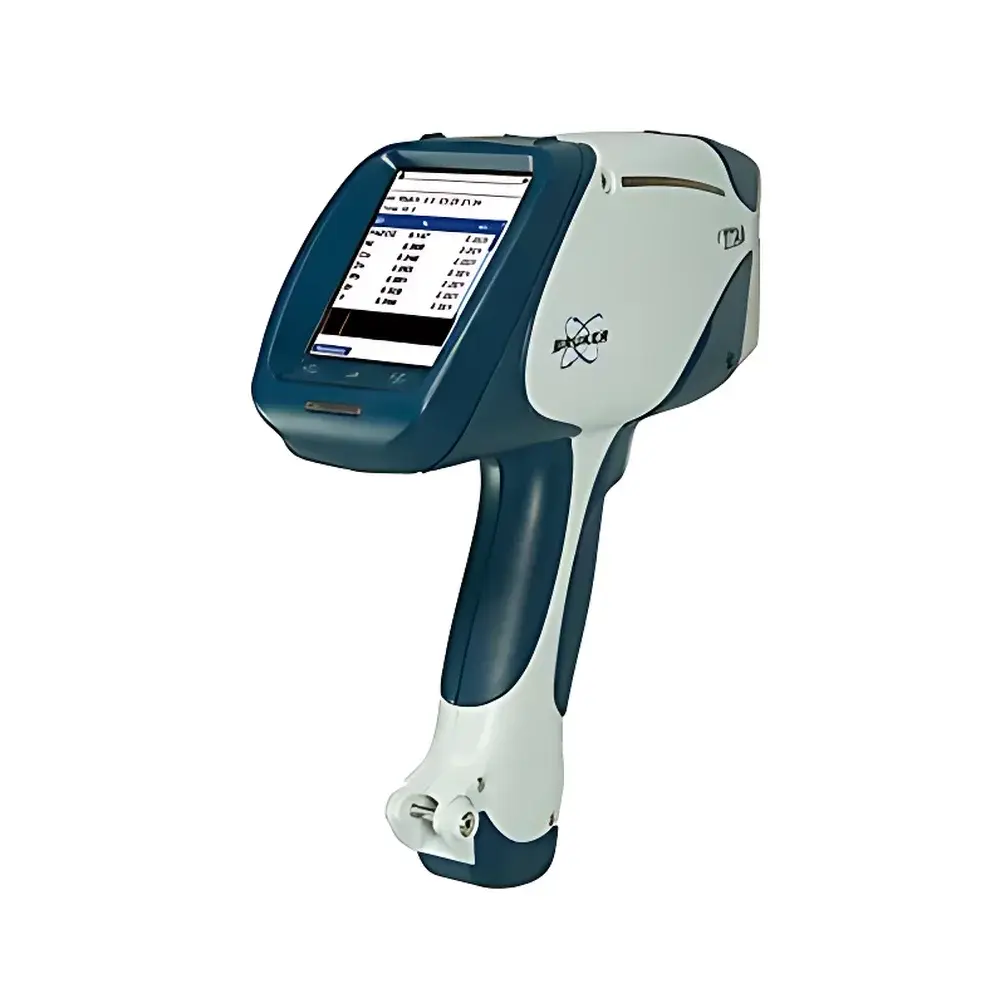
Bruker S1 TITAN Handheld Energy Dispersive X-Ray Fluorescence (ED-XRF) Spectrometer for Ore and Geological Analysis
| Brand | Bruker |
|---|---|
| Origin | Germany |
| Model | S1 TITAN Handheld Ore Analyzer |
| Application | Field-Portable |
| Industry-Specific Use | Geological & Mining |
| Elemental Range | Mg–U |
| Quantification Range | 1 ppm – 99.99% |
| Energy Resolution | <140 eV (Mn Kα) |
| Detector | Silicon Drift Detector (SDD) |
| Compliance | Meets ISO 8596, ASTM E2818, and USP <233> for elemental quantification in geological matrices |
Overview
The Bruker S1 TITAN is a field-deployable, handheld energy dispersive X-ray fluorescence (ED-XRF) spectrometer engineered for rapid, non-destructive elemental analysis of geological materials in situ. Based on the fundamental principle of X-ray fluorescence—where primary X-rays excite atoms in a sample, causing emission of characteristic secondary X-rays—the S1 TITAN delivers laboratory-grade qualitative and quantitative data without requiring sample digestion, vacuum environments, or helium purging. Its optimized excitation geometry, high-power microfocus X-ray tube, and large-area silicon drift detector (SDD) enable reliable detection of light elements from magnesium (Mg) through uranium (U), including critical low-Z elements such as Al, Si, P, S, and Cl—elements traditionally challenging for portable XRF systems. Designed for rugged outdoor operation, the instrument features IP54-rated ingress protection, MIL-STD-810G shock resistance, and an ergonomic, balanced form factor suitable for extended use during geological surveys, core logging, and haul truck screening.
Key Features
- Light-element capability down to Mg (12) without vacuum or He flush—enabling accurate analysis of silicates, sulfides, phosphates, and clay-rich matrices.
- High-resolution SDD detector with <140 eV resolution at Mn Kα ensures superior peak separation for overlapping transitions (e.g., Pb Mα/Sb Kα, As Kα/Pb Lα), critical for complex ore assemblages.
- Integrated GPS, barcode scanner, and HD camera for georeferenced data capture, sample documentation, and spatial mapping of elemental distributions.
- Ruggedized aluminum-magnesium alloy housing with reinforced touchscreen interface operable with gloves and under direct sunlight.
- Real-time spectrum processing using Bruker’s proprietary FP (Fundamental Parameters) and empirical calibration algorithms, supporting both factory-loaded and user-defined calibrations.
- Battery life exceeding 8 hours per charge (hot-swappable Li-ion packs), enabling full-shift operation across remote exploration sites.
Sample Compatibility & Compliance
The S1 TITAN is validated for direct analysis of heterogeneous solid samples—including drill cores, crushed rock, mine face exposures, tailings, soil profiles, sediment layers, and industrial concentrates—without homogenization or pelletization. It complies with international standards governing field-based elemental analysis: ISO 8596 (XRF performance specifications), ASTM E2818 (standard test method for determination of elements in geological materials by ED-XRF), and USP (for trace metal quantification where applicable). For regulated environments—including GMP-aligned mineral processing QA/QC labs—the system supports audit-ready operation via optional Bruker S1 Remote software with 21 CFR Part 11-compliant electronic signatures, secure user roles, and immutable audit trails.
Software & Data Management
Bruker’s proprietary S1 PX software provides intuitive workflow-driven operation—from acquisition and real-time spectral review to calibration management and report generation. All spectra, metadata (GPS coordinates, operator ID, time stamp, photo), and quantified results are stored in a structured SQLite database, exportable in CSV, PDF, or XML formats compatible with GIS platforms (e.g., ArcGIS, QGIS) and LIMS integration. Advanced reporting modules generate customizable grade reports, cross-plot visualizations (e.g., Cu vs. Au, Fe vs. SiO₂), and stratigraphic logs. Firmware updates and method libraries are delivered securely via Bruker’s cloud-based S1 Connect portal, ensuring continuous alignment with evolving analytical requirements and regulatory expectations.
Applications
- Exploration & Prospecting: Rapid reconnaissance of outcrops, trenching, and grid-based surveys to identify geochemical anomalies and prioritize drill targets.
- Core Logging: High-density elemental profiling of drill core intervals to define lithological boundaries, alteration halos, and mineralization vectors.
- Mine-Site Process Control: Real-time grade verification of ROM (run-of-mine) material, conveyor belt sampling, and truckload assays to optimize blending and feed control.
- Environmental & Rehabilitation Monitoring: Screening of soils, sediments, and leachates for heavy metals (Pb, As, Cd, Hg) and radionuclides (U, Th) in compliance with EPA Method 6200 and ISO 18227.
- Mineral Processing Support: On-site analysis of concentrates, smelter feeds, slag, and flotation products to monitor recovery efficiency and impurity ingress.
- Research & Teaching: Field-based geochemical education, provenance studies, and multi-element mapping in academic and government geological surveys.
FAQ
Does the S1 TITAN require helium or vacuum for light-element analysis?
No. Its optimized X-ray optics, high-efficiency SDD, and proprietary atmospheric correction algorithms eliminate the need for He purge or vacuum chambers when measuring Mg, Al, Si, P, and S.
Can the instrument be calibrated for site-specific ore types?
Yes. Users can develop and deploy custom calibrations using certified reference materials (CRMs) or well-characterized local standards via the S1 PX Calibration Wizard.
Is spectral data export compatible with third-party geochemical software?
Yes. Full-spectrum (.spe) and processed results (.csv/.xml) files are natively supported by common platforms including GeoChem, RockWorks, and I-Mineral.
What safety certifications does the S1 TITAN hold?
It is CE-marked, compliant with IEC 62471 (photobiological safety), and meets ANSI N43.3 radiation safety requirements for handheld XRF devices.
How is data integrity ensured in regulated workflows?
With optional S1 Remote licensing, the system enforces role-based access control, electronic signatures, and tamper-evident audit logs aligned with FDA 21 CFR Part 11 and ISO/IEC 17025 requirements.




