

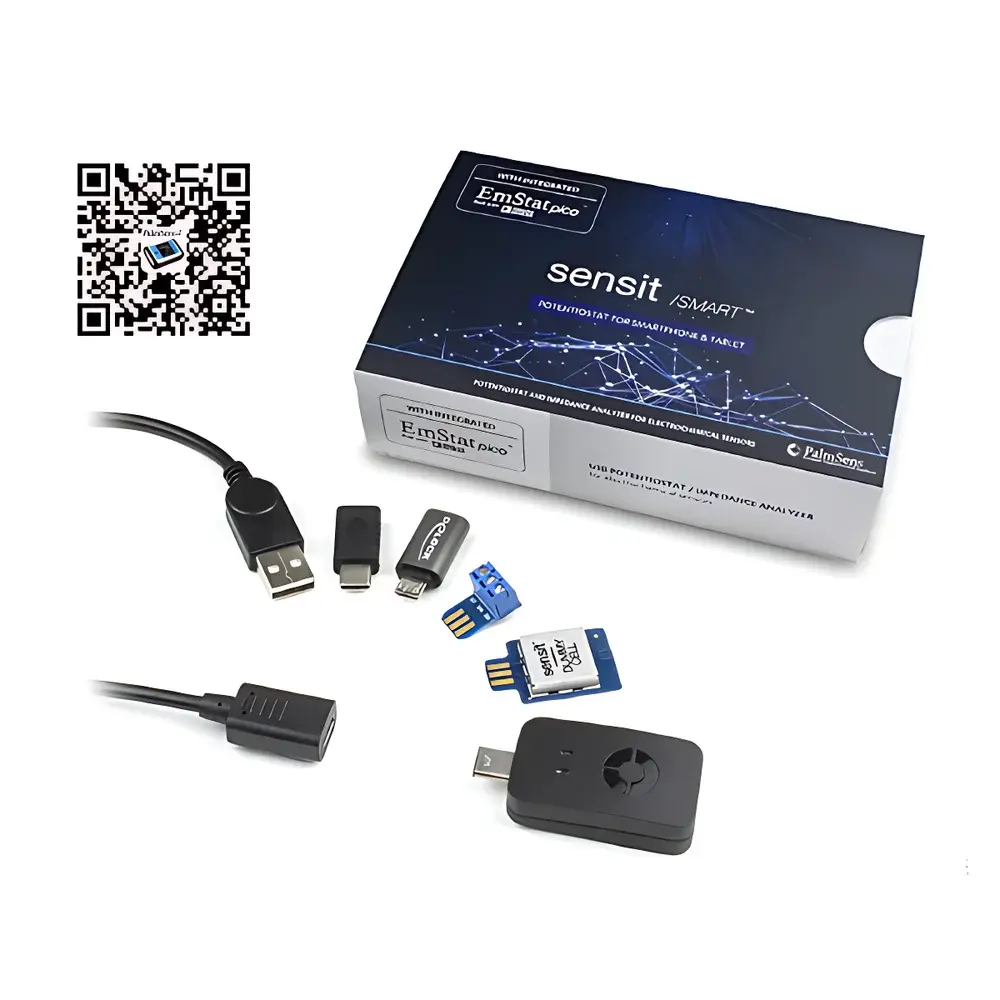
PalmSens SensitSmart USB-C Portable Electrochemical Workstation
| Brand | PalmSens |
|---|---|
| Origin | Netherlands |
| Model | SensitSmart |
| Instrument Type | Portable Electrochemical Workstation |
| Current Range | 100 nA to 3 mA |
| Current Accuracy | < 1% of selected current range |
| Potential Accuracy | ≤ 0.1% |
| Potentiostatic Range | −1.7 V to +2.0 V |
| EIS Frequency Range | 0.016 Hz to 200 kHz |
| Communication & Power | USB-C |
| Dimensions | 43 × 25 × 11 mm |
| Compatible Electrode Pitch | 2.54 mm |
| Electrode Thickness Support | 0.1–0.8 mm |
| Max Electrode Width | 11 mm |
| Supported Techniques | LSV, CV, DPV, SWV, NPV, CA, I–t, PAD, OCP, MA, EIS |
Overview
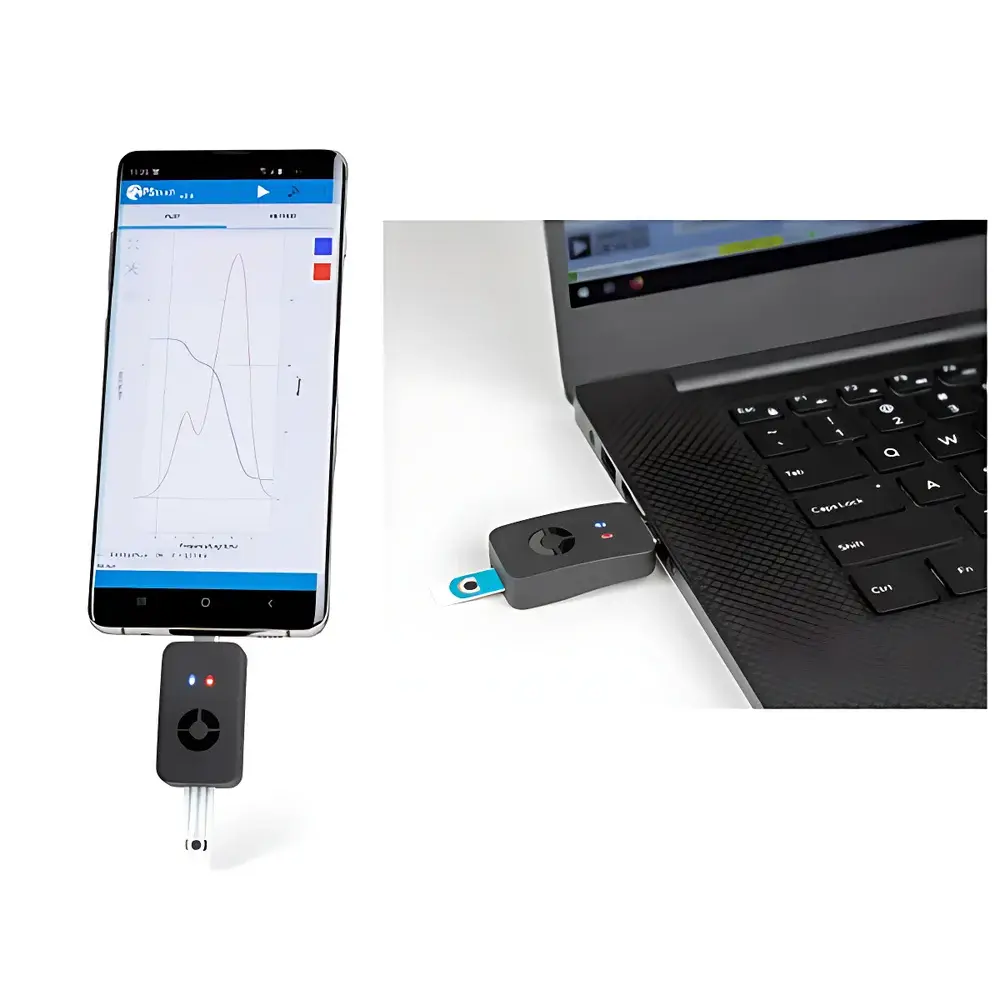
The PalmSens SensitSmart is a compact, USB-C–powered electrochemical workstation engineered for high-fidelity potentiostatic and galvanostatic measurements in resource-constrained or field-deployable environments. Based on a precision analog front-end architecture and digital signal processing optimized for low-noise current acquisition, the SensitSmart implements controlled-potential electrochemistry using three-electrode cell configurations (working, reference, counter). Its core measurement principle relies on real-time feedback-controlled voltage application with simultaneous high-resolution current sampling—enabling quantitative detection of redox-active species via faradaic current response. The device supports full-frequency-domain electrochemical impedance spectroscopy (EIS) from ultra-low frequencies (0.016 Hz) up to 200 kHz, facilitating both kinetic and interfacial characterization of electrode processes. With a physical footprint smaller than a standard USB flash drive (43 × 25 × 11 mm), it is designed for integration into point-of-need analytical workflows including on-site environmental screening, decentralized clinical testing, and embedded sensor development.
Key Features
- Ultra-compact form factor (43 × 25 × 11 mm) with integrated USB-C interface for direct power delivery and bidirectional data communication—no external power supply or adapter required.
- Wide dynamic current range spanning 100 nA to 3 mA, with resolution as fine as 5.5 pA at the 100 nA full-scale range (0.006% FSR).
- Precise potentiostatic control across −1.7 V to +2.0 V vs. reference electrode, with potential accuracy ≤ 0.1% of set value and current accuracy < 1% of selected range.
- Full-spectrum EIS capability from 0.016 Hz to 200 kHz, supporting multi-sine and single-sine excitation modes with phase-sensitive detection.
- Native compatibility with screen-printed electrodes (SPEs) featuring 2.54 mm pin pitch, thicknesses between 0.1 mm and 0.8 mm, and maximum width of 11 mm—enabling rapid assay deployment without custom fixtures.
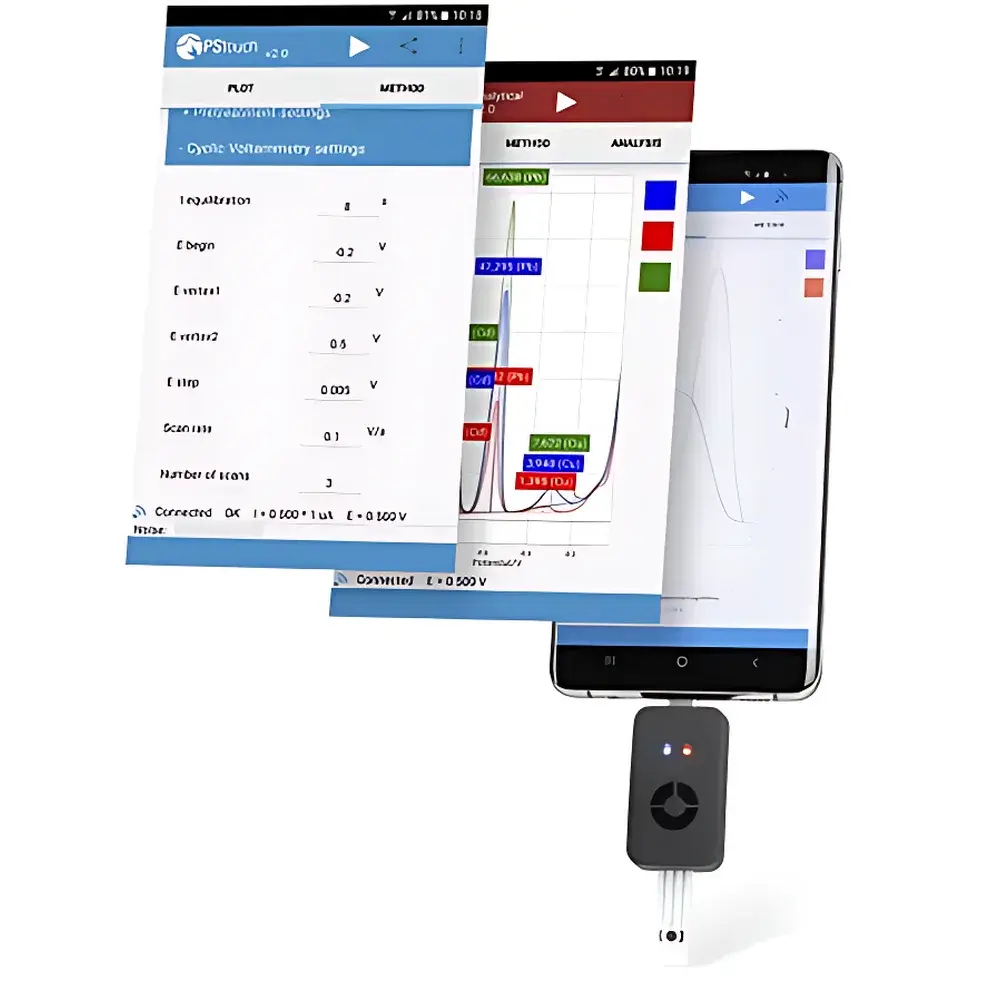
- Dual-platform software support: PSTrace (Windows/macOS) for advanced method scripting, calibration management, and GLP-compliant data export; PSTouch (Android) for field-based acquisition and real-time visualization.
Sample Compatibility & Compliance
The SensitSmart is validated for use with disposable and reusable electrochemical cells employing standard three-electrode geometries. It interfaces seamlessly with commercially available screen-printed carbon, gold, or platinum electrodes—particularly those conforming to ISO 15197:2013 dimensional tolerances for lateral electrode alignment. While the instrument itself does not carry CE marking under IVD Directive 2017/746, its hardware and firmware comply with EN 61326-1 (EMC for laboratory equipment) and EN 61010-1 (safety requirements for electrical equipment). When used with validated assay protocols and documented calibration procedures, data generated by the SensitSmart meets traceability requirements for ISO/IEC 17025-accredited laboratories performing routine electrochemical analysis.
Software & Data Management
PSTrace provides a modular, scriptable environment supporting method sequencing, real-time FFT-based noise filtering, and automated baseline correction. All raw data—including time-stamped potential, current, and impedance spectra—are stored in vendor-neutral CSV and JSON formats. Audit trails record user actions, parameter changes, and calibration events in accordance with FDA 21 CFR Part 11 principles (when deployed with appropriate system validation and electronic signature controls). PSTouch delivers equivalent core functionality on Android devices (v9.0+), including offline data capture, Bluetooth-assisted electrode identification, and one-tap export to cloud storage services. Both applications support batch processing for multi-sample comparative analysis and generate publication-ready figures with customizable axis scaling and legend placement.
Applications
- Environmental Monitoring: On-site quantification of heavy metals (e.g., Pb²⁺, Cd²⁺, Hg²⁺) in water samples using anodic stripping voltammetry (ASV) with disposable bismuth-film electrodes.
- Food Safety Screening: Rapid detection of nitrite, sulfite, or pesticide residues via amperometric enzyme inhibition assays on SPE platforms.
- Point-of-Care Diagnostics: Integration into microfluidic lab-on-chip systems for glucose, lactate, or cortisol monitoring using enzymatic biosensors.
- Materials Characterization: In situ evaluation of battery electrode kinetics, corrosion inhibitor efficiency, and conductive polymer switching behavior via CV and EIS.
- Wearable Sensor Development: Prototype validation of flexible textile-based electrodes under mechanical strain, leveraging the device’s low-power USB-C operation and robust noise rejection.
FAQ
Is the SensitSmart compatible with third-party electrochemical software?
Yes—the device exposes a documented HID-compliant USB protocol, enabling integration with Python (via PySerial or libusb), MATLAB, or LabVIEW through open-source drivers maintained by the PalmSens developer community.
Does the SensitSmart support bipotentiostat or galvanostat modes?
No—it operates exclusively as a single-channel potentiostat/galvanostat. Bipotentiostatic configurations require the PalmSens EmStat GO or MultiPalmSens platforms.
Can EIS measurements be performed in battery-operated mode?
Not natively—the SensitSmart draws power directly from the USB-C host port and lacks an internal battery. However, it functions reliably with portable USB power banks meeting USB PD 3.0 specifications.
What electrode connection standard does the SensitSmart use?
It employs a spring-loaded 6-pin ZIF (zero insertion force) connector compliant with standard screen-printed electrode footprints, accommodating 2.54 mm pitch and substrate thicknesses from 0.1 mm to 0.8 mm.
Is firmware update supported in the field?
Yes—firmware upgrades are delivered via PSTrace and require no hardware modification; all updates preserve existing calibration coefficients and user-defined method templates.





