
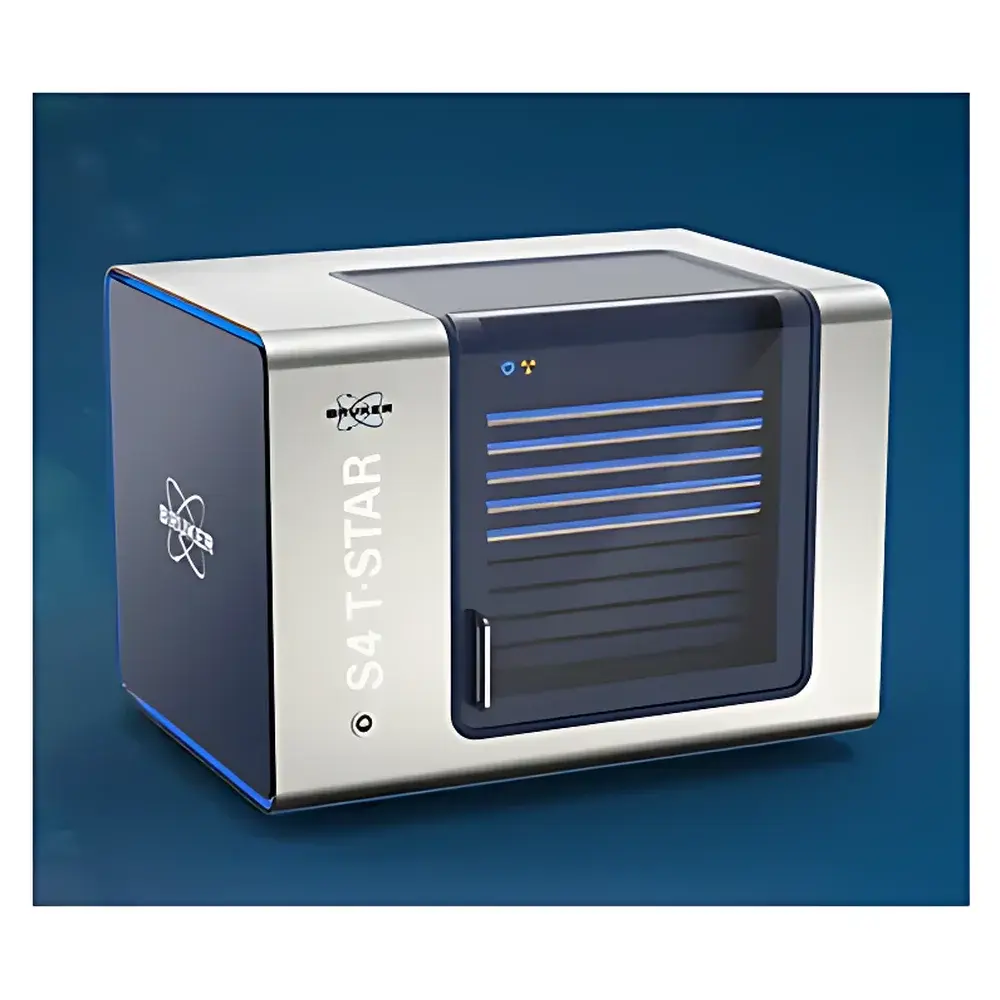
Bruker S4 TStar Total Reflection X-Ray Fluorescence Spectrometer
| Brand | Bruker |
|---|---|
| Origin | Germany |
| Model | S4 TStar |
| Configuration | Benchtop |
| Application Type | General Purpose |
| Elemental Range | Al (13) to U (92) |
| Detection Range | 0.1 pg to 100 wt% |
| Energy Resolution | <125 eV at Mn Kα (FWHM), <135 eV at Cu Kα |
| Repeatability | ≤0.1% RSD (for major elements, ≥100 s counting) |
| Detector | Silicon Drift Detector (SDD) |
Overview
The Bruker S4 TStar is a high-performance benchtop total reflection X-ray fluorescence (TXRF) spectrometer engineered for ultra-trace elemental analysis of micro-volume liquid, colloidal, and thin-film samples. Unlike conventional energy dispersive X-ray fluorescence (ED-XRF), TXRF employs a grazing-incidence excitation geometry—typically <0.1°—where the primary X-ray beam undergoes total external reflection at the surface of a flat, optically polished carrier (e.g., quartz, silicon wafer, or glass slide). This configuration confines the X-ray standing wave within the top ~3–5 nm of the sample layer, drastically reducing background from substrate scattering and enabling detection limits in the sub-ppt (pg range) regime. The S4 TStar leverages a high-brilliance Pd anode X-ray tube, monochromatic excitation via multilayer optics, and a large-area silicon drift detector (SDD) with optimized throughput and energy resolution. Its design targets laboratories requiring regulatory-grade trace metal quantification without the infrastructure demands of ICP-MS or ICP-OES—particularly where sample volume is limited, digestion is undesirable, or solid-phase matrix effects must be avoided.
Key Features
- Sub-ppt detection limits (0.1–1 pg absolute, equivalent to <1 ppt in 10 µL aqueous deposits) for elements from aluminum (Z=13) to uranium (Z=92)
- Grazing-incidence optical path with motorized θ/2θ goniometer and real-time beam alignment feedback for reproducible excitation geometry
- Integrated high-stability Pd anode X-ray source with selectable voltage (up to 50 kV) and current (up to 1 mA), coupled with graded multilayer monochromator for reduced Bremsstrahlung background
- Large-area (50 mm²) silicon drift detector (SDD) with <125 eV FWHM resolution at Mn Kα (5.89 keV), enabling precise peak deconvolution in complex multi-element spectra
- Automated sample stage with 3-axis precision positioning (±0.5 µm repeatability), supporting carriers up to 54 × 54 mm (including 2-inch wafers, 30-mm quartz slides, standard microscope slides, and custom rectangular substrates)
- Onboard vacuum chamber (10⁻² mbar base pressure) for enhanced light-element sensitivity (down to Al) and stable spectral acquisition
- Pre-aligned, field-serviceable optics module with no user calibration required—designed for >10,000 hours of operational stability
Sample Compatibility & Compliance
The S4 TStar accepts undigested, minimally prepared samples deposited as dried residues on inert reflective carriers. Compatible formats include: (i) 10–20 µL aqueous or organic solutions on 30-mm quartz carriers; (ii) semiconductor wafers (up to 2-inch diameter) for contamination mapping and depth-resolved analysis via angle-resolved TXRF; (iii) clinical cytology specimens (e.g., blood smears, tissue sections, cell monolayers) directly mounted on standard glass slides; and (iv) filter membranes or nanoparticle-coated substrates for aerosol or nanomaterial characterization. No acid digestion, dilution, or matrix-matching is required—eliminating contamination risks and procedural variability inherent in wet-chemistry methods. The system supports full compliance with ISO 17025 quality management requirements. Data acquisition, processing, and reporting modules are configurable to meet audit trail, electronic signature, and data integrity criteria per FDA 21 CFR Part 11 and EU Annex 11 when deployed in GLP/GMP environments.
Software & Data Management
Operating under Bruker’s proprietary SPECTRA software platform, the S4 TStar provides fully integrated instrument control, spectrum acquisition, quantitative analysis (fundamental parameters method with internal standard correction), and report generation. The software includes pre-validated method templates for pharmacopeial applications (USP /, EP 2.4.20), environmental testing (EPA Method 6020B adaptation), and semiconductor industry standards (SEMI F57). All spectral data are stored in vendor-neutral .spc format with embedded metadata (sample ID, operator, timestamp, acquisition parameters, calibration history). Audit trail functionality logs every user action—including method modification, result reprocessing, and report export—with time-stamped, non-erasable records. Raw data and processed results can be exported to LIMS via ASTM E1384-compliant XML or CSV interfaces.
Applications
- Pharmaceutical Quality Control: Quantification of residual catalysts (e.g., Pd, Pt, Ni) and leachables (e.g., Pb, Cd, As) in active pharmaceutical ingredients (APIs) and final dosage forms—meeting USP thresholds (e.g., Pb ≤ 0.5 ppm in oral solids)
- Food & Agricultural Safety: Direct analysis of rice, infant formula, and drinking water for As, Cd, Pb, and Hg at levels aligned with Codex Alimentarius and WHO guidelines (e.g., inorganic As ≤ 10 ppb in polished rice)
- Environmental Monitoring: Ultra-trace metal profiling in surface water, wastewater effluents, digested sludge extracts, and radioactive waste simulants—achieving detection below 1 ppb for U, Th, and transuranics
- Materials Science: Surface contamination screening of Si wafers (≤1 × 10¹⁰ atoms/cm² sensitivity), thin-film stoichiometry verification, and nanoparticle composition analysis without TEM/EDS sample preparation artifacts
- Clinical & Life Sciences: Elemental mapping of biological tissues (e.g., Fe/Cu/Zn distribution in brain sections), metalloprotein quantification in serum, and intracellular metal uptake studies using cultured cells on coated slides
FAQ
What sample preparation is required for TXRF analysis on the S4 TStar?
Minimal preparation: liquid samples are pipetted (5–20 µL), dried under inert gas or IR lamp, and analyzed as solid residues. No digestion, filtration, or matrix modifiers are needed.
Can the S4 TStar quantify light elements such as sodium or magnesium?
Yes—under vacuum operation and optimized excitation conditions, it achieves reliable quantification from aluminum (Z=13) upward; sodium (Z=11) and magnesium (Z=12) are accessible with extended counting times and specialized calibration.
How does TXRF compare to ICP-MS for trace metal analysis?
TXRF offers comparable detection limits for many elements without plasma gas consumption, cleanroom requirements, or polyatomic interference corrections—but lacks isotopic resolution and has lower dynamic range than ICP-MS.
Is internal standardization mandatory for quantitative TXRF?
While optional for relative comparisons, internal standardization (e.g., 100 ng of Ga or Y added per sample) is recommended for highest accuracy (<2% error) across heterogeneous matrices and varying deposition geometries.
Does the S4 TStar support automated batch analysis?
Yes—the XYZ stage and software support unattended analysis of up to 48 carriers via programmable sequences, including auto-focus, multi-point mapping, and pass/fail decision logic based on user-defined specification limits.






