
MicroStation AquaSense Miniature Water Quality Monitoring System
| Origin | Shenzhen, China |
|---|---|
| Manufacturer Type | Authorized Distributor |
| Origin Category | Domestic (PRC) |
| Model | MicroStation AquaSense |
| Pricing | Available Upon Request |
Overview
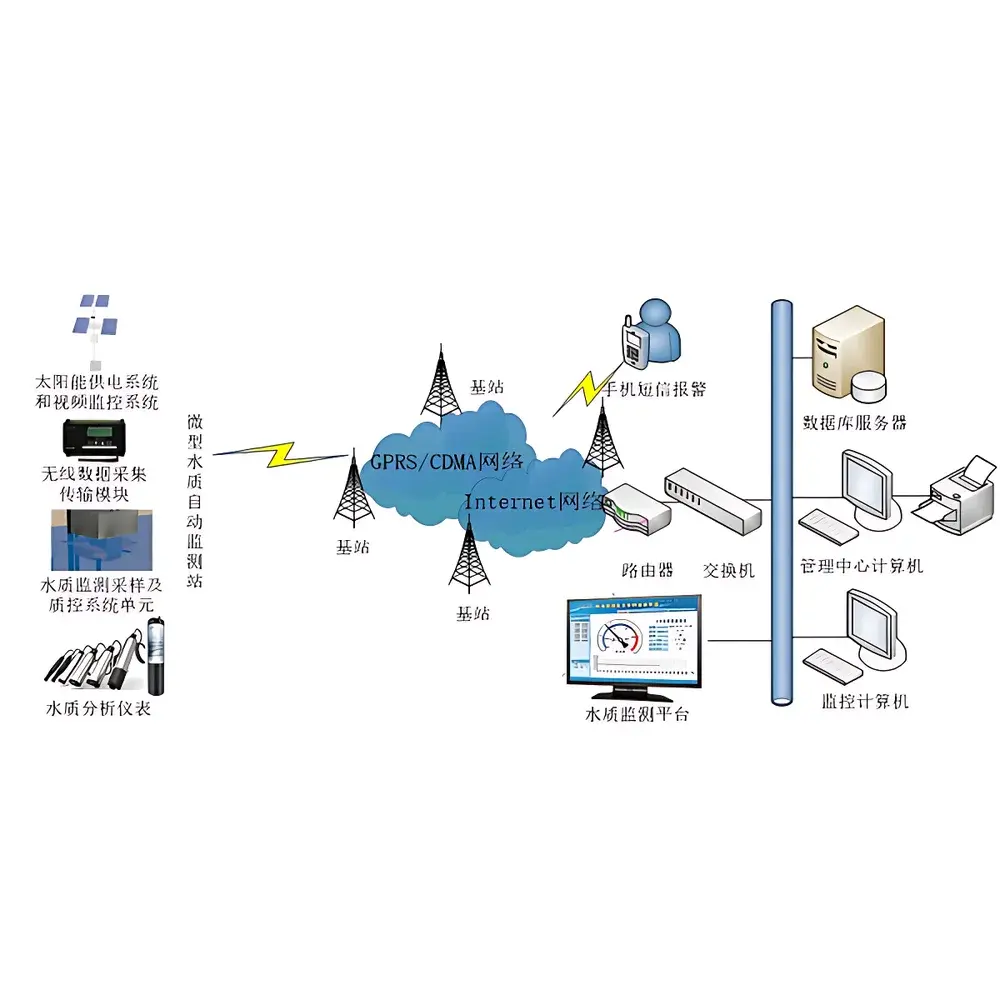
The MicroStation AquaSense Miniature Water Quality Monitoring System is an integrated, solar-powered environmental monitoring platform engineered for long-term, unattended operation in resource-constrained aquatic environments. It employs a hybrid in-situ and low-volume intermittent sampling architecture grounded in standardized electrochemical, optical, and physical measurement principles—including conductivity, pH, dissolved oxygen (DO), turbidity, ammonium (NH₄⁺), nitrate (NO₃⁻), total phosphorus (TP), and chemical oxygen demand (COD) via UV-Vis spectral analysis. Unlike conventional fixed-station analyzers requiring continuous flow and grid power, the MicroStation AquaSense operates autonomously using photovoltaic energy harvesting and intelligent duty-cycling logic—enabling deployment at shallow rivers, narrow canals, tidal creeks, and low-flow reservoir inlets where civil infrastructure, land access, or hydraulic head are severely limited.
Key Features
- Solar-First Power Architecture: Integrated monocrystalline PV panel (≥40 W), deep-cycle LiFePO₄ battery (12 V / 50 Ah), and MPPT charge controller ensure ≥180 days of continuous operation under 3.5 sun-hours/day irradiance—eliminating dependence on AC grid infrastructure.
- In-Situ Sensor Integration: Multi-parameter probe arrays mounted directly at the water interface minimize transport-induced drift; DO measured via optical luminescence decay, pH via solid-state ISFET, turbidity via 90° scattered light (860 nm LED), and nutrients via segmented flow analysis (SFA) with micro-dosing precision.
- Intermittent Low-Volume Sampling: Patented peristaltic micro-pumping system draws ≤15 mL per analysis cycle, reducing sample consumption by >70% versus conventional systems—critical for low-flow (<0.1 m³/s) or seasonally dry sections.
- Modular Mounting Flexibility: Four certified deployment configurations: cabinet-mounted (shore-based), floating buoy (anchored), cantilevered arm (bridge/pier), and telescopic lift (tidal zone)—each compliant with ISO 5667-15 for representative sampling point selection.
- Edge Intelligence & Fault Resilience: Onboard ARM Cortex-A53 processor executes local data validation (e.g., range checks, spike detection per ASTM D5173), automatic zero/span calibration scheduling, and adaptive transmission throttling during cellular signal degradation.
Sample Compatibility & Compliance
The MicroStation AquaSense is validated for use in freshwater, brackish, and estuarine matrices with salinity ≤15 ppt and suspended solids ≤200 mg/L. All wetted components meet NSF/ANSI Standard 61 for drinking water system components. Sensor output protocols conform to MODBUS RTU (RS-485) and SDI-12 standards. Data acquisition firmware supports audit-trail logging per GLP requirements, with timestamped metadata (temperature, battery voltage, pump actuation count) embedded in every transmitted record. System design aligns with EPA Method 1600 series for microbiological surrogates and ISO 7027 for turbidity—ensuring regulatory acceptability in national water quality reporting frameworks.
Software & Data Management
Data is transmitted via dual-mode GPRS/CDMA (with fallback to NB-IoT in 4G-limited zones) using TLS 1.2 encrypted MQTT payloads. The cloud-based AquaPortal platform provides role-based dashboards (ISO/IEC 27001-certified hosting), automated alerting (SMS/email/SNMP traps), and export-ready CSV/JSON datasets compliant with WQX (Water Quality Exchange) schema v3.2. Audit logs retain full traceability—including sensor calibration history, firmware version rollbacks, and user-initiated maintenance events—for FDA 21 CFR Part 11–aligned environments. Optional integration with SCADA systems via OPC UA server module.
Applications
- Real-time monitoring of small river cross-sections (width <15 m, depth <2 m) for early pollution event detection (e.g., agricultural runoff, illicit discharge).
- Longitudinal profiling of nutrient gradients in eutrophic lakes and reservoirs with minimal ecological footprint.
- Tidal creek and mangrove fringe monitoring where sediment mobility and fluctuating salinity challenge traditional intake designs.
- Supporting national surface water classification programs (e.g., China’s “River Chief” initiative, EU WFD Article 8 reporting) through high-density, cost-effective node deployment.
- Calibration reference stations for satellite-derived water quality products (e.g., Sentinel-3 OLCI chlorophyll-a validation).
FAQ
What is the minimum recommended water depth for floating-platform deployment?
A minimum depth of 0.8 m is required to ensure stable submersion of the sensor array and prevent air entrainment during wave action.
Can the system operate during extended cloudy periods?
Yes—battery autonomy exceeds 30 days at 10% nominal solar input (e.g., monsoon season), verified per IEC 61215:2016 Annex J accelerated aging tests.
Is remote firmware update supported?
Yes, over-the-air (OTA) updates are performed via signed binary packages with SHA-256 verification and rollback capability.
Does the system support third-party sensor integration?
Yes—via configurable analog (4–20 mA, 0–5 V) and digital (RS-485, SDI-12) inputs; documentation includes register maps and calibration coefficient templates.
What cybersecurity certifications does the data transmission layer hold?
MQTT broker infrastructure is audited annually against NIST SP 800-53 Rev. 4 controls and complies with GDPR Article 32 technical safeguards.







