
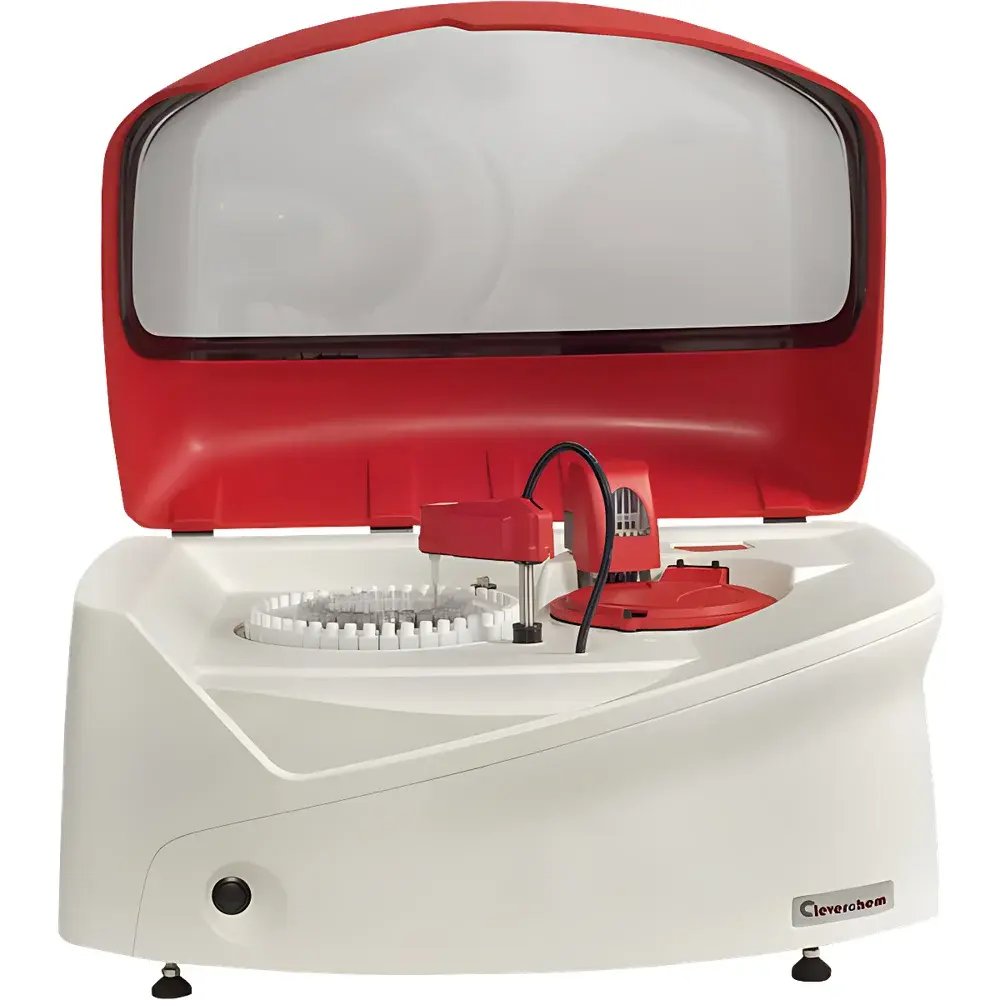
DeChem-Tech CleverChem Anna Automated Wet-Chemistry Water Quality Analyzer
| Brand | DeChem-Tech |
|---|---|
| Origin | Germany |
| Model | CleverChem Anna |
| Instrument Type | Laboratory-Based Automated Discrete Analyzer |
| Detection Parameters | Total Nitrogen, Total Phosphorus, Ammonia-N, Nitrate, Nitrite, Orthophosphate, Silicate, Sulfate, Sulfide, Chloride, Hexavalent Chromium, Alkalinity, Iron, Zinc, Fluoride |
| Sample Throughput | Up to 200 samples/hour |
| Sample Capacity | 49 positions |
| Reagent Positions | 31 (with optional refrigerated storage) |
| Optical Cell | Reusable 64-position quartz cuvette carousel, 1 cm pathlength |
| Cleaning System | 8-step ultrasonic cuvette cleaning station with optical validation |
| Dilution Capability | In-cuvette dilution up to 100× (1 mL dilutor volume) |
| Software | Dual-language (English/Chinese), supports true sample blank and reagent blank correction |
| Waste Management | Sealed, sensor-monitored waste collection system |
| Compliance | Designed for GLP/GMP environments |
Overview
The DeChem-Tech CleverChem Anna is a laboratory-grade automated discrete analyzer engineered for high-precision, wet-chemistry-based water quality analysis in petrochemical, industrial, and environmental monitoring laboratories. It implements standardized colorimetric and spectrophotometric methods—fully replicating manual APHA, ISO, and ASTM reference procedures—by precisely metering microliter volumes of sample and reagents into reusable quartz cuvettes, initiating controlled chemical reactions, and quantifying analyte concentrations via absorbance measurement at defined wavelengths. Unlike flow-injection or segmented-flow systems, the CleverChem Anna employs a discrete, non-continuous reaction architecture: each sample-reagent combination reacts independently in its own optical cell, eliminating cross-contamination risk and enabling simultaneous multi-parameter analysis without method interference. Its design prioritizes metrological integrity, operational safety, and long-term cost efficiency—particularly critical for routine analysis of complex, matrix-rich wastewater streams from refineries, ethylene plants, and cooling water circuits.
Key Features
- High-throughput discrete analysis: Up to 200 samples per hour, with concurrent determination of ≥10 parameters across all 49 sample positions.
- Micro-volume chemistry: Sample and reagent consumption in the µL range—reducing consumable costs by >70% versus conventional benchtop methods.
- Reusable 64-position quartz cuvette carousel: 1 cm optical pathlength ensures high photometric sensitivity and long-term stability; each cuvette undergoes rigorous optical validation post-cleaning before reuse.
- 8-step ultrasonic cleaning station: Includes deionized water rinse, acid wash, alkaline soak, sonication, drying, and spectral verification—ensuring <0.001 AU baseline drift between runs.
- Integrated 1 mL dilutor with in-cuvette dilution logic: Automatically handles over-range samples and constructs calibration curves via serial dilution—all within the same reaction vessel.
- Refrigerated 31-position reagent carousel: Maintains temperature-sensitive reagents (e.g., sulfanilamide, NEDD, antipyrine derivatives) at 4–8 °C; cooling is user-activatable to conserve energy during stable-temperature operation.
- Sealed, sensor-monitored waste handling: Real-time level detection and vapor-tight containment prevent exposure to H2S, Cr(VI) aerosols, and acidic vapors—meeting OSHA PEL and EU CLP hazard communication requirements.
Sample Compatibility & Compliance
The CleverChem Anna accepts liquid samples with suspended solids ≤50 mg/L (pre-filtration recommended for turbid refinery effluents). It accommodates pH 2–12, salinity up to 35 g/L NaCl, and moderate organic loadings typical of upstream produced water and downstream cooling tower blowdown. Method validation aligns with ISO 15681-1 (phosphorus), ISO 11905-1 (nitrogen), ASTM D1253 (residual chlorine), and EPA 353.2 (nitrate/nitrite). When deployed with validated SOPs and enabled audit-trail logging, the system meets data integrity expectations under GLP (OECD Principles) and regulated GMP environments—including traceability of operator actions, method version control, and electronic signature support per FDA 21 CFR Part 11 Annex 11 guidelines.
Software & Data Management
The embedded Windows-based software provides dual-language UI (English/Chinese), intuitive workflow configuration, and real-time run monitoring. It supports full blank compensation—separate sample blank, reagent blank, and method blank subtraction—to correct for chromophoric interferences common in hydrocarbon-contaminated matrices. Calibration curves are generated using weighted linear regression (1/x or 1/x²), with automatic outlier rejection and forced-zero intercept where chemically justified. All raw absorbance data, peak integration logs, cleaning validation reports, and maintenance timestamps are stored in an encrypted SQLite database. Export formats include CSV, PDF analytical reports, and LIMS-compatible ASTM E1384-compliant XML.
Applications
The CleverChem Anna serves as a core analytical platform for petrochemical QA/QC labs performing regulatory and process-control testing on: boiler feedwater (alkalinity, silica, iron), refinery wastewater (total N/P, Cr(VI), sulfide), cooling tower systems (phosphate corrosion inhibitors, nitrate biocide residuals), and desalination pre-treatment streams (chloride, fluoride, sulfate). Its robustness against high-chloride, high-sulfate, and low-pH matrices—combined with sub-ppb detection limits for key contaminants—makes it suitable for compliance reporting under ISO 14001 EMS, REACH substance tracking, and internal refinery environmental KPI dashboards.
FAQ
What standards does the CleverChem Anna validate against for total nitrogen analysis?
It implements ISO 11905-1 (alkaline persulfate digestion followed by UV spectrophotometry) and EPA 351.2, with method-specific digestion modules available as optional hardware upgrades.
Can the system analyze undiluted seawater samples for chloride and sulfate?
Yes—its extended dynamic range and built-in 100× dilution capability allow direct analysis of high-salinity matrices; chloride is measured via mercuric thiocyanate spectrophotometry (ISO 9297), sulfate via barium sulfate turbidimetry (ISO 9298).
Is remote diagnostics supported?
The instrument includes Ethernet connectivity and secure VNC-enabled remote access for technical support; all diagnostic logs, error codes, and sensor health metrics are accessible via the software’s Maintenance Console.
How often must the quartz cuvettes be replaced?
Under normal operation (200 samples/day, proper cleaning protocol), cuvettes maintain optical performance for ≥12 months; replacement is triggered only upon failure of the automated optical validation step.
Does the software support electronic signatures for regulated environments?
Yes—when configured with the optional 21 CFR Part 11 Compliance Module, it enforces role-based access, biometric or token-based e-signatures, and immutable audit trails for all critical data modifications.
Related Products







