
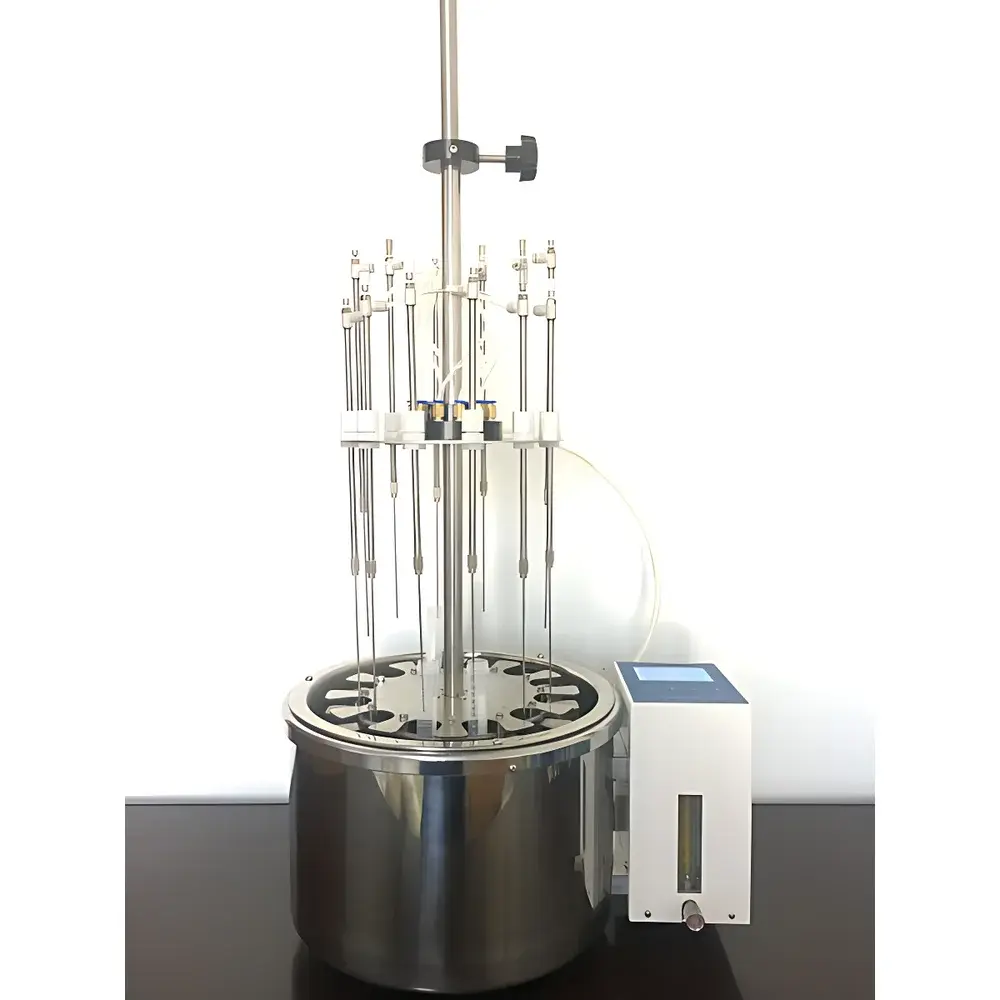
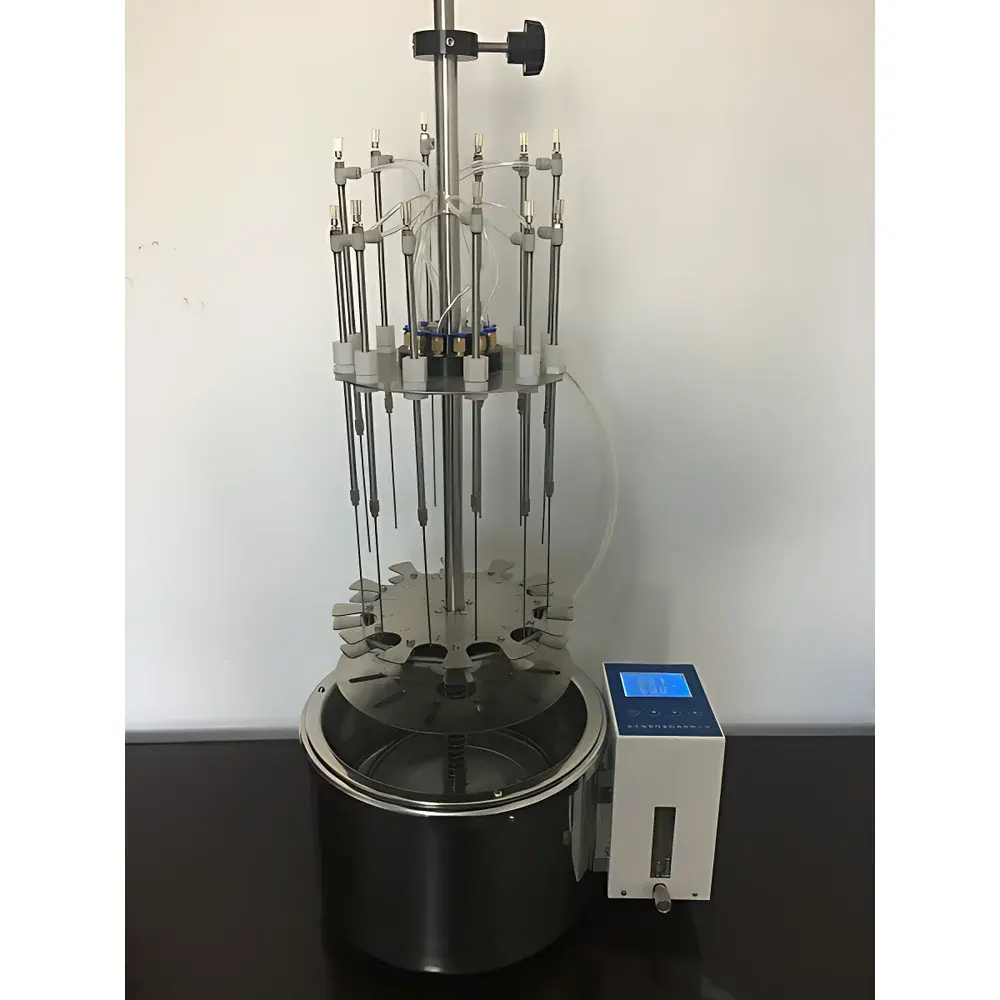
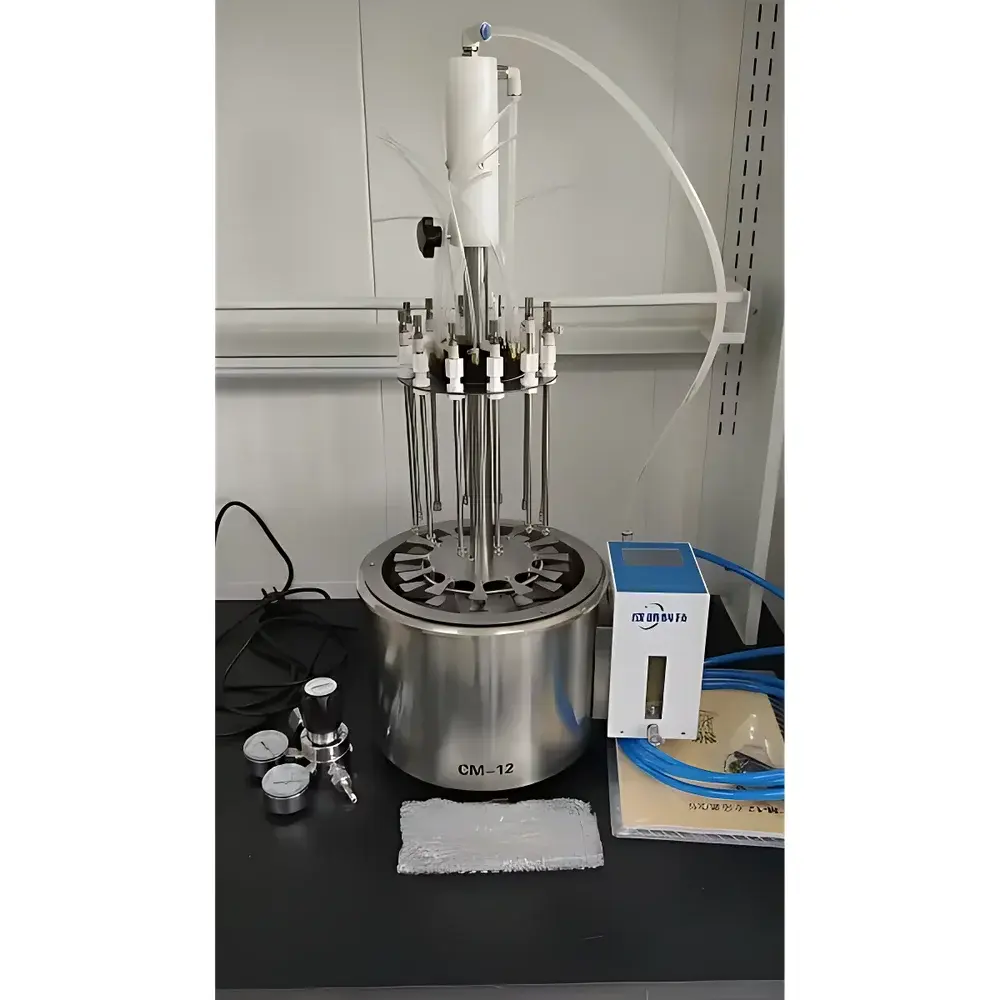
Chengmeng CM-12 Water Bath Nitrogen Evaporator
| Brand | Chengmeng Technology |
|---|---|
| Origin | Beijing, China |
| Model | CM-12 |
| Heating Method | Water Bath |
| Temperature Range | Ambient +5°C to 99°C |
| Temperature Stability | ±0.5°C |
| Tube Diameter Compatibility | 10–29 mm |
| Gas Flow Rate | 0–15 L/min |
| Sample Positions | 12 |
| Heating Power | 1000 W |
| Display | 66×45 mm LCD |
| Timer Range | 0–9999 min |
| Vertical Adjustment Travel | 200 mm |
| Gas Inlet Connector | Ø7 mm |
| Needle Length | 150 mm (standard) |
| Bath Dimensions | Ø260×150 mm |
| Overall Dimensions | 390×300×850 mm |
| Weight | 9.5 kg |
Overview
The Chengmeng CM-12 Water Bath Nitrogen Evaporator is an engineered solution for controlled, gentle solvent removal in analytical laboratories. It operates on the principle of inert gas-assisted surface evaporation—introducing a regulated stream of nitrogen (or compressed air) across the surface of heated liquid samples to accelerate solvent volatilization while minimizing thermal degradation and analyte loss. Unlike dry-block or infrared evaporators, the CM-12 employs a precisely temperature-controlled water bath to deliver uniform, low-gradient heating—critical for thermolabile compounds in pesticide residue analysis, pharmaceutical QC, and clinical biofluid processing. Its design conforms to standard laboratory workflows for sample preparation prior to GC, HPLC, LC-MS, and ICP-MS analysis, supporting method reproducibility under GLP-compliant environments.
Key Features
- 12-position modular sample rack with spring-loaded, numbered tube clamps—ensuring secure positioning for tubes (Ø10–29 mm), centrifuge vials, and conical flasks (1–50 mL capacity).
- Independent vertical adjustment (200 mm travel) of stainless-steel gas needles per position—enabling precise alignment above meniscus level for optimal gas dispersion and minimal cross-contamination.
- Dual-gas capability: configurable for nitrogen (recommended for oxidation-sensitive analytes) or compressed air (suitable for robust matrices), each routed through dedicated inlet ports with pressure-rated connectors (0.2 MPa max).
- Intelligent PID temperature control with 66×45 mm backlit LCD interface—providing real-time display of setpoint, actual bath temperature (±0.1°C resolution), and timer status; includes overtemperature cutoff and dry-run protection.
- Corrosion-resistant construction: 304 stainless steel bath vessel, silicone-free PTFE-coated gas manifolds, and Japan-sourced odorless, transparent silicone tubing compliant with USP Class VI requirements.
- Rotatable circular bath platform—facilitating ergonomic access during sample loading/unloading without disturbing adjacent positions or gas flow calibration.
Sample Compatibility & Compliance
The CM-12 accommodates standard laboratory consumables including borosilicate glass test tubes, polypropylene centrifuge tubes, and tapered culture tubes. Its wide bore range (Ø10–29 mm) supports common formats used in EPA Method 525.3 (drinking water), AOAC 2007.01 (pesticide multiresidue), and USP chromatographic sample prep. All wetted materials are inert to acetonitrile, methanol, dichloromethane, ethyl acetate, and hexane—validated per ASTM D4294 for organic solvent resistance. The unit meets CE safety directives (2014/35/EU, 2014/30/EU) and is compatible with ISO/IEC 17025-accredited lab infrastructure when operated within defined SOPs.
Software & Data Management
While the CM-12 operates as a standalone instrument, its analog-digital hybrid control architecture supports integration into validated workflows. The embedded timer logs elapsed time per run (0–9999 min), and temperature setpoints are retained after power cycling. For 21 CFR Part 11 compliance, external data loggers (e.g., Omega OM-DAQPRO-5300) may be connected via RS-232 or analog voltage output (0–5 V) to record bath temperature and runtime metadata. Audit trails, electronic signatures, and user-access controls are implemented at the LIMS or ELN layer—not within the device firmware—aligning with industry-standard validation practices for regulated environments.
Applications
- Agricultural residue testing: Concentration of QuEChERS extracts from fruits, vegetables, grains, and plant tissues prior to GC-ECD or LC-MS/MS quantification.
- Pharmaceutical quality control: Solvent exchange and volume reduction of dissolution media, stability study samples, and herbal extract preparations per ICH Q5C guidelines.
- Environmental monitoring: Pre-concentration of EPA SW-846 Methods 8081B (PCBs), 8270D (SVOCs), and 502.2 (VOCs) aqueous extracts.
- Clinical toxicology: Processing of serum, plasma, urine, and whole blood specimens for targeted metabolite screening using tandem mass spectrometry.
- Food safety analytics: Reduction of matrix interferences in milk, wine, juice, and infant formula extracts prior to dioxin/furan analysis by HRGC-HRMS (EU Regulation 2022/2447).
FAQ
What is the maximum recommended operating temperature for continuous use?
The water bath is rated for sustained operation up to 99°C; however, for long-duration protocols (>4 h), a setpoint ≤85°C is advised to minimize evaporation rate variability and extend heater element service life.
Can the CM-12 be used under a fume hood?
Yes—the entire unit fits within standard 1200 mm wide hoods; its low-profile design (850 mm height) and sealed gas distribution manifold prevent nitrogen dispersion into the lab environment.
Is calibration documentation provided with the instrument?
A factory calibration certificate (traceable to NIST standards) is included, covering temperature accuracy (±0.5°C at 60°C) and timer deviation (<±0.5% over 60 min); users must perform periodic verification per ISO/IEC 17025 Clause 6.5.
What maintenance is required for the gas delivery system?
Stainless-steel needles should be inspected monthly for clogging; silicone tubing requires replacement every 6 months in high-humidity or chlorinated solvent environments to prevent permeation-induced flow drift.
Does the CM-12 support remote monitoring or network connectivity?
No native Ethernet or Wi-Fi interface is integrated; however, analog voltage outputs allow third-party SCADA or LabVIEW-based supervision systems to monitor bath temperature and runtime status in real time.



