
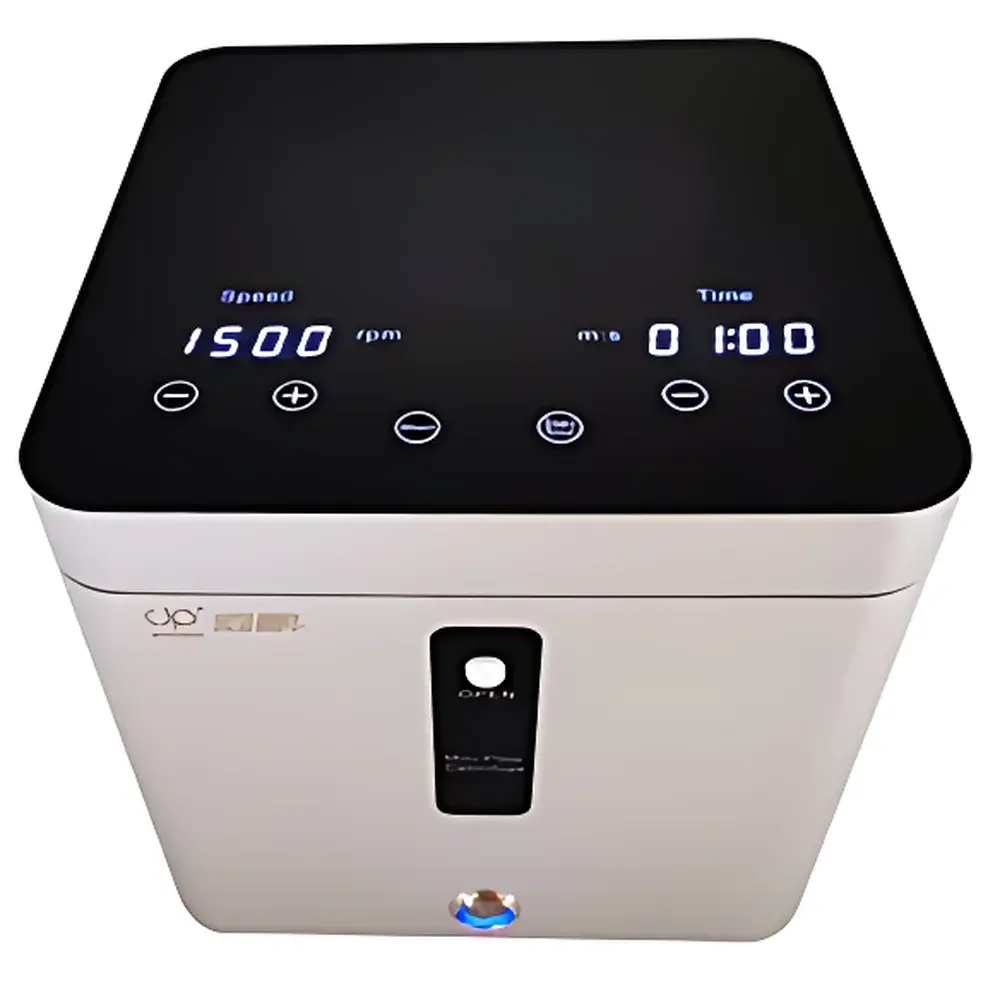
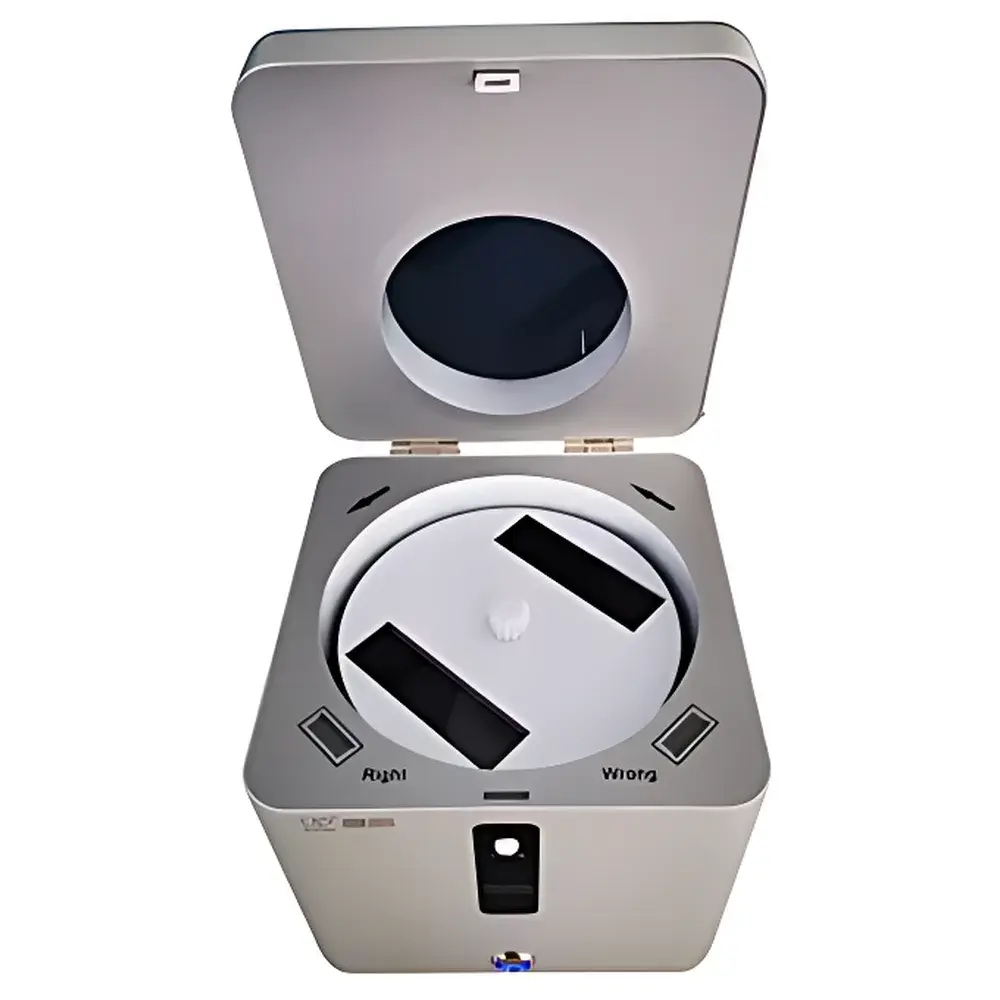
Keebio MP300 Microplate Centrifuge
| Brand | Keebio |
|---|---|
| Model | MP300 |
| Type | Benchtop Microplate Centrifuge |
| Maximum Speed | 3000 rpm |
| Maximum RCF | 627 × g |
| Capacity | 2 × standard PCR microplates (96-well or 384-well) |
| Rotor Configuration | Fixed-angle vertical rotor |
| Drive System | Brushless DC motor |
| Power Supply | DC 24 V, 3 A |
| Dimensions (W × D × H) | 230 mm × 200 mm × 19.3 mm |
| Weight | 2.1 kg |
| Acceleration/Deceleration | Instant start |
| Control Interface | Full-screen capacitive touch panel with holographic backlight display |
| Operating Modes | Pulse (short-run) and timed modes |
| Compliance | Designed for GLP-compliant laboratories |
Overview
The Keebio MP300 Microplate Centrifuge is an engineered benchtop instrument designed exclusively for rapid, precise, and contamination-free pelleting of liquid contents in standard microplates—primarily 96-well and 384-well formats. Unlike general-purpose centrifuges, the MP300 employs a fixed-angle vertical rotor architecture optimized for microplate geometry, enabling uniform radial acceleration across all wells without plate deformation or well-to-well cross-contamination. Its operational principle relies on controlled rotational force generation (RCF) to drive residual droplets from well walls toward the bottom, eliminating carryover in downstream applications such as qPCR setup, ELISA plate washing, enzymatic reaction termination, and nucleic acid extraction workflows. With a maximum RCF of 627 × g at 3000 rpm and sub-15-second electronic braking, the MP300 delivers reproducible, low-shear pelleting suitable for sensitive biological samples—including pre-amplified cDNA, antibody-conjugated beads, and viral lysates—without compromising integrity or yield.
Key Features
- Vertical fixed-angle rotor precisely aligned for standard microplate footprint—ensures consistent centrifugal force distribution across all wells, regardless of skirted, semi-skirted, or non-skirted plate design.
- Brushless DC motor with integrated encoder feedback provides stable speed control (300–3000 rpm in 10-rpm increments), zero maintenance, and silent operation under load.
- Dual-mode operation: pulse mode for immediate transient pelleting (e.g., post-transfer condensation removal); timed mode with adjustable duration (1–99 seconds) for standardized protocol execution.
- Full-screen capacitive touch interface with holographic backlighting enables glove-compatible operation, real-time parameter visualization, and intuitive navigation without physical buttons or mechanical wear points.
- Structural chassis fabricated from one-piece high-strength aluminum alloy ensures vibration damping and long-term dimensional stability—even during repeated high-cycle usage in high-throughput core facilities.
- 95° full-lid opening mechanism allows unobstructed access for rapid plate insertion and retrieval, minimizing workflow interruption and supporting ergonomic handling in laminar flow hoods or biosafety cabinets.
Sample Compatibility & Compliance
The MP300 accommodates all ANSI/SBS-standard microplates: flat-bottom, round-bottom, and V-bottom 96-well plates; low-profile and high-profile 384-well plates; skirted, semi-skirted, and unskirted variants; and standard thin-wall PCR plates (0.1–0.2 mL well volume). It supports common labware materials including polypropylene, polystyrene, and cyclic olefin copolymer (COC). The device is validated for use in environments requiring adherence to Good Laboratory Practice (GLP) and ISO 15189-accredited clinical laboratories. Its closed-loop motor control and non-volatile parameter memory support audit-ready operation per CLSI EP15-A3 recommendations for microplate-based assay reproducibility. While not FDA 21 CFR Part 11 certified out-of-box, its deterministic behavior and traceable settings enable integration into validated workflows when paired with documented SOPs and change control procedures.
Software & Data Management
The MP300 operates as a standalone instrument with no external software dependency. All operational parameters—including speed, time, mode selection, and last-used configuration—are stored in non-volatile memory and retained after power cycling. The touch interface logs the most recent five run histories (timestamp, rpm, duration, mode), accessible via dedicated history menu. No cloud connectivity or proprietary drivers are required; however, optional RS-232 or USB-C serial output (available via accessory module) permits integration with LIMS or ELN systems for automated run logging—supporting traceability requirements in regulated QC/QA environments. Firmware updates are performed via secure USB flash drive using signed binary packages, ensuring version control and integrity verification.
Applications
- Pre-PCR sample consolidation: removing condensation from thermal cycler lids prior to amplification.
- ELISA and immunoassay plate preparation: pelleting wash buffer residues before substrate addition.
- Cell-based assay normalization: settling suspended cells or beads in viability or cytotoxicity assays.
- Nucleic acid purification: accelerating binding buffer displacement in spin-column and magnetic bead protocols.
- Protein crystallization screening: compacting precipitant drops in sitting-drop plates prior to imaging.
- High-throughput drug discovery: standardizing liquid height across compound library plates prior to robotic dispensing.
FAQ
Can the MP300 accommodate 1536-well plates?
No—the MP300 is mechanically constrained to ANSI/SBS-compliant 96-well and 384-well formats. Its rotor geometry and lid clearance do not support 1536-well plate dimensions.
Is rotor balancing required before each run?
No—the fixed vertical rotor is factory-balanced and does not require user balancing. Symmetrical loading of identical microplates is recommended for optimal performance.
Does the MP300 generate significant heat during extended use?
The brushless DC motor and aluminum chassis provide passive thermal dissipation; surface temperature rise remains below 5 °C above ambient after continuous 30-minute operation at 3000 rpm.
Can I use the MP300 inside a cold room or refrigerated cabinet?
Yes—operational temperature range is 4–40 °C with relative humidity ≤ 80% non-condensing. Condensation on internal electronics must be avoided during transitions between temperature zones.
What safety certifications does the MP300 hold?
The unit complies with IEC 61010-1:2010 for laboratory electrical equipment and meets EMC requirements per IEC 61326-1:2020 Class B. CE marking is affixed for EU market conformity.



