
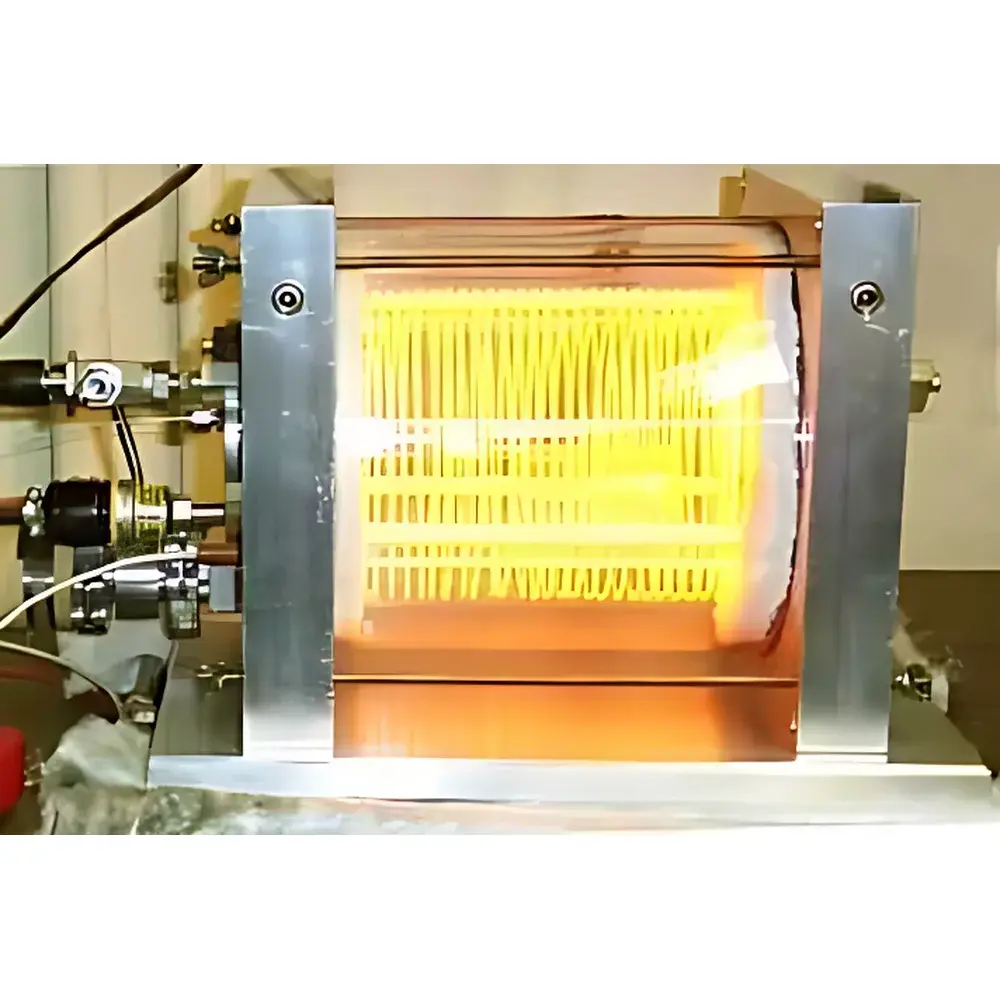
FTF11 Advanced Transparent High-Temperature Muffle Furnace (700°C)
| Origin | USA |
|---|---|
| Manufacturer Type | Authorized Distributor |
| Origin Category | Imported |
| Model | FTF11 |
| Pricing | Available Upon Request |
| Max Operating Temperature | 700 °C |
| Heating Chamber Dimensions (D×L) | 11 cm × 20 cm |
| External Dimensions (L×W×H) | 40 cm × 30 cm × 30 cm |
| Controller Dimensions (L×W×H) | 30 cm × 25 cm × 30 cm |
| Thermocouple Type | J-Type |
| Heating Element Material | Kanthal A-1 |
| Power Supply | 220 V, 50 Hz, 30 A |
| Rated Power at 700 °C | ~2 kW |
| Temperature Control | PID Algorithm with SCR Power Regulation |
| Cooling Method | Integrated Water-Cooling System |
| Atmosphere Options | Ambient Air, Vacuum, Inert/Reactive Gas (User-Specified), Atmospheric Pressure Range: 0–101.3 kPa |
| Mass | ~1 kg |
| Temperature Uniformity & Stability | ±0.5 °C at Setpoint (Center Zone, Steady-State) |
Overview
The FTF11 Advanced Transparent High-Temperature Muffle Furnace is an engineered solution for real-time thermal process observation under controlled high-temperature conditions up to 700 °C. Unlike conventional opaque muffle furnaces, the FTF11 integrates a fully transparent fused-quartz observation chamber—constructed from high-purity, thermally shock-resistant quartz—that enables unobstructed optical access to the entire heating zone during operation. This design supports direct visual monitoring of sample morphology changes, phase transitions, sintering behavior, and reaction kinetics without interrupting thermal cycles. The furnace employs resistive heating via Kanthal A-1 alloy elements, delivering uniform radiant heat distribution within a precisely defined cylindrical cavity (11 cm diameter × 20 cm length). Temperature is measured using a calibrated J-type thermocouple embedded in the chamber wall near the geometric center, feeding data to a digital PID controller with zero-crossing SCR power regulation for stable thermal setpoint maintenance (< ±0.5 °C deviation at steady state). Its compact footprint (40 × 30 × 30 cm), low mass (~1 kg), and integrated water-cooling jacket ensure safe surface temperatures and rapid cooldown between cycles—critical for iterative experimental protocols in materials science and thermal analysis laboratories.
Key Features
- Fully transparent fused-quartz heating chamber enabling real-time optical observation at temperatures up to 700 °C
- PID-controlled temperature regulation with J-type thermocouple feedback and zero-crossing SCR power modulation
- High-temperature Kanthal A-1 heating elements ensuring long-term stability and oxidation resistance in air and inert atmospheres
- Configurable atmosphere environment: ambient air, vacuum (via optional port), or user-supplied gas (N₂, Ar, H₂, forming gas) at pressures from 0 to 101.3 kPa
- Integrated water-cooling system maintaining external housing surface temperature below 60 °C during continuous 700 °C operation
- Modular controller unit (30 × 25 × 30 cm) with intuitive interface, programmable ramp-soak profiles, and hardware-based safety cutoffs
- Compact total mass (~1 kg) and standardized 220 V / 50 Hz / 30 A input compatibility for global laboratory deployment
Sample Compatibility & Compliance
The FTF11 accommodates solid samples up to Ø10 cm × 18 cm in dimension, including ceramics, metal powders, battery electrode composites, catalyst pellets, and polymer blends. Its quartz chamber exhibits minimal UV/visible absorption above 200 nm, supporting concurrent use with external optical diagnostics such as pyrometry, Raman spectroscopy, or high-speed imaging systems. The furnace meets mechanical and electrical safety requirements per IEC 61010-1:2010 for laboratory equipment. While not certified for Class I Div 1 hazardous locations, it complies with general-purpose lab ventilation guidelines (ASHRAE 110) when operated under inert or reduced-pressure conditions. All firmware and control logic adhere to GLP-relevant traceability principles, with timestamped setpoint logs stored internally for audit readiness.
Software & Data Management
The embedded controller supports manual mode and multi-step programmable profiles (up to 16 segments), each configurable for ramp rate (0.1–20 °C/min), soak duration (1 min–99 h 59 min), and final hold condition. Real-time temperature data is output via RS-232 serial interface (optional USB-to-serial adapter available) for integration with LabVIEW, MATLAB, or custom SCADA environments. Logged data includes absolute time stamp, setpoint, actual chamber temperature, and power output percentage—formatted as CSV for post-processing. No proprietary software installation is required; raw ASCII stream parsing is fully documented in the included technical manual. Firmware updates are performed via SD card (supplied), with version rollback capability and checksum-verified integrity checks.
Applications
- In-situ thermal gravimetric analysis (TGA) correlation studies using synchronized mass and optical readouts
- Controlled oxidation/reduction experiments on transition-metal oxides with visible color-phase mapping
- Sintering behavior assessment of additive-manufactured metal parts under argon or hydrogen atmospheres
- Thermal stability screening of flame-retardant polymers and composite laminates
- Calibration validation of infrared pyrometers against known blackbody references inside the quartz cavity
- Low-mass catalyst activation protocols requiring precise dwell times at intermediate temperatures (e.g., 300–600 °C)
FAQ
Is the quartz chamber compatible with vacuum operation down to 10⁻³ mbar?
Yes—the chamber flange uses a Viton O-ring seal rated for vacuum service up to 10⁻³ mbar; optional vacuum gauge and pump interface kit available separately.
Can the furnace be used under reducing atmospheres such as 5% H₂ in N₂?
Yes—provided appropriate gas flow control and leak-checking procedures are followed per ISO 8573-1:2010 for compressed air purity classes; hydrogen-compatible fittings recommended.
Does the controller support FDA 21 CFR Part 11-compliant electronic signatures?
No—the local controller does not include user authentication or audit trail features required for Part 11; however, third-party SCADA integration with validated e-signature modules is supported via serial data export.
What is the expected lifetime of the Kanthal heating elements at continuous 700 °C operation?
Under clean-air conditions and nominal cycling (≤5 cycles/day), mean time to failure exceeds 5,000 hours; life is reduced by >30% in sulfur-bearing or halogen-rich atmospheres.
Is external cooling water required, and what are the inlet specifications?
Yes—a continuous supply of deionized water at 15–25 °C, 0.2–0.5 MPa pressure, and ≥1.5 L/min flow rate is mandatory for safe operation above 500 °C.
Related Products



