
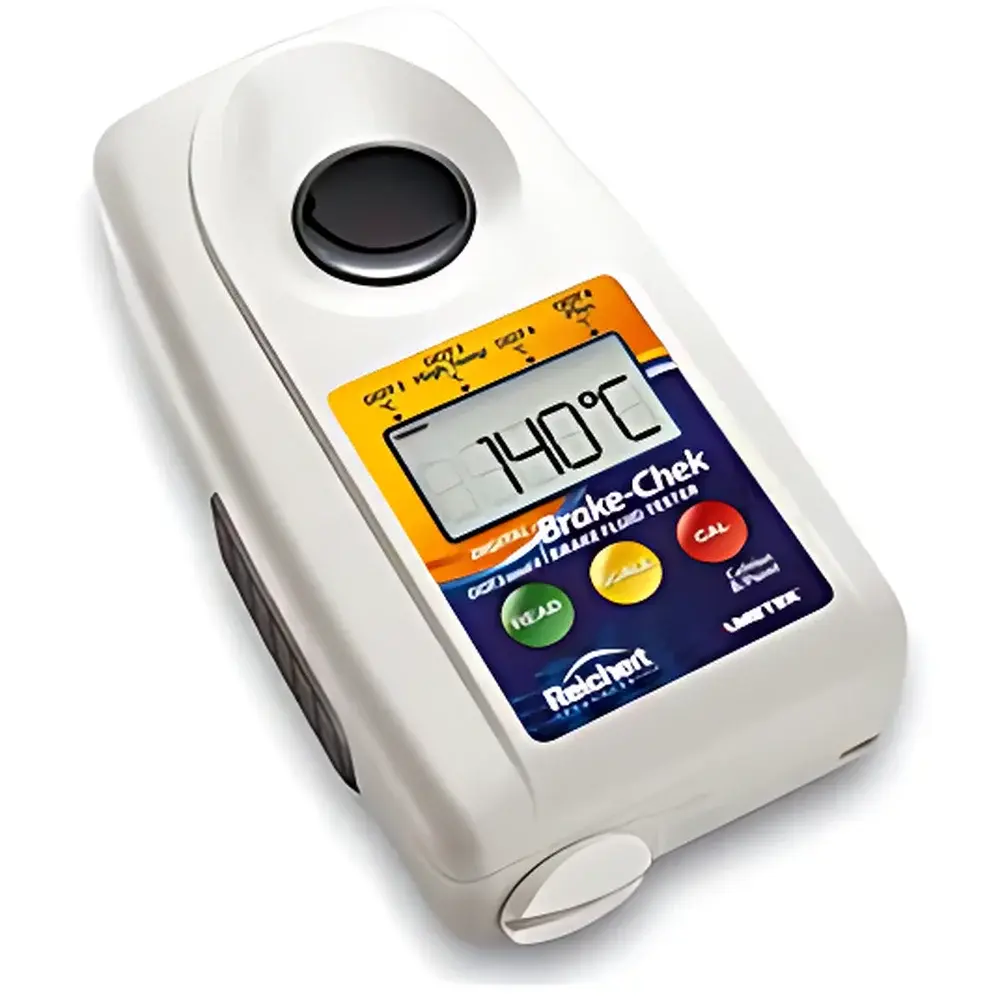
Reichert Brake-Chek Digital Brake Fluid Refractometer
| Brand | Reichert |
|---|---|
| Origin | USA |
| Model | Brake-Chek |
| Type | Handheld Refractometer |
| Temperature Control | Yes (ATC) |
| Digital Display | Yes |
| Measurement Range | 121–260 °C (for DOT3), up to 299 °C (DOT3HT), 125–275 °C (DOT4), 150–275 °C (DOT4 Plus) |
| Accuracy | ±1 °C |
| Light Source | 589 nm LED |
| Dimensions | 54 × 27 × 100 mm |
| Weight | 100 g |
| Power | 2 × AAA batteries (included) |
| Battery Life | ~10,000 measurements |
| Auto-off & Sleep Mode | Yes |
| IP Rating | IP65 |
| Compliance | CE, RoHS, WEEE |
| Warranty | 1 year |
Overview
The Reichert Brake-Chek Digital Brake Fluid Refractometer is a purpose-built handheld optical instrument engineered for rapid, field-deployable assessment of brake fluid degradation via refractive index–based boiling point estimation. Unlike conventional thermometric or chemical test strips, the Brake-Chek leverages the well-established correlation between water contamination in glycol-ether–based brake fluids (DOT3, DOT3HT, DOT4, DOT4 Plus) and their refractive index shift at 589 nm — a wavelength aligned with the sodium D-line standard used in precision refractometry. As moisture ingress lowers the fluid’s dry boiling point, the instrument converts measured refractive index into an equivalent boiling temperature using factory-calibrated polynomial algorithms traceable to NIST-standard reference fluids. This enables technicians to non-invasively screen for >3.0% water content — the industry-recognized threshold at which brake system reliability begins to degrade significantly per SAE J1703 and FMVSS No. 116 specifications.
Key Features
- Digital refractometry with integrated 589 nm LED illumination ensures stable, drift-free optical performance across ambient temperatures from −10 °C to +50 °C.
- Automatic Temperature Compensation (ATC) referenced to 20 °C eliminates manual correction and maintains measurement integrity without external thermostating.
- Compact ergonomic design (54 × 27 × 100 mm; 100 g) with rubberized grip and detachable neck strap supports one-handed operation in confined service bays or roadside inspections.
- IP65-rated enclosure provides dust-tight sealing and protection against low-pressure water jets — suitable for shop-floor and outdoor deployment.
- Intelligent power management delivers ~10,000 measurements per set of AAA batteries, with configurable auto-sleep and hard-power-off modes to prevent inadvertent discharge.
- Compliance with CE, RoHS, and WEEE directives confirms adherence to EU electromagnetic compatibility, hazardous substance restriction, and end-of-life electronics recycling requirements.
Sample Compatibility & Compliance
The Brake-Chek is validated for use with all major glycol-ether–based brake fluids conforming to SAE J1703 and ISO 4925 classifications, including DOT3, DOT3HT, DOT4, and DOT4 Plus formulations. It is not intended for silicone-based (DOT5) or borate-ester–modified fluids (DOT5.1), as their refractive behavior deviates significantly from calibration matrices. Each unit ships with factory documentation supporting traceability to ISO/IEC 17025-accredited calibration procedures. While not a replacement for laboratory-grade boiling point analyzers (e.g., ASTM D1121), the Brake-Chek meets functional verification requirements under ISO 9001:2015 clause 7.1.5 for in-service monitoring equipment used in automotive maintenance quality systems.
Software & Data Management
The Brake-Chek operates as a standalone optical measurement device with no embedded firmware update capability or data export interface. All calculations occur in real time within the onboard microcontroller; results are displayed numerically on the high-contrast LCD and retained only during active measurement. For auditability, users are advised to record readings manually in maintenance logs compliant with IATF 16949 clause 8.5.1.2 or OEM-specific service documentation protocols. The absence of wireless connectivity or cloud synchronization ensures full compliance with internal IT security policies in regulated fleets and dealer networks.
Applications
- Routine preventive maintenance in franchised and independent automotive service centers performing brake system flushes per manufacturer-recommended intervals (typically every 2 years or 40,000 km).
- Pre-delivery inspection (PDI) and post-purchase evaluation in used vehicle certification programs requiring documented brake fluid condition.
- Fleet safety audits where DOT-compliant commercial vehicles must demonstrate adherence to FMCSA Part 393.47 brake system integrity standards.
- Technical training labs for ASE A5 Brake Systems certification, providing students with hands-on exposure to fluid degradation diagnostics aligned with SAE J2657 curriculum guidelines.
- Mobile roadside assistance units requiring portable, battery-powered tools capable of rapid pass/fail triage before hydraulic pressure testing.
FAQ
Does the Brake-Chek measure water content directly?
No — it estimates effective boiling point depression caused by water contamination via refractive index, then infers approximate water concentration using empirically derived correlations for each DOT specification.
Can it be recalibrated in the field?
No — calibration is performed at the Reichert manufacturing facility using certified reference fluids; users perform only zero-point verification with distilled water prior to each work shift.
Is it compatible with DOT5 (silicone) brake fluid?
No — the optical calibration matrix is specific to polyglycol ether chemistries; silicone-based fluids exhibit nonlinear refractive behavior outside the instrument’s validated range.
What does the IP65 rating mean for daily use?
It certifies full protection against dust ingress and resistance to water projected from a 6.3 mm nozzle at 100 kPa for at least 3 minutes — sufficient for washbay environments but not submersion.
How often should verification with distilled water be performed?
Before first use each day, and after any exposure to extreme ambient temperature shifts (>15 °C change) to ensure ATC stability.





