
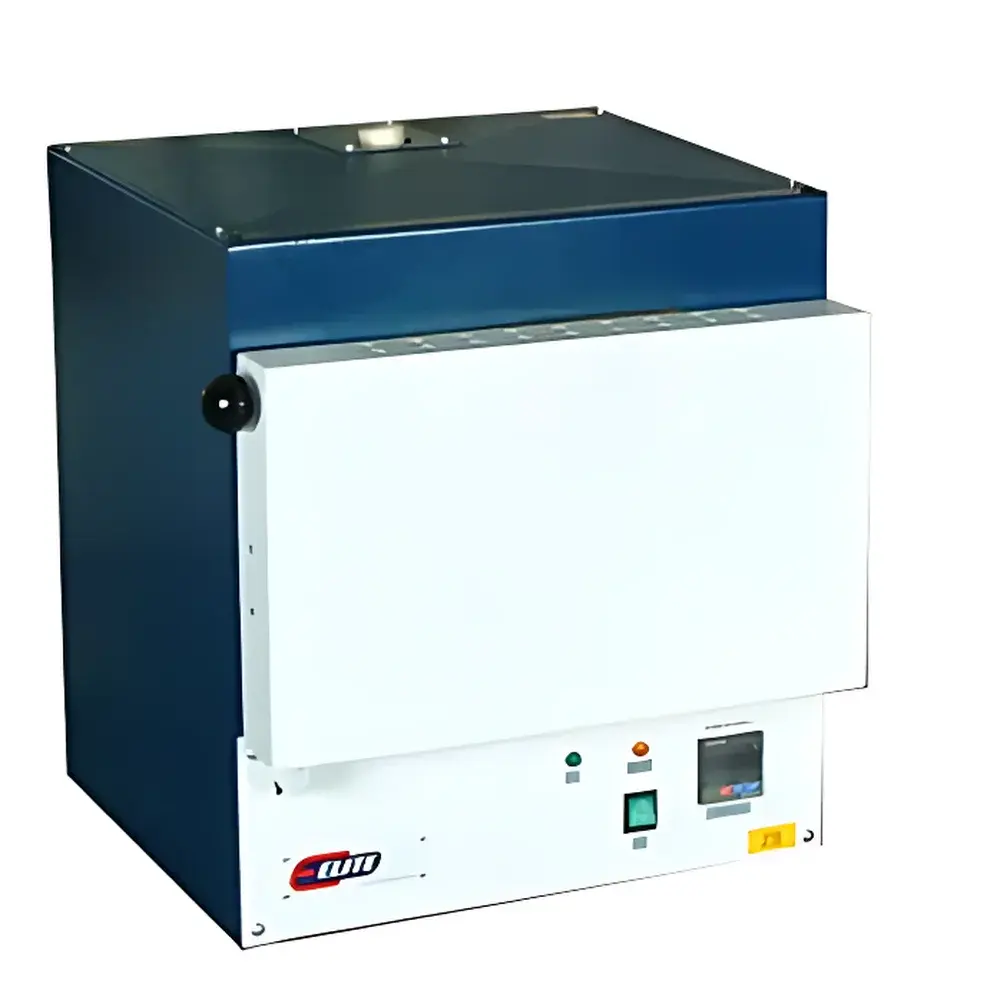
English Product Name
| Origin | UK |
|---|---|
| Type | Box-type Muffle Furnace |
| Max Temperature | 1100 °C |
| Operating Temperature Range | Ambient to 1050 °C (continuous) |
| Temperature Uniformity | ±5 °C at 1050 °C |
| Control Accuracy | ±2 °C |
| Internal Dimensions (W×D×H) | 178 × 305 × 125 mm |
| Chamber Volume | 7 L |
| Max Power | 2 kW |
| Heating Rate to 1100 °C | ≤50 min |
| Heating Element | Kanthal A1 resistance wire embedded in ceramic fiber grooves, dual-sided configuration |
| Insulation | Low-mass ceramic fiber board (density ~128 kg/m³) |
| External Casing | Galvanized steel with polyester powder coating |
| Door Safety | Spring-assisted upward-opening insulated door with automatic power cut-off upon opening |
| Exhaust | Integrated top-mounted flue port |
| Thermocouple | Type N (Nickel-Nickel Molybdenum), calibrated per IEC 60584-2 |
| Electrical Supply | 240 V AC, single-phase, 50/60 Hz |
Overview
The Carbolite Gero BCF Series 1100 °C Benchtop Muffle Furnace is a precision-engineered thermal processing instrument designed for routine and regulated laboratory applications requiring stable, repeatable high-temperature operation up to 1100 °C. Built on Carbolite Gero’s legacy of industrial-grade furnace design, the BCF series employs a dual-sided heating architecture with Kanthal A1 resistance wire embedded within high-purity ceramic fiber insulation—enabling rapid thermal response, minimal energy consumption, and exceptional temperature homogeneity across the working zone. Unlike conventional refractory-lined furnaces, its low-mass ceramic fiber construction reduces thermal inertia, allowing both accelerated ramp rates (≤50 minutes to full 1100 °C) and controlled cooling profiles without external quenching. The furnace operates exclusively in ambient air atmosphere, eliminating the need for gas supply infrastructure while maintaining strict compliance with ISO 9001-certified manufacturing processes and CE marking under the EU Machinery Directive 2006/42/EC and Electromagnetic Compatibility Directive 2014/30/EU.
Key Features
- Dual-sided heating system with ceramic fiber–embedded Kanthal A1 heating elements ensures uniform axial and radial temperature distribution (±5 °C at 1050 °C, per ASTM E220 calibration methodology)
- Low-density ceramic fiber insulation (128 kg/m³) minimizes heat storage, enabling rapid cool-down and reducing standby energy loss by >40% compared to brick-lined alternatives
- Upward-swinging insulated door with mechanical safety interlock: automatically de-energizes all heating circuits upon door actuation, meeting EN 61000-6-2 immunity requirements for operator protection
- Robust galvanized steel chassis with UV-stable polyester powder coating resists corrosion in humid or saline lab environments
- Integrated flue port accommodates standard 50 mm ducting for fume extraction during ashing, calcination, or volatile residue removal
- Type N thermocouple (IEC 60584-2 compliant) mounted in fixed central location provides traceable, NIST-traceable temperature feedback with long-term drift <0.5 °C/year
Sample Compatibility & Compliance
The BCF11/7 model supports crucibles, boats, and ceramic setters up to Ø100 mm × 80 mm height, accommodating standard ASTM E178-22 and ISO 5660-1 sample geometries. Its air-atmosphere operation is suitable for ash content determination (AOAC 923.03, ISO 2171), loss-on-ignition (LOI) analysis (ASTM D7348), and pre-treatment of catalyst supports prior to BET surface area measurement. All electrical and thermal safety systems conform to UL 61010-1:2012 and IEC 61010-1:2010 standards. The furnace’s structural integrity has been validated for continuous operation at 1050 °C per IEC 60068-2-2 (heat test), and its thermal management satisfies FDA 21 CFR Part 11 data integrity prerequisites when paired with optional Cal 9500 programmable controller (audit trail, user authentication, electronic signature support).
Software & Data Management
While the base unit operates with analog/digital front-panel controls, multiple programmable controller options enable GLP/GMP-aligned process documentation. The Cal 9500 controller (optional) delivers 20 stored programs, 16-segment ramp/soak profiles, real-time temperature logging at 1-second intervals, and CSV export via USB. All controllers feature PID algorithm tuning (auto/manual), deviation alarms, and configurable hold-to-stabilize logic. Data files include timestamped setpoints, actual temperatures, power output %, and event logs (door open/close, alarm triggers)—fully compatible with LIMS integration via Modbus RTU over RS485. Firmware updates are performed via secure authenticated firmware upload, satisfying IEC 62443-3-3 SL2 cybersecurity requirements.
Applications
- Quantitative ash analysis in food, feed, and pharmaceutical raw materials (USP , Ph. Eur. 2.2.34)
- Thermal gravimetric pre-conditioning of geological samples prior to XRF or ICP-MS digestion
- Heat treatment of metallurgical reference standards (e.g., certified alloy powders per ISO/IEC 17025)
- Pre-firing of ceramic substrates used in sensor development and microelectronics packaging
- Residue incineration in environmental testing labs conducting EPA Method 1631E (mercury in water)
- Calibration verification of thermocouples and RTDs using fixed-point metal baths (Zn, Al, Ag)
FAQ
What is the maximum continuous operating temperature?
The furnace is rated for continuous operation at 1050 °C; 1100 °C is the absolute upper limit for short-duration (<30 min) qualification runs.
Can this furnace be used under inert gas?
No—the BCF series is configured exclusively for air-atmosphere operation. For inert or reducing atmospheres, consider Carbolite Gero’s HTF or GLO series with gas-tight seals and purge ports.
Is third-party calibration certification included?
Factory calibration is performed per ISO/IEC 17025-accredited procedures; a UKAS-traceable certificate (with uncertainty budget) is available as an optional add-on at time of order.
How is temperature uniformity verified?
Uniformity mapping is conducted per ASTM E220 Annex A3 using nine-point thermocouple array; report includes spatial deviation contours at 500 °C, 800 °C, and 1050 °C.
What maintenance is required?
Annual inspection of heating element continuity, thermocouple calibration, door gasket integrity, and flue clearance—documented in accordance with ISO 17025 clause 6.4.3.



