
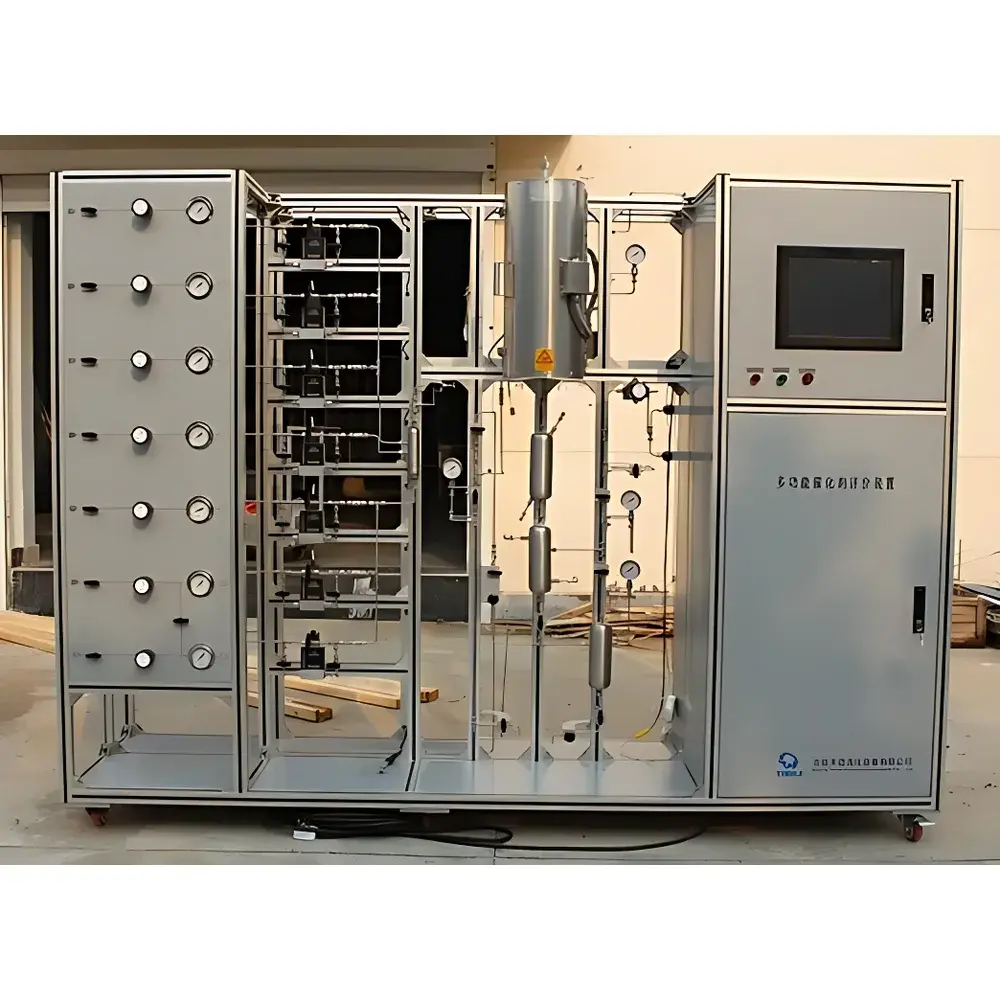
Henven HJD-12 Multifunctional Catalyst Evaluation System
| Brand | Henven |
|---|---|
| Origin | Beijing, China |
| Manufacturer Type | Direct Manufacturer |
| Region | Domestic (China) |
| Model | HJD-12 |
| Price Range | USD 14,000 – 70,000 |
| Reactor Temperature Range | 500–1000 °C |
| Linear Ramp Rate | 0.1–40 °C/min |
| Isothermal Stability | ±0.1 °C |
| Reactor Pressure Range | 0.1–3 MPa |
| Gas Flow Range | 0–300 mL/min |
| Gas Flow Accuracy | ±0.1% FS |
| Liquid Flow Range | 0–25 mL/min |
| Liquid Flow Precision | ±0.01 mL/min |
| Catalyst Loading Capacity | 0–15 mL (customizable) |
Overview
The Henven HJD-12 Multifunctional Catalyst Evaluation System is an integrated, high-fidelity laboratory-scale catalytic testing platform engineered for rigorous kinetic studies, stability assessment, and process parameter optimization under industrially relevant conditions. It operates on the principle of fixed-bed or fluidized-bed catalytic reaction monitoring—supporting both continuous-flow and transient-state operation modes—with full thermal, pressure, and compositional control. Designed specifically for petroleum refining, petrochemical R&D, and heterogeneous catalysis laboratories, the system accommodates aggressive feedstocks including anhydrous hydrogen fluoride (HF), requiring specialized corrosion-resistant construction (e.g., Hastelloy C-276-lined reactors, fluoropolymer-sealed valves, and PFA-coated sensors). Its architecture complies with fundamental safety and operational requirements outlined in API RP 941 (Hydrogen-Related Damage), ISO 15156 (Materials for use in H₂S-containing environments), and ASME B31.3 Process Piping Code—ensuring suitability for high-temperature, high-pressure, and chemically hazardous service.
Key Features
- Corrosion-resistant reactor assembly rated for HF, HCl, H₂S, and other halogenated feeds—constructed with dual-layer alloy cladding and inert surface passivation.
- Modular temperature control system enabling segmented linear ramping (0.1–40 °C/min) and ultra-stable isothermal operation (±0.1 °C over ≥24 h) across up to four independently controlled heating zones.
- Integrated fluidized-bed control module (Renmai™ FBC v2.1) with real-time feedback loops for bed density, differential pressure, and minimum fluidization velocity—enabling automated transition between bubbling, turbulent, and fast-fluidization regimes.
- Redundant sensor network: RTD-based temperature monitoring at inlet, catalyst bed center, outlet, and jacket; piezoresistive pressure transducers with 0.05% FS accuracy; mass flow controllers traceable to NIST standards.
- Self-diagnostic fault management system performing continuous validation of critical interlocks—including over-temperature cutoff (T > 1050 °C), over-pressure vent activation (P > 3.3 MPa), and flow deviation alarms (ΔF > 2% FS for >30 s).
- Industrial-grade stainless steel frame (AISI 316L) with IP54-rated control panel, ESD-safe grounding, and CE-compliant electrical architecture (EN 61000-6-4, EN 61000-6-2).
Sample Compatibility & Compliance
The HJD-12 supports solid catalysts in powder, extrudate, pellet, or monolith formats (0.1–5 mm particle size), as well as liquid-phase co-catalysts and volatile organic/inorganic precursors. It meets ASTM D2274 (Oxidation Stability of Gasoline), ASTM D525 (Oxidation Stability of Gasoline by Oxygen Bomb), and ISO 7536 (Stability Testing of Hydrocarbon Fuels) methodologies when configured with optional oxidation modules. All wetted materials conform to NACE MR0175/ISO 15156 for sour service. The system’s mechanical design adheres to PED 2014/68/EU (Pressure Equipment Directive), and its data acquisition firmware supports ALCOA+ principles (Attributable, Legible, Contemporaneous, Original, Accurate, Complete, Consistent, Enduring, Available) for GLP/GMP-regulated environments.
Software & Data Management
The embedded Linux-based HMI features a 10.1″ capacitive touchscreen interface with multi-user role permissions (Operator, Engineer, Administrator). Real-time process visualization includes dynamic P&ID overlays, trend plots with adjustable time bases (1 s to 72 h), and automatic event logging (start/stop, setpoint changes, alarm triggers). Data export is supported in CSV, HDF5, and ASTM E1461-compliant XML formats. Optional software add-ons include: (i) Catalyst Deactivation Kinetics Module (CDKM) for time-on-stream activity modeling; (ii) Digital Twin Interface for OPC UA integration with DeltaV, Emerson DCS, or Siemens PCS7; and (iii) 21 CFR Part 11 compliance pack with electronic signatures, audit trails, and immutable record retention.
Applications
- Hydroprocessing catalyst screening (HDS, HDN, HDA) under simulated refinery conditions (T = 300–400 °C, P = 3–13 MPa, H₂ partial pressure ≥5 MPa).
- Fluid catalytic cracking (FCC) catalyst regeneration kinetics and coke burn-off profiling.
- Acid-catalyzed alkylation and isomerization studies using HF or AlCl₃-derived feed systems.
- Oxidation stability evaluation of jet fuels (JP-8, Jet A-1), diesel, and bio-blends per ASTM D2274 and D7545.
- Deactivation mechanism analysis via TPO/TPD, pulse chemisorption (CO, NH₃, O₂), and in situ XRD/XANES coupling ports.
- Process intensification studies for microchannel reactors and structured catalysts.
FAQ
Can the HJD-12 be used for hydrogen fluoride (HF)-mediated alkylation studies?
Yes—the reactor train, valves, and sensors are constructed with HF-compatible alloys and fluoropolymer linings, validated per ASTM D1693 for environmental stress cracking resistance.
Does the system support automated catalyst sulfiding protocols?
Yes—integrated H₂S generation and dosing module (optional) enables programmed sulfidation ramps (e.g., 2 °C/min to 320 °C under 10% H₂S/H₂), with real-time H₂S concentration monitoring via electrochemical sensor.
Is remote monitoring and control possible?
Yes—Ethernet/WiFi-enabled communication supports Modbus TCP and MQTT protocols; secure web-based SCADA access is available via optional CloudLink Gateway.
What calibration standards are supplied with the system?
NIST-traceable temperature verification blocks (−10 °C to 1000 °C), certified gas mixtures (5% H₂ in N₂, 1% O₂ in N₂), and gravimetric liquid standard (n-decane, purity ≥99.99%) are included in the commissioning kit.
Can the fluidized-bed configuration be retrofitted to an existing fixed-bed unit?
No—fluidized-bed operation requires dedicated reactor geometry, distributor plate design, cyclone separation, and expanded instrumentation; it is only available as a factory-configured option at time of order.






