
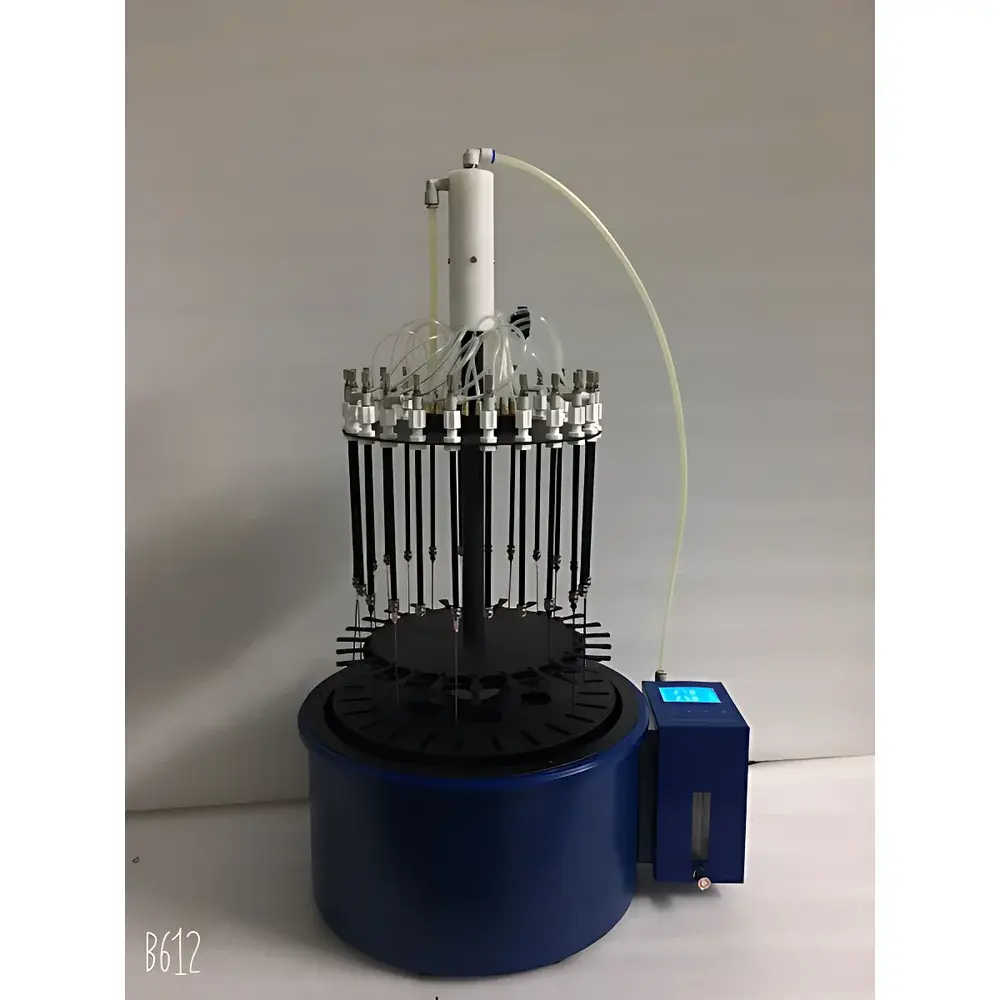
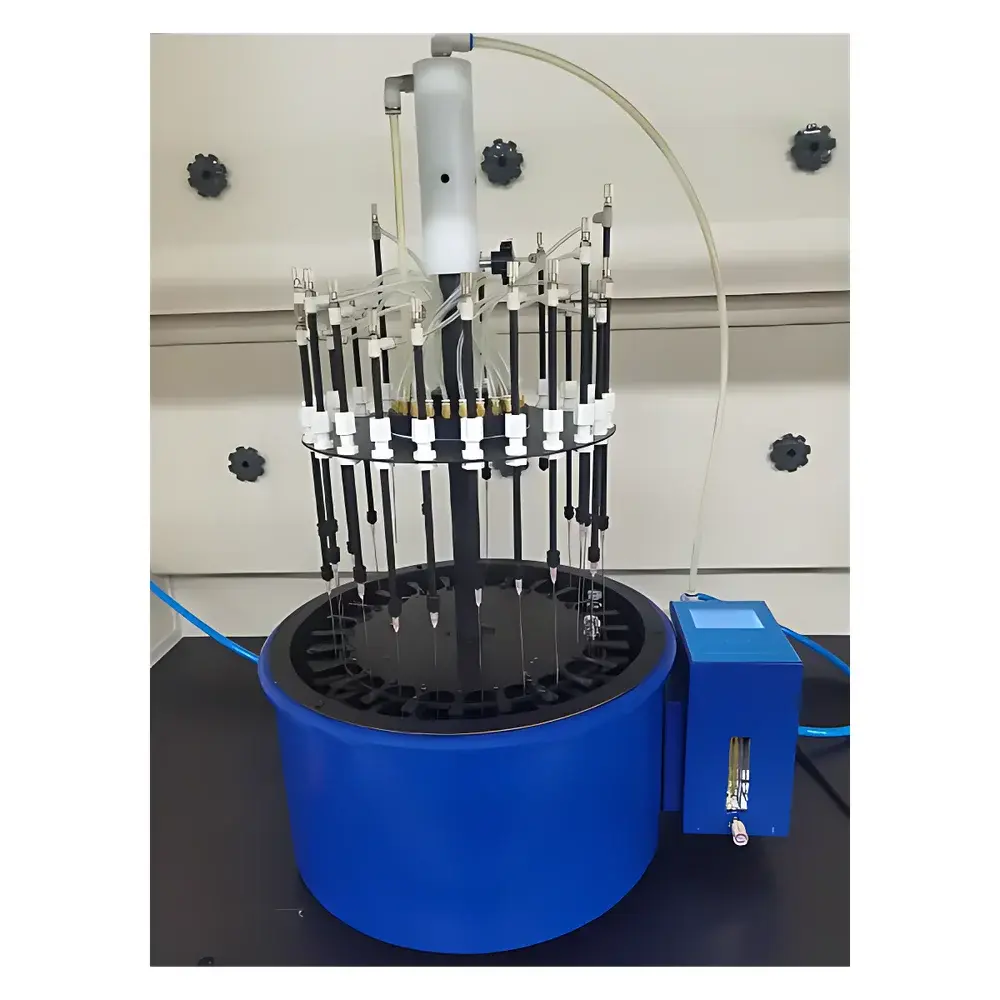
Chengmeng CM-36T Corrosion-Resistant Water Bath Nitrogen Evaporator
| Brand | Chengmeng Technology |
|---|---|
| Origin | Beijing, China |
| Model | CM-36T |
| Heating Method | Water Bath |
| Temperature Range | Ambient to 99 °C |
| Temperature Stability | ±0.5 °C |
| Sample Capacity | 36 positions |
| Tube Diameter Compatibility | 10–29 mm (OD), 10–30 mm (ID) |
| Gas Flow Rate | 0–15 L/min |
| Heating Power | 1000 W |
| Timer Range | 0–9999 min |
| Gas Pressure Range | 0.2 MPa |
| Internal Bath Dimensions | Φ400 × 200 mm |
| External Dimensions | 420 × 420 × 850 mm |
| Construction Material | PTFE-coated stainless steel and corrosion-resistant polymers |
Overview
The Chengmeng CM-36T Corrosion-Resistant Water Bath Nitrogen Evaporator is an engineered solution for controlled, gentle solvent removal from multiple liquid samples under inert or ambient gas atmospheres. It operates on the principle of nitrogen-assisted surface evaporation: regulated streams of nitrogen or compressed air are directed via adjustable PTFE-coated needles onto the surface of heated samples, accelerating solvent volatilization while minimizing thermal degradation, oxidation, or cross-contamination. Unlike dry-block evaporators, the water bath design delivers uniform, low-gradient thermal energy—critical for thermolabile analytes in environmental, pharmaceutical, clinical, and food safety laboratories. The system integrates precise PID temperature control, independent per-position gas flow regulation, and full PTFE protection across all wetted and structural surfaces—making it suitable for applications involving acidic digestates, alkaline extracts, halogenated solvents, and aggressive reagent matrices.
Key Features
- 36-position circular sample platform with full 360° rotation—enables ergonomic front-access operation and eliminates positional bias during evaporation.
- PTFE-coated stainless steel water bath (Φ400 × 200 mm internal volume) and PTFE-lined gas distribution manifold ensure long-term resistance to HCl, HF, HNO3, NaOH, and organic acids commonly used in EPA Method 3050B/3052, ISO 17294-2, and ASTM D5176 digestion workflows.
- Independent height-adjustable PTFE-coated gas needles (4″ × 18 gauge, 120 mm length) for each position—optimized for tube diameters from 10–29 mm OD and volumes of 1–50 mL.
- Dual-gas inlet capability: dedicated ports for nitrogen (for oxygen-sensitive samples) and compressed air (for robust matrices), both regulated by SMC TUS-certified transparent polyurethane tubing meeting USP Class VI biocompatibility standards.
- Individual needle-level flow control via precision brass needle valves and laminar-flow digital gas meters (0–15 L/min total, ≤330 mL/min per position), enabling method reproducibility across validation protocols.
- Intelligent LCD controller with PID algorithm, over-temperature alarm, dry-run protection, and programmable timer (0–9999 min)—supports unattended overnight runs compliant with GLP documentation requirements.
- Modular lift mechanism with ring-type spring support allows seamless vertical translation of the entire sample rack into and out of the bath—reducing operator fatigue and improving workflow continuity in high-throughput labs.
Sample Compatibility & Compliance
The CM-36T accommodates a broad range of container formats including round-bottom test tubes, conical centrifuge tubes (15 mL and 50 mL), culture tubes, and small-volume vials. Its PTFE-coated architecture meets material compatibility requirements outlined in ISO 15190:2020 (laboratory safety) and ASTM D4327 (ion chromatography sample prep). While not certified to IEC 61010-1 for explosion-proof use, the unit complies with general electrical safety standards for laboratory equipment operating below 1000 V AC. For regulated environments, the timer logging function supports audit-ready recordkeeping; however, native 21 CFR Part 11 compliance requires integration with validated LIMS or ELN systems.
Software & Data Management
The CM-36T operates as a standalone instrument without proprietary software dependency. All operational parameters—including setpoint temperature, elapsed time, and manual valve positions—are displayed and retained locally on the LCD interface. No onboard data storage or USB export is provided; users intending to archive run conditions must manually log entries or integrate external environmental monitoring systems (e.g., Vaisala viewLinc or DeltaTrak) via analog 4–20 mA output (optional accessory). This architecture prioritizes reliability and electromagnetic interference (EMI) resilience in shared instrumentation suites.
Applications
- Pre-concentration of trace metals (As, Pb, Cd, Hg) in wastewater per EPA 200.8 and ISO 17294-2 following acid digestion.
- Residue analysis in pesticide multiresidue methods (e.g., QuEChERS AOAC 2007.01), where solvent exchange from acetonitrile to toluene demands inert atmosphere control.
- Pharmaceutical impurity profiling per ICH Q2(R2), particularly for volatile organic impurities requiring low-temperature evaporation prior to GC-MS injection.
- Fatty acid methyl ester (FAME) preparation in biodiesel QC (ASTM D6584), where methanol removal must avoid thermal decomposition of unsaturated esters.
- Forensic toxicology sample prep, including urine drug screening workflows where ammonium hydroxide–based extractions necessitate corrosion-resistant hardware.
FAQ
Is the CM-36T compatible with hydrofluoric acid (HF) digestion solutions?
Yes—the entire fluid path, including bath walls, gas manifolds, needle guides, and support trays, is uniformly coated with industrial-grade PTFE (≥100 µm thickness), validated for intermittent exposure to ≤5% HF at temperatures ≤80 °C.
Can the instrument be calibrated for temperature and flow rate traceability?
Temperature calibration is achievable using NIST-traceable RTD probes inserted into designated bath ports; flow calibration requires external mass flow meters (e.g., Brooks Instrument SLA Series) due to absence of built-in transducers.
What maintenance intervals are recommended for sustained corrosion resistance?
Inspect PTFE coating integrity every 6 months using visual and tactile assessment; replace gas needles annually or after 500 cycles; clean bath chamber with deionized water and mild detergent after each use—never use abrasive pads or chlorine-based cleaners.
Does the unit support remote monitoring or network connectivity?
No native Ethernet, Wi-Fi, or Bluetooth interfaces are included; remote supervision requires third-party IoT sensors interfaced via analog outputs or mechanical relay triggers.
Is the CM-36T suitable for GMP-regulated production environments?
It may be deployed in GMP settings as a non-critical ancillary device when operated within documented SOPs, with periodic performance qualification (PQ) covering temperature uniformity (±0.5 °C across all 36 positions) and gas flow repeatability (RSD ≤3% over 10 consecutive runs).
Related Products



