
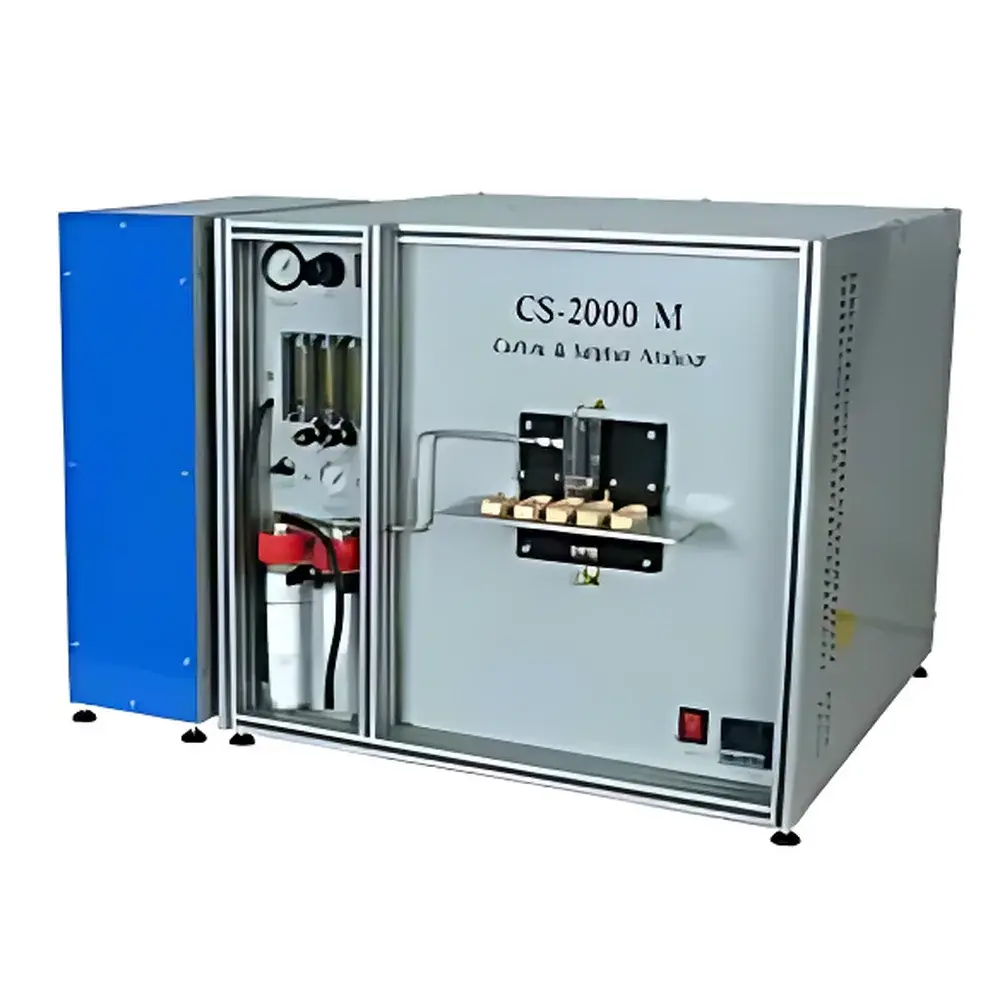
CS2000M Carbon-Sulfur Analyzer (Imported, Non-Dispersive Infrared Method)
| Origin | Imported |
|---|---|
| Manufacturer Type | Authorized Distributor |
| Detection Principle | Non-Dispersive Infrared (NDIR) |
| Model | CS2000M |
| Measurement Range | C: 0–100%, S: 0–100% |
| Accuracy | ±1% of measured content |
| Analysis Time | 90 s (typical) |
| Sample Mass | 300–500 mg |
| Combustion Temperature | Ambient to 1400 °C |
| Oxygen Purity | >99.5%, Pressure: 40 PSI |
| Gas Flow Rate | 3.0 L/min |
| Reagent | Magnesium Perchlorate |
| Interface | 4 RS-232 ports for analytical balance integration |
Overview
The CS2000M Carbon-Sulfur Analyzer is a precision laboratory instrument engineered for quantitative determination of total carbon (C) and total sulfur (S) in solid heterogeneous samples using high-temperature resistive combustion coupled with non-dispersive infrared (NDIR) detection. Designed specifically for routine quality control and compositional analysis in coal, coke, cement, petrochemical, mineralogical, agricultural, and environmental laboratories, the system operates on the principle of complete oxidation—where sample material is combusted quantitatively in a controlled oxygen-rich environment at temperatures up to 1400 °C. The resulting CO₂ and SO₂ gases are swept through dedicated NDIR optical cells, each tuned to absorbance bands specific to carbon dioxide (4.26 µm) and sulfur dioxide (7.35 µm). Three independent infrared detectors ensure full dynamic range coverage across trace-level (ppm) to major-element (wt%) concentrations without manual detector switching.
Key Features
- Resistive-heating combustion furnace with silicon carbide heating elements and PID-controlled thermal regulation for stable, reproducible combustion profiles.
- Modular single-chamber combustion tube design—fully accessible for maintenance, cleaning, or ceramic liner replacement without tools or calibration disruption.
- Integrated 7-position removable sample carousel enabling sequential manual loading; combustion boats are mechanically aligned to minimize operator exposure to hot surfaces.
- Triple NDIR cell configuration with automatic SO₂ cell selection logic, eliminating manual range switching and reducing measurement uncertainty.
- Dedicated gas handling architecture featuring low-dead-volume flow paths, optimized scrubbing (Mg(ClO₄)₂ desiccant), and minimal clogging risk via laminar-flow manifold design.
- Multi-point calibration capability across the full 0–100% range for both C and S, supporting certified reference materials (CRMs) traceable to NIST or ISO-certified standards.
- Robust electrical and thermal isolation between furnace, detector, and electronics modules to ensure long-term signal stability and inter-run reproducibility.
Sample Compatibility & Compliance
The CS2000M accommodates diverse solid matrices including bituminous and anthracite coals, metallurgical coke, limestone-based cements, catalytic supports (e.g., alumina, zeolites), geological ores, soil digests, and dried botanical tissues. Sample preparation follows ASTM D3176 (Standard Practice for Ultimate Analysis of Coal and Coke) and ISO 1171 (Solid Mineral Fuels — Determination of Ash). The system meets functional requirements for GLP-compliant environments: audit-trail-enabled software logs all method parameters, calibration events, user actions, and raw detector outputs. While not pre-certified for FDA 21 CFR Part 11, its data export structure (CSV, XML) and user-access controls support validation under internal SOPs aligned with ISO/IEC 17025 and USP .
Software & Data Management
Controlled via a standalone Windows PC (Windows 2000/XP compatible), the CS2000M’s native software provides menu-driven operation with context-sensitive help, real-time spectral monitoring, and embedded diagnostic routines for gas flow, detector voltage, and furnace thermocouple integrity. Statistical functions include batch averaging, RSD calculation, drift correction, and linear/non-linear calibration curve fitting with residual analysis. All raw absorbance values, peak integrals, and calculated concentrations are timestamped and stored in a structured local database. Export options include ASCII, Excel-compatible CSV, and XML for LIMS integration. Comprehensive printed documentation includes operational manuals, safety protocols, and step-by-step troubleshooting guides.
Applications
Primary use cases include coal rank assessment (ASTM D388), sulfur specification verification per ASTM D3177 for compliance with EPA Clean Air Act thresholds, catalyst sulfur poisoning studies, cement clinker quality assurance (ISO 29581-1), and geochemical sulfur cycling research in sediment cores. In environmental labs, it supports regulatory reporting for total organic carbon (TOC) equivalents in soils (EPA Method 9060A adaptation) and sulfur mass balance in fly ash characterization. Its wide dynamic range eliminates need for dilution or secondary methods when analyzing high-sulfur coals (>4 wt%) or ultra-low-sulfur petroleum coke (<0.1 wt%).
FAQ
What combustion temperature range does the CS2000M support?
The resistive furnace operates from ambient temperature up to 1400 °C, programmable in 1 °C increments, with thermal ramp rates configurable per method.
Is the instrument compliant with ASTM or ISO standards for carbon-sulfur analysis?
Yes—the hardware and methodology align with ASTM D3176, D3177, D4294, and ISO 1171, ISO 4390, and ISO 15557 for solid fuel and mineral analysis.
Can the system be integrated into an existing LIMS?
Yes—via standardized CSV/XML exports and optional OPC-UA or TCP/IP middleware; no proprietary drivers required.
What maintenance intervals are recommended for the combustion tube and IR cells?
Ceramic combustion liners should be inspected every 500 analyses and replaced as needed; NDIR cells require annual verification using certified gas standards.
Does the analyzer support automated weighing integration?
Yes—four RS-232 ports allow simultaneous connection to analytical balances (e.g., 0.1 mg resolution), with auto-import of sample mass into analysis records.







