
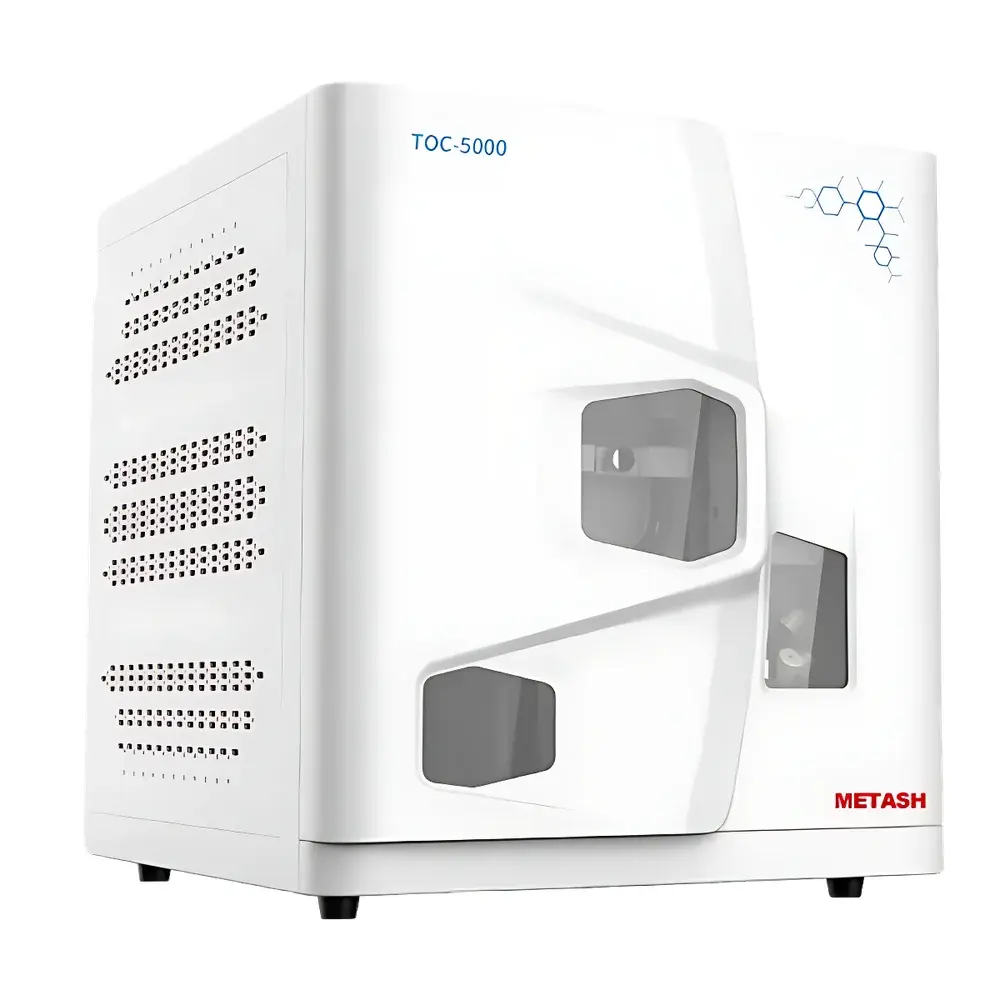
Metash TOC-5000 RD Total Organic Carbon Analyzer
| Brand | Metash Instruments |
|---|---|
| Origin | Shanghai, China |
| Manufacturer Type | Direct Manufacturer |
| Instrument Type | Laboratory TOC Analyzer |
| Model | TOC-5000 RD |
| Detection Principle | Non-Dispersive Infrared (NDIR) Absorption |
| Oxidation Method | High-Temperature Catalytic Combustion |
| Measurement Range | 0–1000 mg/L (expandable to 100,000 mg/L) |
| Accuracy | ≤5% |
| Resolution | 0.01 ppb |
| Detection Limits | TC: 50 µg/L |
| IC | 20 µg/L |
| Repeatability | ≤3% |
Overview
The Metash TOC-5000 RD is a high-performance laboratory total organic carbon (TOC) analyzer engineered for precise, trace-level quantification of organic carbon in aqueous matrices—including drinking water, wastewater, pharmaceutical process water, and ultrapure water used in semiconductor manufacturing. It operates on the principle of high-temperature catalytic combustion oxidation followed by non-dispersive infrared (NDIR) detection of evolved CO₂. This dual-stage methodology ensures complete mineralization of refractory and volatile organic compounds, delivering robust TC (Total Carbon), IC (Inorganic Carbon), and TOC (TC − IC) measurements with high recovery rates (>98% for standard sucrose and benzoic acid reference materials). The system is designed for compliance with international regulatory frameworks including US EPA Method 415.3, ASTM D7573, ISO 8245, and pharmacopeial standards (USP , EP 2.2.44), supporting validated environmental monitoring and quality control workflows.
Key Features
- Triple-stage dehydration system: Integrates an electronic cooling condenser, rapid-replacement hydrophobic membrane filter, and imported molecular sieve dryer to selectively remove water vapor without CO₂ loss—critical for maintaining NDIR signal stability and minimizing baseline drift.
- Optimized NDIR detection module: Features a thermally stabilized IR source, highly polished gold-coated gas cell, and temperature-compensated detector assembly to ensure long-term photometric accuracy across ambient fluctuations (15–35 °C).
- Dynamic high-temperature catalytic oxidation: Operates at 680–900 °C with dual-catalyst options (Pt/Al₂O₃ and CeO₂-based) to accommodate high-salinity or matrix-challenging samples while preserving catalyst lifetime through programmable dilution and acid dosing.
- Automated fluidic architecture: Utilizes a multi-position rotary valve and precision peristaltic/metering pump system for fully automated sample introduction, acid addition, sparging, dilution (up to 100×), and post-run cleaning—reducing manual intervention and carryover risk.
- Modular intelligent design: Each subsystem (oxidation furnace, NDIR cell, fluidics, electronics) incorporates embedded diagnostics and status reporting, enabling real-time fault isolation and predictive maintenance planning.
Sample Compatibility & Compliance
The TOC-5000 RD accepts liquid samples directly (aqueous solutions, extracts, eluates) and supports optional solid-sample introduction via acid digestion modules. It meets stringent requirements for regulated environments: its software implements full FDA 21 CFR Part 11 compliance—including role-based user authentication, electronic signatures, immutable audit trails, and operation/event logging with timestamped metadata. Instrument qualification documentation aligns with IQ/OQ/PQ protocols per GMP and GLP guidelines. All hardware components are CE-marked and conform to IEC 61010-1 safety standards for laboratory equipment.
Software & Data Management
The proprietary Metash TOC Control Suite provides integrated instrument control, method development, data acquisition, and report generation within a SQL Server–backed relational database. The interface supports customizable validation templates, automatic calibration curve generation (linear/logarithmic), and QC flagging based on user-defined acceptance criteria (e.g., %RSD, recovery %). Audit logs record all critical actions—including parameter changes, calibration events, and result modifications—with tamper-proof digital signatures. Real-time monitoring displays live status of furnace temperature, gas flow rates, detector voltage, and reagent levels; alerts trigger automatically upon deviation from preset thresholds (e.g., waste bottle fill level >90%, diluent depletion).
Applications
- Regulatory compliance testing for municipal and industrial wastewater discharge (EPA NPDES, EU WFD)
- Pharmaceutical water system validation (PW, WFI, Pure Steam condensate) per USP/EP/JP
- Environmental fate studies and biodegradability assessment (OECD 301 series)
- Monitoring of semiconductor ultrapure water (UPW) resistivity and TOC excursions
- Research applications requiring speciation of TC, IC, TOC, and NPOC (Non-Purgeable Organic Carbon)
FAQ
What oxidation method does the TOC-5000 RD use, and why is it preferred for complex matrices?
It employs high-temperature catalytic combustion (680–900 °C) with optional dual-catalyst configurations—enabling complete oxidation of recalcitrant organics and tolerance to chloride concentrations up to 25 g/L.
How does the triple-stage dehydration improve NDIR measurement fidelity?
By removing water vapor before CO₂ detection without adsorbing CO₂, it eliminates spectral interference and thermal noise, ensuring stable baseline and sub-ppb resolution over extended run times.
Is the system compliant with FDA 21 CFR Part 11 for electronic records?
Yes—the software enforces ALCOA+ principles (Attributable, Legible, Contemporaneous, Original, Accurate) with full audit trail, electronic signature enforcement, and secure role-based access control.
Can the instrument measure both TOC and IC in a single run?
Yes. The automated acidification/sparging sequence quantifies IC first; subsequent combustion yields TC, allowing TOC calculation in one uninterrupted analysis cycle.
What maintenance intervals are recommended for the catalytic oxidizer and NDIR cell?
Catalyst replacement is typically required every 6–12 months depending on sample load and salinity; NDIR optical components require annual verification but no routine cleaning due to sealed, inert gas-purged cell design.
Related Products







