
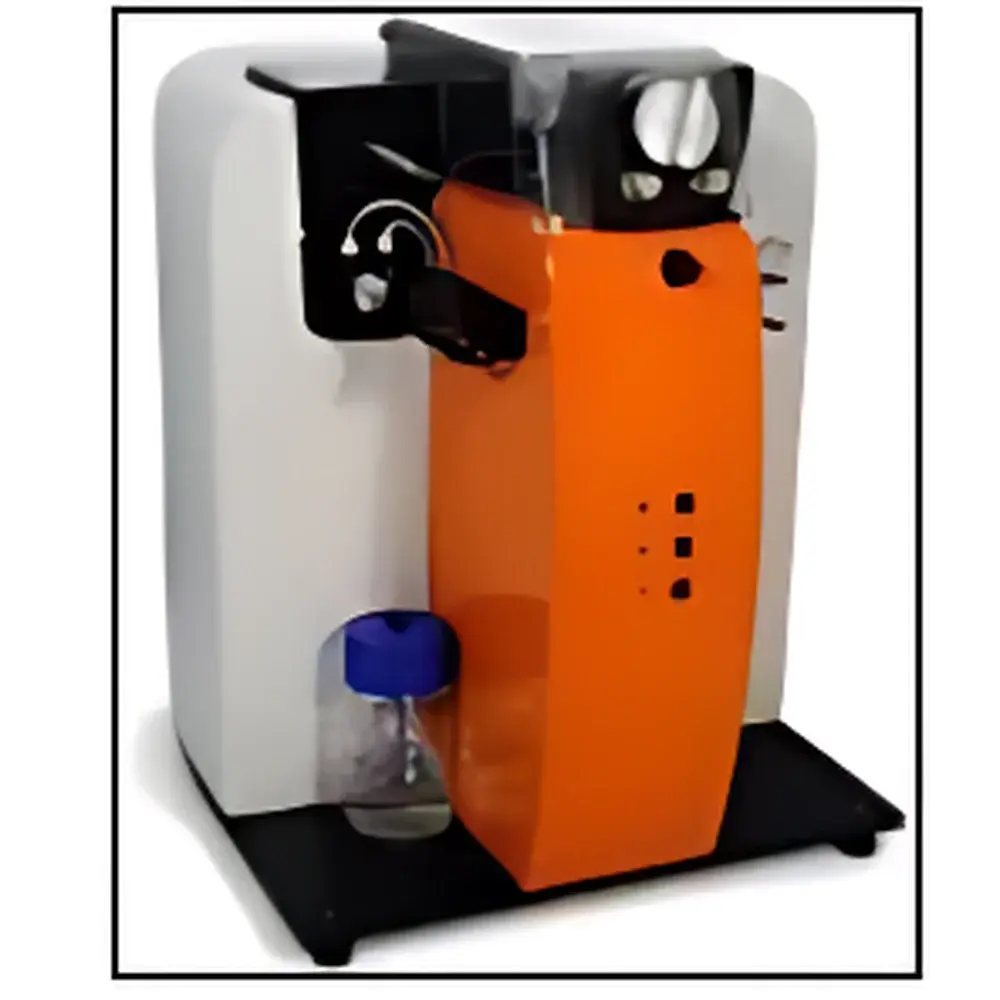
KSV SPR-NAVI Surface Plasmon Resonance Analyzer
| Brand | KSV |
|---|---|
| Origin | Finland |
| Model | SPR-NAVI |
| Measurement Principle | Angular-interrogation SPR with rotating laser |
| Wavelength | 670 nm (optional alternate wavelengths available) |
| Angular Resolution | 0.005° |
| Refractive Index (RI) Range | 1.00–1.45 |
| SPR Angle Range | 40–80° |
| Detection Limit | ΔRI = 3 × 10⁻⁶ (equivalent to ~3 pg/mm² for protein adsorption) |
| Flow Cell Volume | 1 µL |
| Sample Volume per Injection | ≥20 µL |
| Temperature Control Range | 8–40 °C (0.5 °C increments) |
| Fluid Handling | Dual-channel, manual 12-port syringe injector |
| Pump | Dual-channel conductive, software-controlled |
| Dimensions (H×W×D) | 38 × 32 × 31 cm |
| Weight | 10 kg |
| Power Supply | 150 W, 100/240 V AC, 50/60 Hz |
| Interface | USB 2.0, Windows OS compatible |
Overview
The KSV SPR-NAVI Surface Plasmon Resonance Analyzer is a benchtop, angular-interrogation SPR instrument engineered for real-time, label-free quantification of molecular interactions at solid–liquid interfaces. It operates on the physical principle of surface plasmon resonance—where incident p-polarized light, coupled via a prism to a thin gold film, induces collective oscillations of conduction electrons at the metal–dielectric interface. A shift in the resonance angle (θSPR) occurs proportionally to changes in local refractive index induced by biomolecular binding, adsorption, or conformational rearrangement. Designed in collaboration with Dr. Ulf Jonsson (co-founder and former CEO of Biacore AB) and Dr. Janusz Sadowski (20-year veteran in SPR instrumentation at VTT Technical Research Centre of Finland), the SPR-NAVI delivers laboratory-grade kinetic and thermodynamic data—association rate (kon), dissociation rate (koff), equilibrium dissociation constant (KD), and surface mass density—without fluorescent or enzymatic labeling. Its modular architecture supports both academic discovery workflows and early-stage biopharmaceutical development under GLP-aligned experimental conditions.
Key Features
- High-precision angular interrogation system with rotating laser and 0.005° angular resolution, enabling detection of refractive index changes as low as 3 × 10⁻⁶ RIU (~3 pg/mm² for immobilized proteins)
- Dual-channel fluidic path with independent syringe-driven injection, supporting reference-subtracted measurements to minimize bulk RI drift and nonspecific signal artifacts
- Thermally stabilized sample zone encompassing flow cell and sample loop, controllable from 8–40 °C in 0.5 °C increments for reproducible temperature-dependent binding studies
- Modular optical design accommodating up to four user-selectable laser wavelengths (standard: 670 nm; optional wavelengths available upon request)
- Compact footprint (38 × 32 × 31 cm) and lightweight (10 kg) construction optimized for shared core facilities and mobile lab deployment
- Interchangeable SPR sensor chips (12 × 20 mm gold-coated slides) with standardized mounting, compatible with ultrasonic cleaning in common organic solvents and aqueous media
Sample Compatibility & Compliance
The SPR-NAVI accommodates a broad range of analytes and surface chemistries, including native and recombinant proteins, peptides, antibodies, nucleic acids (DNA, RNA, aptamers), carbohydrates, small-molecule ligands, liposomes, and synthetic polymers. It supports standard self-assembled monolayer (SAM) chemistries—including thiol-based, electroactive, and photo-switchable variants—as well as custom surface modifications (e.g., carboxymethyl dextran, Ni-NTA, streptavidin, neutravidin). The system is compatible with industry-standard biosensor chip formats and enables in situ functionalization using optional dip-coating accessories. While not certified for GMP manufacturing environments, its software architecture supports audit-trail-enabled operation consistent with GLP documentation requirements. Data output conforms to FAIR principles (Findable, Accessible, Interoperable, Reusable), and raw angular/time-series datasets are exportable in ASCII-compatible formats for third-party kinetic modeling (e.g., Scrubber, KinExA, or custom Python/Matlab routines).
Software & Data Management
Controlled via Windows-native software with intuitive graphical interface, the SPR-NAVI software provides synchronized acquisition of angular shift vs. time, real-time sensorgram visualization, and automated baseline correction. It supports multi-cycle kinetics, concentration series analysis, steady-state affinity fitting, and reference channel subtraction. All instrument parameters—including temperature setpoint, injection timing, flow rate (via pump control), and wavelength selection—are programmable and logged with timestamped metadata. Software-generated reports include full experimental logs, parameter configurations, and exportable CSV/TXT files containing raw angular data, derived RU-equivalents, and fitted kinetic constants. No proprietary file locking or vendor-specific viewer is required; all data structures follow open, documented conventions suitable for integration into LIMS or ELN platforms.
Applications
- Real-time characterization of protein–protein, protein–small molecule, antibody–antigen, and nucleic acid–ligand interactions
- Binding kinetics and affinity screening during lead optimization in early drug discovery
- Surface adsorption thermodynamics and conformational stability assessment of engineered biologics
- Functional evaluation of biosensor surfaces, LB films, and molecularly imprinted polymers
- Quantitative analysis of protein fouling, biofilm formation, and surface passivation efficacy
- Electrochemical SPR (EM-SPR) studies enabled by optional electroactive SAMs and bias-controlled flow cells
- Method development for regulatory submissions requiring orthogonal binding data (e.g., supporting ICH Q5E comparability assessments)
FAQ
Is the SPR-NAVI compliant with FDA 21 CFR Part 11?
The instrument itself is not Part 11-certified; however, its software supports user authentication, electronic signatures (via Windows domain login), and immutable audit trails when deployed on validated IT infrastructure.
Can I use my own sensor chips?
Yes—the SPR-NAVI accepts standard 12 × 20 mm gold-coated slides, including custom-fabricated substrates with tailored surface chemistries, provided they meet dimensional and optical coupling specifications.
What is the minimum sample volume required per injection?
The flow cell volume is 1 µL, but effective delivery requires ≥20 µL per injection to ensure complete replacement of the sensing region and avoid carryover.
Does the system support regeneration protocols?
Regeneration is fully supported through programmable buffer switching and manual or automated injection sequences; optimal conditions must be empirically determined per ligand–analyte pair.
Is temperature control applied only to the flow cell?
No—temperature stabilization encompasses the entire fluidic path, including the sample loop and inlet tubing, ensuring minimal thermal gradient-induced artifacts during kinetic runs.






