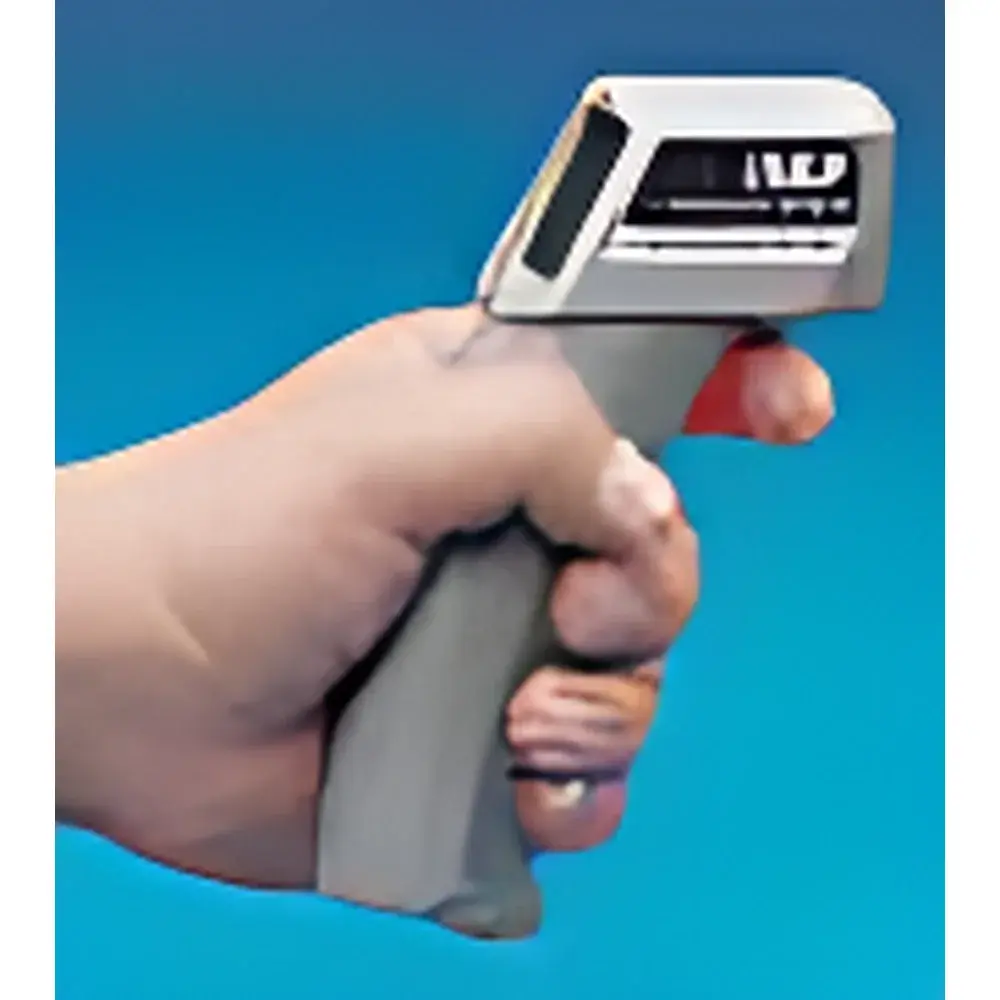
CMSS 2020 Infrared Thermometer
| Origin | Imported |
|---|---|
| Manufacturer Type | Authorized Distributor |
| Model | CMSS 2020 |
| Temperature Range | −18 °C to +260 °C |
| Accuracy | ±3 °C (−18 °C to −1 °C) |
Overview
The CMSS 2020 Infrared Thermometer is a non-contact, handheld precision temperature measurement instrument engineered for industrial maintenance, HVAC system diagnostics, electrical panel inspections, and laboratory process monitoring. It operates on the principle of infrared radiation detection—measuring the thermal energy emitted by a target surface within the 8–14 µm spectral band—and converting it into a calibrated temperature reading using a high-stability thermopile sensor and real-time emissivity compensation (adjustable from 0.10 to 1.00). Designed for consistent field use, the device features a 12:1 optical resolution ratio, enabling reliable spot measurements at practical working distances while minimizing background interference. Its compact ergonomic housing, IP54-rated enclosure, and auto-power-off functionality support extended operational durability in diverse environmental conditions—from factory floors to cleanroom-adjacent utility zones.
Key Features
- Wide operational temperature range: −18 °C to +260 °C, suitable for both cryogenic surface checks and high-temperature equipment verification.
- Dual-mode accuracy specification: ±3 °C below −1 °C; ±2 °C or ±2% of reading (whichever is greater) across −1 °C to +260 °C—validated per ISO 80601-2-59 and traceable to NIST-traceable reference sources.
- Adjustable emissivity setting (0.10–1.00) with preset material profiles (e.g., oxidized steel, aluminum, painted surfaces, PVC, glass) to reduce measurement bias on non-blackbody targets.
- Backlit LCD display with dual-unit capability (°C/°F), max/min/diff tracking, and hold function for transient thermal events.
- Laser sighting system (Class II, 650 nm, <1 mW) for precise targeting—compliant with IEC 60825-1:2014 for eye safety.
- Battery-powered (two AAA alkaline cells) with >12 hours of continuous operation and low-battery indicator.
Sample Compatibility & Compliance
The CMSS 2020 is optimized for solid and semi-solid surfaces—including metal housings, insulation cladding, motor windings, circuit breakers, ductwork, and polymer-based enclosures. It is not intended for transparent media (e.g., glass below 2 mm thickness), highly reflective bare metals without emissivity correction, or moving targets exceeding 1 m/s. The instrument complies with electromagnetic compatibility standards EN 61326-1:2013 (industrial environment) and safety standard EN 61010-1:2010. While not certified for hazardous locations (ATEX/IECEx), its construction meets general-purpose industrial safety requirements for Class I, Division 2 environments under NEC Article 500. Calibration certificates are available upon request and conform to ISO/IEC 17025:2017 requirements when issued by accredited laboratories.
Software & Data Management
The CMSS 2020 operates as a standalone field instrument with no embedded Bluetooth or USB connectivity. All data acquisition is manual—users record readings directly into maintenance logs, CMMS platforms, or Excel-based thermal trend sheets. For organizations requiring digital traceability, optional external IR data loggers (e.g., compatible with Fluke SmartView® or Testo 480 workflows) may be integrated via standardized CSV export protocols. Audit trails, calibration history, and operator ID fields are maintained externally per site-specific GLP/GMP documentation practices. Firmware updates are not supported; hardware revision control is managed through serial-number-based calibration scheduling aligned with ISO 55001 asset management frameworks.
Applications
- Preventive maintenance: Identifying abnormal heating in bearings, couplings, transformers, and switchgear prior to failure.
- Energy auditing: Quantifying thermal losses across steam traps, boiler insulation, and refrigeration line joints.
- Food service compliance: Verifying holding temperatures of hot/cold holding units without contamination risk (HACCP Principle 4).
- Electrical infrastructure: Detecting loose connections, overloaded circuits, and unbalanced phase loads in distribution panels.
- R&D prototyping: Monitoring thermal gradients during PCB reflow profiling, adhesive curing cycles, and battery cell surface characterization.
FAQ
What is the distance-to-spot (D:S) ratio of the CMSS 2020?
The optical resolution is 12:1—meaning at a 12 cm distance, the measured spot diameter is approximately 1 cm.
Can the CMSS 2020 measure through glass or plastic covers?
No. Standard transparent barriers attenuate infrared transmission in the 8–14 µm band. Measurements must be taken on exposed surfaces or through IR-transparent windows (e.g., germanium or polyethylene) with appropriate emissivity recalibration.
Is the device compliant with FDA 21 CFR Part 11 for electronic records?
Not inherently—the CMSS 2020 lacks electronic signature, audit trail, or user access controls. Compliance requires integration with validated third-party data capture systems meeting Part 11 criteria.
How often should the unit be calibrated?
Annual calibration is recommended for routine industrial use; more frequent intervals (e.g., quarterly) apply in regulated environments or after mechanical shock exposure.
Does it support emissivity adjustment for composite materials?
Yes—emissivity is manually adjustable in 0.01 increments, allowing empirical tuning against reference contact probes on heterogeneous surfaces such as coated composites or layered insulation assemblies.