
Defelsko PosiTest AT Pull-Off Adhesion Tester
| Brand | Defelsko |
|---|---|
| Origin | USA |
| Model | PosiTest AT |
| Compliance | ASTM D4541, ISO 4624 |
| Measurement Principle | Hydraulic Pull-Off |
| Accuracy | ±1% of full scale (NIST-traceable) |
| Load Range | 0–3000 psi (0–20 MPa) |
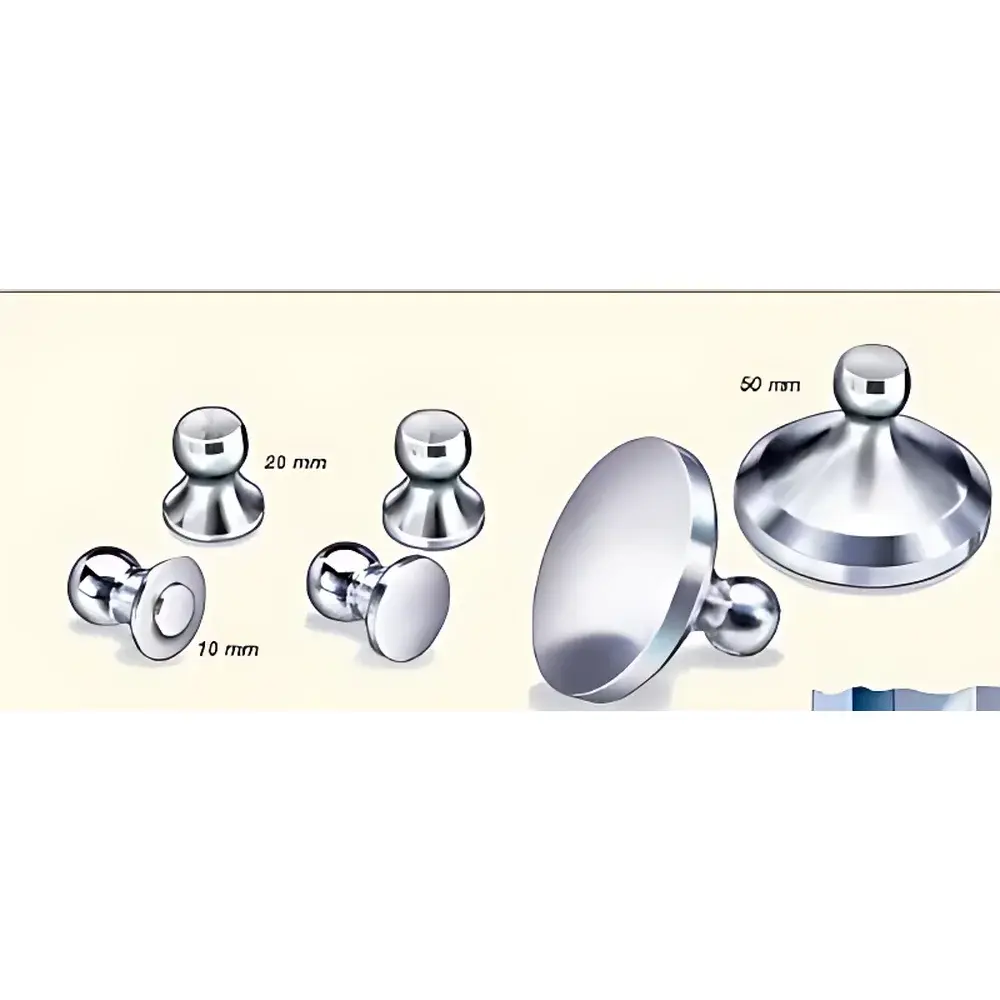
| Probe Sizes | 10 mm, 14 mm, 20 mm, 50 mm |
| Resolution | ±1 psi (±0.01 MPa) for 20 mm probe |
| Self-Centering Base | Yes |
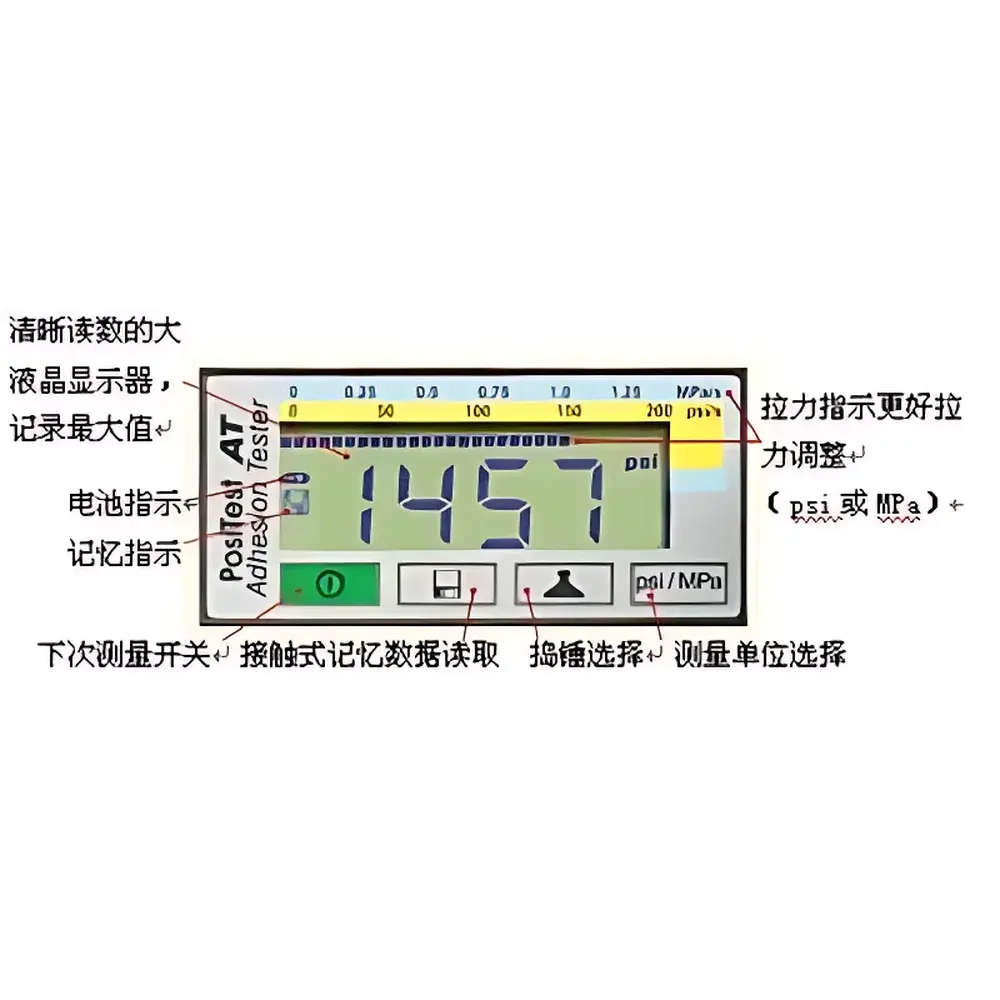
| Display | Backlit LCD (psi / MPa) |
| Data Storage | Up to 200 tests with date/time/stamp size |
| Interface | USB |
| Software | PosiSoft (Windows), multilingual (EN/DE/FR/IT/ES), supports annotation, CSV/DOC export |
| Environmental Rating | IP65 (dustproof, water-resistant, shock-resistant) |
| Warranty | 1 year |
Overview
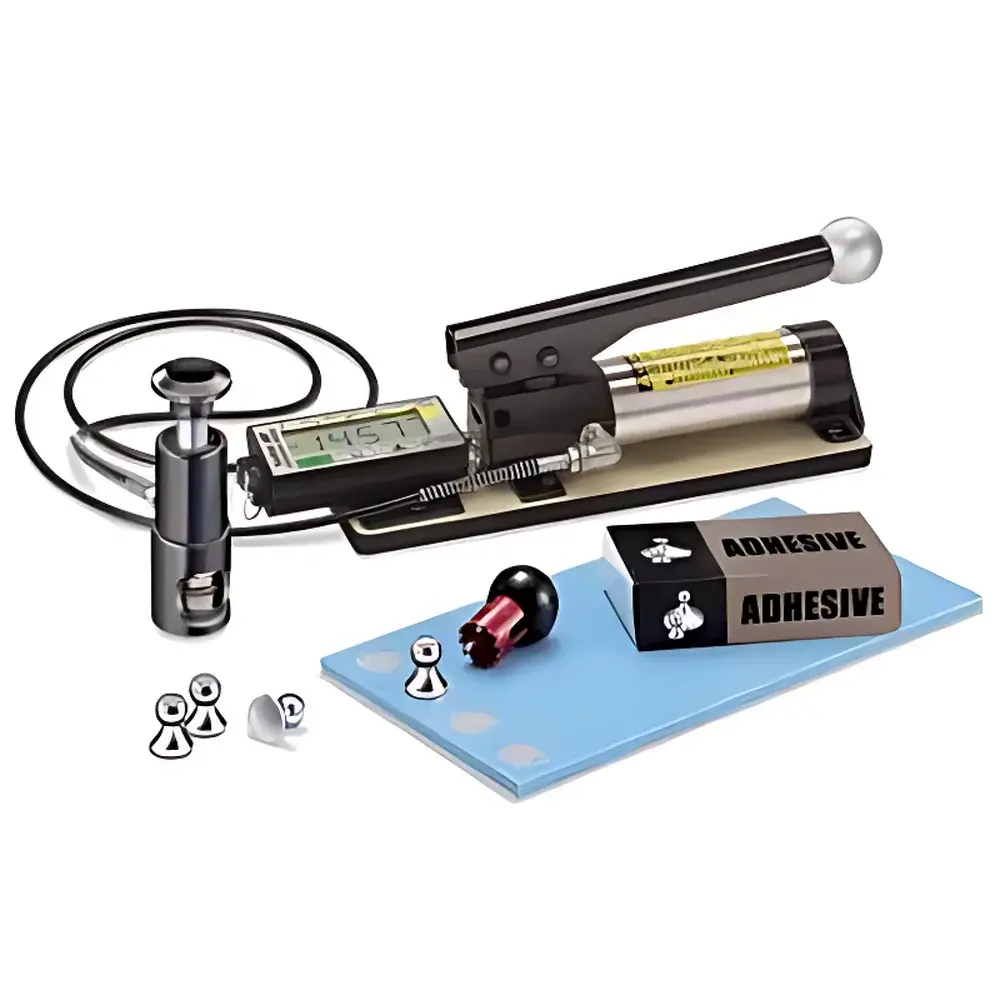
The Defelsko PosiTest AT is a manually operated, hydraulic pull-off adhesion tester engineered for quantitative assessment of coating-to-substrate bond strength across diverse industrial and field applications. It operates on the principle of controlled axial tensile loading applied perpendicular to the coated surface via a bonded dolly (test stub), until interfacial or cohesive failure occurs. The resulting peak force is converted into stress (MPa or psi) using the cross-sectional area of the dolly, in strict accordance with standardized test methodologies. Designed for use on metallic, concrete, masonry, wood, and plastic substrates, the PosiTest AT delivers NIST-traceable accuracy of ±1% of full scale—verified at time of shipment—and maintains measurement integrity on both planar and moderately irregular surfaces thanks to its self-centering base mechanism. Its compact, ruggedized architecture ensures reliable performance in laboratory, production floor, and outdoor environments—including high-humidity or dusty conditions—without dependency on external power sources.
Key Features
- Hydraulic actuation system with high-fidelity pressure amplification, enabling consistent, smooth load application without mechanical backlash or slippage.
- Self-centering base with integrated alignment compensation—eliminates operator-induced angular error and preserves measurement validity on non-planar substrates (e.g., curved pipe surfaces, textured concrete).
- Interchangeable aluminum dollies (10 mm, 14 mm, 20 mm, 50 mm diameters) calibrated per ASTM D4541 Annex A1; larger dollies increase statistical confidence for low-strength or heterogeneous coatings.
- Backlit LCD display showing real-time load (psi or MPa), peak hold value, and test stamp size—user-selectable units with automatic range scaling.
- IP65-rated enclosure ensures operational reliability under rain exposure, abrasive dust, and incidental impact—validated per IEC 60529.
- Integrated data logging stores up to 200 test records, each timestamped and tagged with dolly size, enabling traceability without external instrumentation.
- Onboard zeroing and calibration verification function supports daily user checks prior to critical measurements.
Sample Compatibility & Compliance
The PosiTest AT accommodates a broad spectrum of substrate-coating systems: epoxy and polyurethane coatings on carbon steel; intumescent fireproofing on structural steel; polymer-modified cementitious overlays on cured concrete; and marine antifouling paints on aluminum hulls. Its 20 mm dolly is optimized for metal, plastic, and timber substrates, while the 50 mm variant meets ISO 4624 requirements for low-modulus coatings on porous or brittle media such as cast-in-place concrete and brickwork. Optional AT-C configuration includes a precision drill guide for isolating thick-film test zones—critical for evaluating multi-layer systems where intercoat adhesion must be distinguished from substrate bonding. All configurations comply with ASTM D4541 (Standard Test Method for Pull-Off Strength of Coatings Using Portable Adhesion Testers), ISO 4624 (Paints and Varnishes — Pull-Off Test for Adhesion), and are routinely accepted in third-party inspection protocols aligned with SSPC-PA 2, NORSOK M-501, and ISO 12944 Part 6.
Software & Data Management
PosiSoft software (Windows-compatible, included) provides secure, audit-ready data handling in regulated environments. It enables bidirectional USB communication for batch download of stored test records—including numeric values, timestamps, dolly ID, and operator notes. Users may annotate individual tests with contextual observations (e.g., “failure mode: cohesive in primer layer”), assign project IDs, and generate PDF reports compliant with internal QA documentation standards. Export options include native .csv for statistical analysis in JMP or Minitab, and .docx for integration into client deliverables. The software enforces electronic signature capture and maintains immutable audit trails—supporting compliance with FDA 21 CFR Part 11 requirements when deployed in pharmaceutical facility qualification or GMP coating validation workflows.
Applications
- Quality assurance of protective coatings during offshore platform refurbishment (ASTM D4541 Class C testing on weathered carbon steel).
- Verification of concrete repair mortar bond strength post-curing in bridge deck rehabilitation projects.
- Field validation of fire-resistive coating adhesion on structural steel columns prior to occupancy certification.
- In-process monitoring of powder coating adhesion on automotive chassis components before topcoat application.
- Forensic investigation of coating delamination failures—correlating pull-off strength with SEM/EDS cross-section analysis.
- Research-grade evaluation of novel nanocomposite coatings on aerospace-grade aluminum alloys (AMS 2467 compliance support).
FAQ
What standards does the PosiTest AT meet?
It conforms to ASTM D4541, ISO 4624, and SSPC-PA 2, with documented traceability to NIST SRM 2241 for force calibration.
Can it measure adhesion on curved surfaces?
Yes—the self-centering base automatically compensates for surface curvature up to ±5°, maintaining perpendicular load application per ISO 4624 Section 6.3.
Is calibration required before each test?
No—routine zeroing suffices; however, annual recalibration by an accredited lab (e.g., ISO/IEC 17025) is recommended for audit readiness.
How is failure mode determined?
Failure mode (adhesive, cohesive, or mixed) is assessed visually post-test per ASTM D4541 Section 8.3; the instrument records only peak load—not failure classification.
Does the AT-C model require special training?
Minimal—drill guide usage follows a three-step sequence outlined in the operator manual; no certification is mandated beyond standard safety protocols for rotary tools.



