
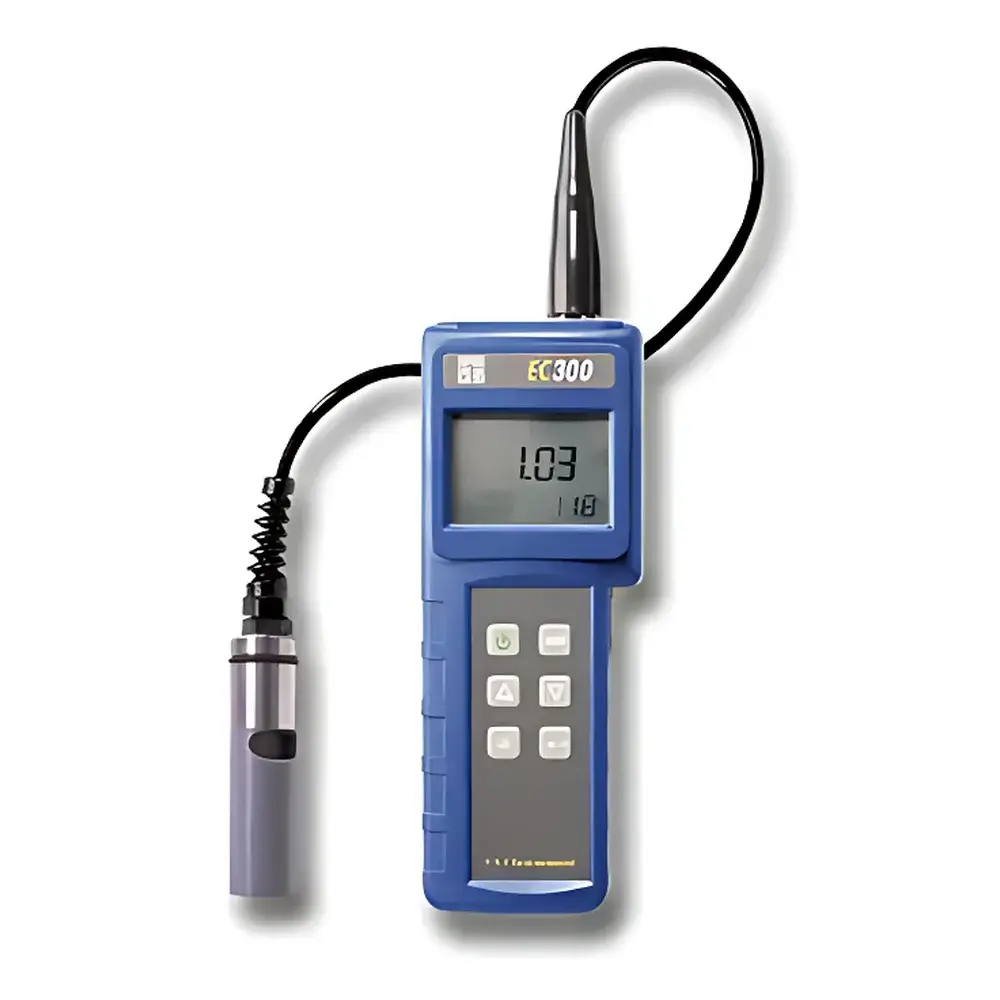
YSI EC300 Portable Conductivity, Salinity & Temperature Meter
| Brand | YSI |
|---|---|
| Model | EC300 |
| Origin | USA |
| Instrument Type | Portable Electrochemical Conductivity Meter |
| Measurement Parameters | Conductivity (0–200.0 mS/cm), Salinity (0.0–70.0 ppt), TDS (user-defined conversion factor 0.30–1.00), Temperature (−10 to +90 °C) |
| Accuracy | Conductivity ±1% ±2 µS/cm (low range) to ±2.5% ±0.5 mS/cm (high range) |
| Resolution | Temp 0.1 °C |
| Electrode | Four-electrode stainless steel probe with stress-relieved cable interface |
| Cable Options | 4 m or 10 m |
| Compliance | Designed for field-deployable environmental monitoring per ASTM D1125, ISO 7888, and US EPA Method 120.1 |
Overview
The YSI EC300 Portable Conductivity, Salinity & Temperature Meter is an engineered field instrument designed for high-reproducibility electrochemical measurement in aquatic environments. Based on four-electrode AC conductivity sensing architecture, the EC300 eliminates polarization errors and electrode fouling effects common in two-electrode systems—enabling stable, drift-resistant measurements across a wide dynamic range (0–200.0 mS/cm). Its integrated thermistor-based temperature sensor provides simultaneous thermal compensation in real time, supporting automatic calculation of specific conductivity (at 25 °C), practical salinity (PSS-78), and total dissolved solids (TDS) using user-configurable linear conversion factors (0.30–1.00). The device operates without external power sources beyond its internal battery, making it suitable for unattended deployment in remote freshwater, estuarine, coastal, and industrial effluent settings.
Key Features
- Four-electrode stainless steel conductivity cell—minimizes polarization, enhances long-term stability, and reduces calibration frequency
- Integrated high-accuracy thermistor with ±0.2 °C absolute accuracy over −10 to +90 °C, enabling precise automatic temperature compensation (ATC)
- Auto-ranging conductivity measurement across four overlapping decades (0–499.9 µS/cm, 500–4999 µS/cm, 5.00–49.99 mS/cm, 50.0–200.0 mS/cm)
- Field-configurable TDS conversion factor (0.30–1.00), defaulting to 0.65 per Standard Methods 2510B
- Stress-relieved cable interface at probe junction—mechanically decouples bending forces to extend service life under repeated submersion cycles
- Single-hand operable keypad with backlit LCD display optimized for outdoor visibility and gloved operation
- Battery status indicator with low-power warning and intelligent sleep mode to maximize field runtime
Sample Compatibility & Compliance
The EC300 is validated for direct immersion in natural waters—including rivers, lakes, wetlands, tidal zones, aquaculture ponds, and wastewater outfalls—as well as process streams in food & beverage, pharmaceutical, and power generation facilities. Its stainless steel probe meets NEMA 6P ingress protection standards for temporary submersion. Data output conforms to ASTM D1125 (Standard Test Methods for Electrical Conductivity and Resistivity of Water), ISO 7888 (Water Quality – Determination of Electrical Conductivity), and US EPA Method 120.1 (Conductivity, Salinity, and Total Dissolved Solids). While not certified for GLP/GMP-regulated release testing, the instrument supports audit-ready documentation when paired with YSI’s optional data logging accessories compliant with FDA 21 CFR Part 11 requirements for electronic records.
Software & Data Management
The EC300 operates as a standalone meter with no embedded software stack—ensuring deterministic response and zero firmware-related latency. All measurements are stored in non-volatile memory with timestamping (date/time stamp enabled via manual setup). Optional USB-to-serial adapters allow export of ASCII-formatted CSV files for post-processing in Excel, R, or LIMS platforms. When used with YSI’s ProQuatro™ or EcoMapper® telemetry systems, the EC300 can feed real-time conductivity and temperature values into networked environmental monitoring dashboards. Firmware updates (if released) are delivered via YSI’s secure customer portal and require physical connection through the proprietary mini-B USB port.
Applications
- Regulatory compliance monitoring for NPDES permits and watershed restoration programs
- Salinity profiling in estuarine mixing zones and mangrove ecosystems
- TDS verification during reverse osmosis membrane performance audits
- Baseline characterization of groundwater conductivity prior to well development
- Real-time tracking of thermal plume dispersion from power plant discharges
- Educational field labs requiring rugged, intuitive instrumentation for undergraduate hydrology courses
FAQ
Does the EC300 support calibration verification with standard KCl solutions?
Yes—the meter accepts manual entry of calibration constants and allows verification against traceable 0.01 M, 0.1 M, and 1.0 M KCl standards per ISO/IEC 17025 guidelines.
Can the EC300 be used in ice-covered or near-freezing water?
It is rated for operation down to −10 °C ambient and can measure under ice provided the probe tip remains unfrozen and fully immersed; however, prolonged exposure below 0 °C may affect battery discharge characteristics.
Is the stainless steel probe compatible with seawater long-term deployment?
The 316 stainless steel housing resists pitting corrosion in marine environments up to 30-day continuous immersion; for extended deployments (>72 hours), periodic cleaning with dilute citric acid is recommended to remove biofilm and CaCO₃ deposits.
How does the EC300 handle variable pressure during deep-water profiling?
The probe is not pressure-compensated; it is intended for static or slow-profile applications up to 10 m depth. Pressure-induced conductivity shifts are negligible within this range per IAPSO TEOS-10 conventions.
Does the EC300 meet IP68 rating specifications?
No—it carries NEMA 6P certification (equivalent to IP67 for 30 minutes at 1 m depth), but lacks formal IP68 validation for continuous submersion or high-pressure conditions.





