
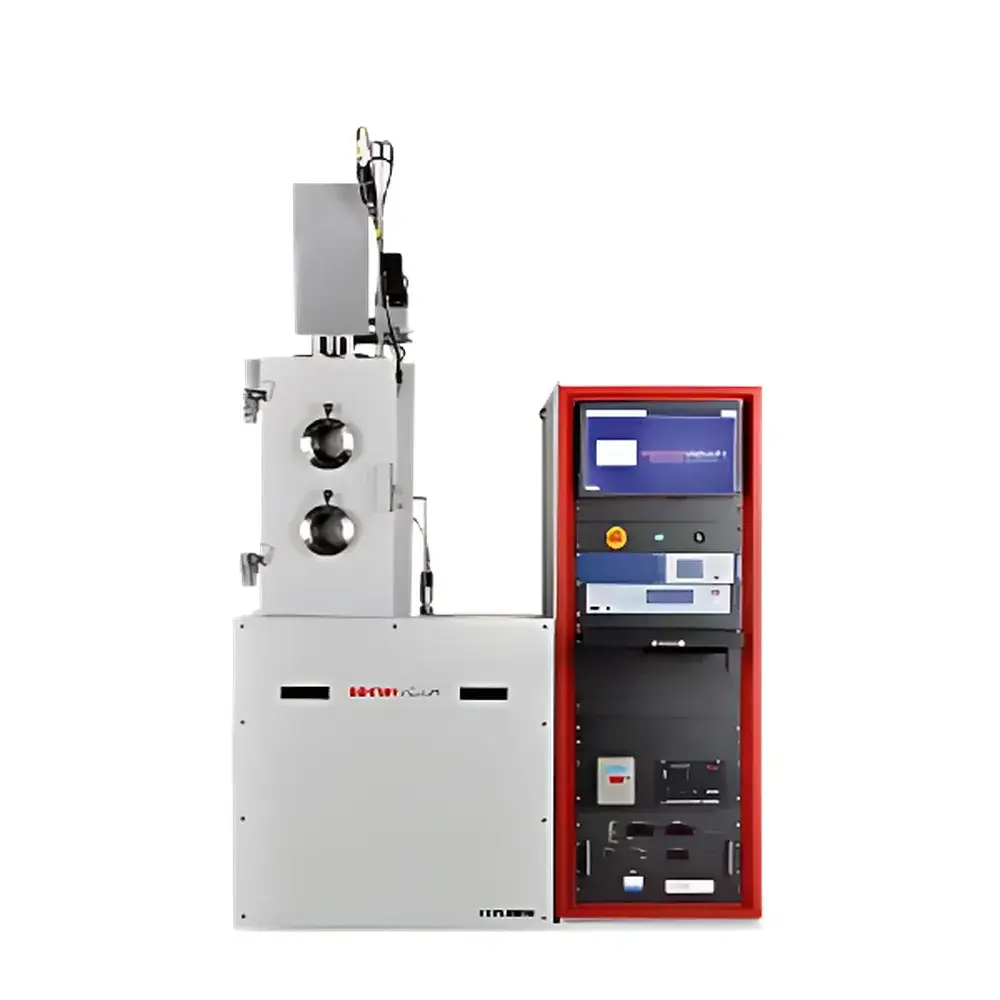
Denton Vacuum Explorer Thin Film Deposition Platform
| Brand | Denton Vacuum |
|---|---|
| Origin | USA |
| Model | Explorer |
| Substrate Size (Max) | 8" (200 mm) |
| Base Pressure | ≤5 × 10⁻⁶ Torr |
| Pumping Options | Turbo-molecular or Diffusion Pump |
| Deposition Methods | Thermal Evaporation, E-beam Evaporation, DC/Pulse DC/RF Sputtering, Co-sputtering, Ion Beam Assisted Deposition (IAD), PECVD |
| Load Lock Option | Available |
| Vacuum Architecture | High-vacuum, differential pumping compatible |
| Compliance | Designed for GLP/GMP-aligned labs |
Overview
The Denton Vacuum Explorer Thin Film Deposition Platform is a modular, high-vacuum (≤5 × 10⁻⁶ Torr) physical vapor deposition (PVD) system engineered for reproducible, multi-technique thin film synthesis in academic research, materials development, and low-volume production environments. Its architecture integrates fundamental PVD principles—including thermal evaporation (resistive and electron-beam), magnetron sputtering (DC, pulsed DC, and RF), ion beam-assisted deposition (IAD), and plasma-enhanced chemical vapor deposition (PECVD)—within a single vacuum chamber platform. The system employs a robust stainless-steel chamber with all-metal seals, conflat flanges, and strategically positioned ports to accommodate source-to-substrate geometry optimization—critical for achieving thickness uniformity <±3% across 200 mm substrates. Differential pumping compatibility enables stable operation of cold-cathode ion sources under controlled partial pressures, ensuring consistent ion energy distribution (50–1000 eV) and current density (0.1–5 mA/cm²) during IAD—a prerequisite for low-stress, stoichiometric oxide/nitride films used in optical coatings and semiconductor passivation.
Key Features
- Modular source configuration: Interchangeable evaporation crucibles, e-beam guns, and up to three magnetron cathodes (including co-sputtering capability)
- High-reproducibility substrate stage: Motorized rotation, tilt (±90°), and vertical translation with integrated thermocouple feedback (±1°C stability)
- Real-time process control: Dual-channel quartz crystal microbalance (QCM) with rate/thickness monitoring, synchronized with source power ramping and gas flow modulation
- Vacuum performance: Base pressure ≤5 × 10⁻⁶ Torr achieved via turbo-molecular pump (2000 L/s) or oil-free diffusion pump; optional load lock reduces chamber exposure time by >70%
- IAD integration: Cold-cathode ion source with independent control of discharge voltage, anode current, and neutral gas flow (O₂, N₂, Ar), enabling stress tuning and enhanced film density without thermal loading
- Software-controlled gas handling: Mass flow controllers (MFCs) for reactive gases with <1% full-scale accuracy and automated leak-check routines per ASTM E493
Sample Compatibility & Compliance
The Explorer accommodates substrates up to 200 mm in diameter—including silicon wafers, glass slides, TEM grids, polymer foils, and irregular 3D components—with customizable fixturing (planar, planetary, and shadow-mask holders). Chamber internal geometry supports uniform shadowing angles for lift-off patterning and conformal coating of high-aspect-ratio features. All wetted surfaces are electropolished 316L stainless steel, compliant with USP Class VI biocompatibility requirements for medical device coating validation. System design adheres to CE machinery directive 2006/42/EC and meets electrical safety standards IEC 61000-6-2/6-4. Optional documentation packages support ISO 9001:2015 quality system integration and FDA 21 CFR Part 11 compliance when paired with validated software modules.
Software & Data Management
Operation is managed through Denton’s proprietary VACUUMware™ v5.2 control suite—a Windows-based application with role-based access control, electronic signature capability, and immutable audit trails. Process recipes store over 120 parameters per run (e.g., pressure ramps, shutter sequences, power profiles, MFC setpoints), with timestamped export to CSV or SQL databases. Real-time trending includes QCM thickness error deviation, ion source impedance drift, and pump speed vs. chamber pressure correlation—enabling root-cause analysis per ISO/IEC 17025 clause 7.7. Raw data files are SHA-256 hashed and archived with retention policies configurable to GLP 21-day minimum or GMP 15-year archival standards.
Applications
- Materials Science: Synthesis of transparent conductive oxides (ITO, AZO), ferroelectric perovskites (PZT), and topological insulator thin films (Bi₂Se₃) requiring precise stoichiometry control
- Electron Microscopy: Ultra-thin carbon and Pt/C replica films for TEM sample preparation, with thickness repeatability ±0.5 nm across 3.05 mm grids
- Optics & Photonics: Dense, low-absorption MgF₂, SiO₂, and Ta₂O₅ anti-reflection and high-reflectance stacks fabricated via IAD at 200 °C substrate temperature
- Semiconductor QA: Failure analysis cross-section coating with Au/Pd for FIB-SEM imaging; sputtered TiW adhesion layers on Cu interconnect test structures
- Flexible Electronics: Roll-to-plate sputtering trials using segmented substrate carriers; barrier layer deposition on PET substrates for OLED encapsulation
FAQ
What base vacuum level is achievable with the standard pump configuration?
With a 2000 L/s turbo-molecular pump and cryo-trapped foreline, the Explorer achieves ≤3 × 10⁻⁶ Torr within 90 minutes from atmospheric conditions—verified by calibrated Bayard-Alpert gauge traceable to NIST standards.
Can the system be upgraded from evaporation-only to full sputtering capability post-purchase?
Yes. The chamber port layout and power supply bussing are pre-wired for retrofitted magnetron cathodes, RF matching networks, and IAD source integration—requiring only mechanical installation and software license activation.
Is remote diagnostics supported for troubleshooting process drift?
All systems include embedded Ethernet connectivity and TLS 1.2-secured remote access. Denton Field Service Engineers can initiate diagnostic sessions to review vacuum logs, power supply waveforms, and QCM calibration history—without compromising local network security.
How does the system ensure film thickness uniformity across large-area substrates?
Uniformity is optimized via substrate rotation speed profiling, source-to-substrate distance mapping (validated by witness wafer profilometry), and real-time closed-loop correction using dual QCM sensors placed at chamber periphery and center.
Are custom vacuum chamber modifications available for specialized geometries?
Denton offers engineering consultation for non-standard viewports, internal baffling, or custom feedthrough configurations—subject to ASME BPVC Section VIII Div. 1 pressure vessel certification where applicable.



