
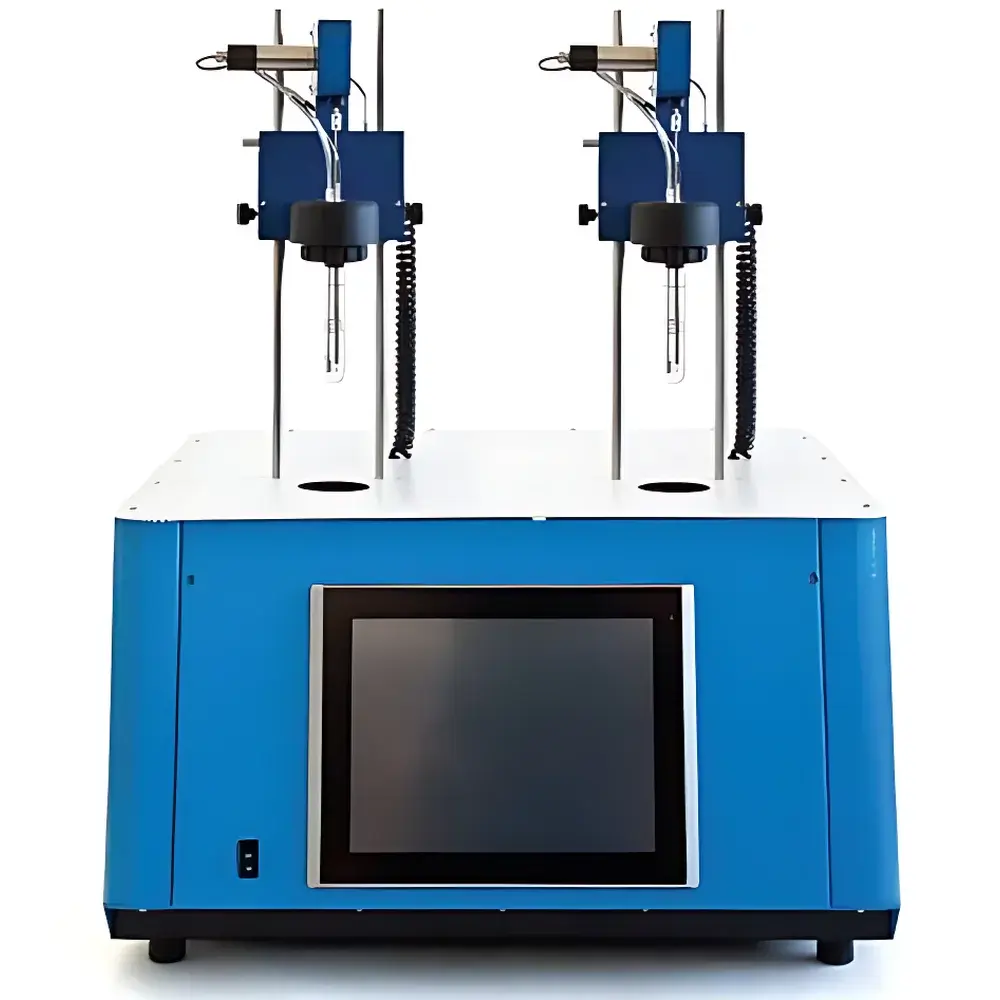
Ducom FPT Freezing Point Tester
| Brand | Ducom |
|---|---|
| Model | FPT |
| Origin | USA |
| Category | Petroleum Low-Temperature Property Tester |
| Cooling Range | −90 °C to +80 °C |
| Temperature Resolution | 0.01 °C |
| Accuracy | ±0.1 °C |
| Repeatability | Compliant with ASTM D2386, D5972, D7154 and IP 528 |
| Temperature Sensor | Class A PT100 |
| Cooling System | Fluorocarbon-free dual-stage refrigeration |
| Detection Method | Coaxial fiber-optic infrared pulse reflection with mirror-enhanced crystal detection |
| Stirring Mechanism | Motor-driven triple-brass-coil agitator |
| Power Supply | 220 V ±15 %, 50–60 Hz or 115 V ±15 %, 60 Hz |
| Dimensions (W×D×H) | 34 × 60 × 80 cm |
| Weight | 34 kg |
| Standards Compliance | ASTM D2386, D5972, D7154, D852, D1177, D1655 |
Overview
The Ducom FPT Freezing Point Tester is a fully automated, benchtop instrument engineered for the precise determination of the freezing point of aviation turbine fuels, engine coolants, antifreeze formulations, brake fluids, and other hydrocarbon-based petroleum products. It operates on the principle of optical detection of solid hydrocarbon crystal formation during controlled cooling, followed by programmed reheating to determine the temperature at which crystalline structures completely disappear — the thermodynamic freezing point. Unlike manual tilt-based pour point testers, the FPT employs coaxial fiber-optic infrared pulse transmission coupled with a precision-machined mirror surface to detect minute light-scattering events associated with early-stage crystal nucleation. This methodology ensures high reproducibility and eliminates operator subjectivity, aligning with modern laboratory requirements for objective, auditable phase-transition measurements.
Key Features
- Fluorocarbon-free dual-stage refrigeration system capable of stable operation down to −90 °C, eliminating environmental and regulatory concerns associated with CFC/HCFC refrigerants.
- Class A PT100 temperature sensor integrated into the sample chamber, delivering traceable accuracy of ±0.1 °C and resolution of 0.01 °C across the full operating range (−90 °C to +80 °C).
- Triple-brass-coil mechanical stirrer driven by a low-noise micro-motor, ensuring consistent agitation without introducing metallic contamination or thermal drift.
- Coaxial fiber-optic detection head with integrated mirror surface and pulsed infrared source, enabling real-time monitoring of crystal onset via reflected light intensity thresholds.
- Automated thermal ramping profile generation and execution, including programmable cooling rates, dwell times, and reheating gradients per ASTM and IP standard protocols.
- Robust safety architecture featuring dual-stage pressure controllers, independent thermostats for each cooling/heating jacket, thermal cut-off switches, and motor/compressor overload protection.
Sample Compatibility & Compliance
The FPT accommodates standard 10–15 mL sample volumes in ASTM D2386-compliant glass test tubes. Its detection sensitivity enables reliable freezing point identification in both clear and mildly hazy samples, including Jet A-1, JP-8, ethylene glycol/water mixtures, and DOT 4 brake fluid. The system is validated for compliance with key international standards: ASTM D2386 (Standard Test Method for Freezing Point of Aviation Fuels), ASTM D5972 (Automatic Phase Transition Method), ASTM D7154 (Automatic Fiber-Optic Method), IP 528 (Automatic Fiber-Optic Determination), and ISO 3013 (Petroleum Products — Determination of Freezing Point of Aviation Fuels). All firmware and software logic are designed to enforce strict adherence to specified hold times, cooling rates, and endpoint criteria defined in these methods — supporting GLP/GMP-aligned audit readiness.
Software & Data Management
The FPT is operated via Ducom’s proprietary Windows-based control software, which provides full parameter configuration, real-time thermal curve visualization, and automated pass/fail evaluation against method-defined acceptance criteria. Each test generates a timestamped digital record containing raw temperature vs. time data, optical signal amplitude traces, user identity, calibration status, and instrument environmental logs. Data export is supported in CSV and PDF formats, with optional integration into LIMS environments via ODBC or RESTful API interfaces. Audit trail functionality complies with FDA 21 CFR Part 11 requirements, including electronic signatures, immutable record retention, and user-level access controls.
Applications
- Quality assurance of aviation turbine fuels in refinery, blending, and airport fueling facilities.
- Low-temperature specification verification of engine coolants and antifreeze concentrates per OEM and SAE specifications.
- R&D screening of novel additive packages intended to suppress wax crystallization in diesel and biofuel blends.
- Regulatory compliance testing for military fuel procurement (e.g., MIL-DTL-83133, DEF STAN 91-91).
- Stability assessment of synthetic lubricants and hydraulic fluids under sub-zero operational conditions.
- Method validation and cross-laboratory correlation studies requiring high inter-instrument reproducibility.
FAQ
What distinguishes the FPT from traditional manual freezing point testers?
The FPT replaces visual observation with objective, fiber-optic–based crystal detection, eliminating inter-operator variability and enabling unattended overnight runs.
Is the cooling system truly CFC-free?
Yes — the dual-stage refrigeration uses environmentally compliant HFC/HFO blends certified under current EPA SNAP and EU F-Gas regulations.
Can the FPT be used for pour point testing?
No — it is specifically configured for freezing point measurement per ASTM D2386/D7154; pour point requires different thermal profiles and detection logic (e.g., ASTM D97 or D5949).
How often does the system require calibration verification?
Daily verification using NIST-traceable reference standards at −50 °C and +20 °C is recommended; full sensor calibration is advised annually or after 500 test cycles.
Does the software support multi-language interfaces?
English is the primary interface; localized versions (German, French, Japanese) are available upon request and validated per regional regulatory expectations.



