
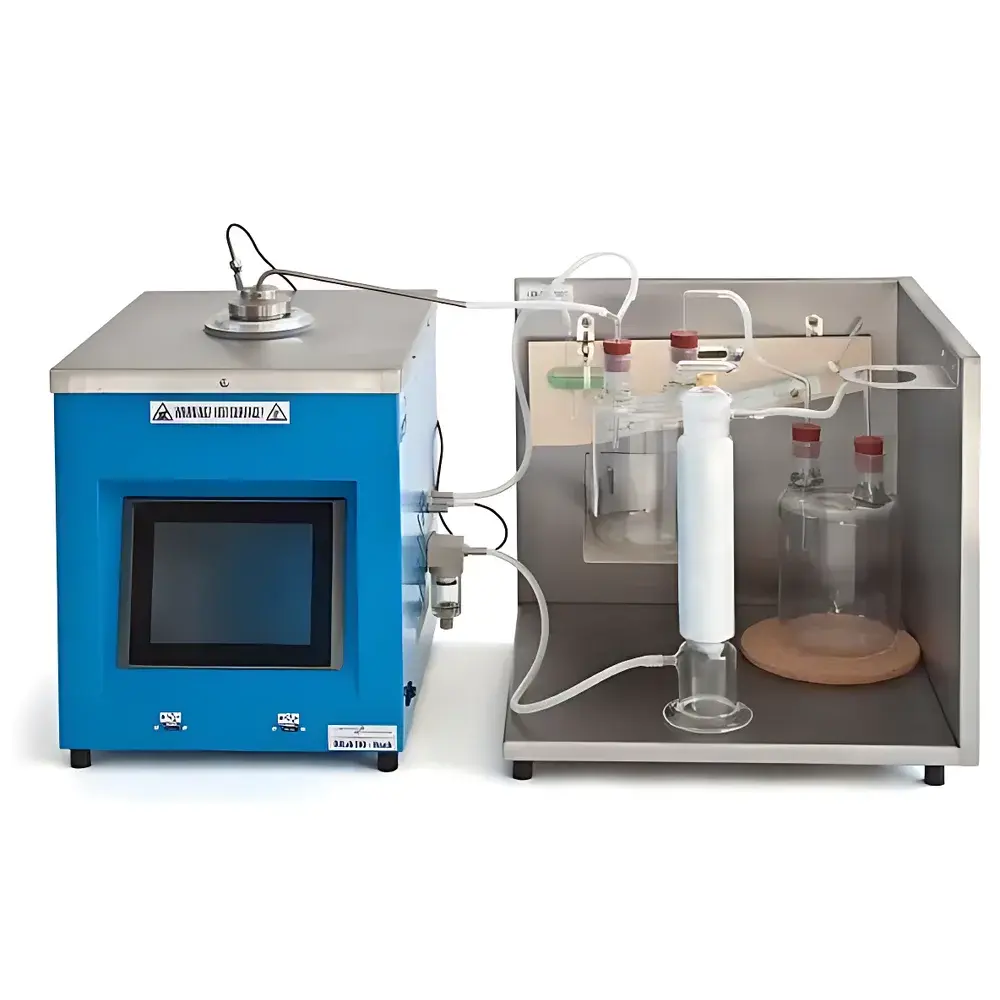
Ducom Noac Noack Volatility Tester
| Brand | Ducom |
|---|---|
| Origin | USA |
| Model | Noac |
| Temperature Range | 0–320 °C |
| Test Range | 225–275 °C |
| Temp. Resolution | 0.01 °C |
| Temp. Accuracy | ±0.1 °C |
| Temp. Repeatability | ASTM D5800-compliant |
| Vacuum Control | –2 mbar (electronic, continuous) |
| Pressure Differential | 20 mmH₂O (auto-regulated) |
| Vacuum Accuracy | ±1% |
| Heating Method | Oil Bath (Method A) or Sample-Controlled (Method B) |
| Compliance | ASTM D5800, IP 42 |
| Dimensions | 40 × 45 × 45 cm (W×D×H) |
| Weight | 22 kg |
| Power | 220 V ±15%, 50–60 Hz or 115 V ±15%, 60 Hz |
Overview
The Ducom Noac Noack Volatility Tester is a fully automated, precision-engineered instrument designed to quantify the evaporation loss of lubricating oils—particularly engine oils—under standardized high-temperature, low-pressure conditions. It implements the fundamental Noack volatility principle: controlled thermal exposure of a weighed oil sample in a sealed crucible under sustained vacuum (–2 mbar), enabling rapid and quantitative removal of volatile fractions. The system operates per two distinct thermal control protocols: Method A maintains a constant oil bath temperature at 250 °C, while Method B regulates the sample temperature directly to 245.2 °C—both aligned with ASTM D5800 and IP 42 requirements. Unlike legacy Wood’s metal bath systems, the Noac employs non-toxic, digitally stabilized heating architecture with integrated PT100 Class A sensors (IEC 60751), ensuring traceable, NIST-traceable temperature fidelity across its full operational range (0–320 °C), with resolution of 0.01 °C and accuracy of ±0.1 °C.
Key Features
- Automated vacuum regulation via electronic pressure controller maintaining –2 mbar throughout the 60-minute test cycle, eliminating manual valve adjustment and drift.
- Dual-mode thermal control: programmable oil-bath heating (Method A) or direct sample-temperature feedback loop (Method B), both compliant with ASTM D5800 Annexes.
- Integrated 8-inch high-resolution TFT/LCD touch-panel PC with embedded firmware for real-time monitoring, parameter logging, and audit-ready event history.
- Automatic mass loss calculation: pre-test and post-cooling sample weights are captured via external analytical balance interface (RS-232/USB), with evaporation loss reported as % mass loss per ASTM D5800 Section 11.
- Robust vacuum subsystem featuring a corrosion-resistant diaphragm pump, Kalrez-sealed valves, and multi-stage进口 particulate filtration to prevent condensate carryover and extend service life.
- Over-temperature protection circuitry with independent hardware cutoff (±5 °C deviation threshold) and ambient condition monitoring (max. 35 °C ambient, 80% RH).
- Auto-calibration traceability: system records calibration events—including probe-specific offset adjustments and verification points—for GLP/GMP documentation compliance.
Sample Compatibility & Compliance
The Noac accommodates standard ASTM D5800 crucibles (typically 5–10 g sample mass) and supports all mineral-, synthetic-, and semi-synthetic-based engine oils, gear oils, and hydraulic fluids. Its design satisfies critical regulatory expectations for method validation and data integrity: full alignment with ASTM D5800 (Standard Test Method for Evaporation Loss of Lubricating Oils by the Noack Method) and IP 42 (Determination of Evaporation Loss of Lubricating Oils—Noack Method). The instrument’s electronic control architecture supports 21 CFR Part 11 readiness when paired with validated LIMS or ELN platforms—enabling electronic signatures, audit trails, and role-based access control for QC/QA environments operating under ISO/IEC 17025 or API Q1 frameworks.
Software & Data Management
Firmware-driven operation eliminates dependency on third-party PCs. All test parameters—setpoints, actual temperatures, vacuum levels, timestamps, and weight inputs—are logged internally with millisecond-level granularity. Export formats include CSV and PDF reports compliant with internal SOPs and external auditor requirements. Calibration history, sensor drift logs, and maintenance alerts are stored in encrypted onboard memory with configurable retention policies. Optional OPC UA integration enables seamless connectivity to enterprise MES or SAP QM modules for automated result routing and statistical process control (SPC) charting.
Applications
This instrument serves as a primary quality gate in lubricant formulation labs, OEM engine oil certification workflows, and refinery QC laboratories. Typical use cases include: evaluating base stock volatility for low-SAPS (Sulfated Ash, Phosphorus, Sulfur) formulations; verifying NOACK stability of low-viscosity grade oils (e.g., 0W-16, 0W-20); screening additive package volatility resistance; supporting ILSAC GF-6 and ACEA C5/C6 compliance testing; and generating comparative volatility profiles during bench-scale oxidation studies (ASTM D2896, D2272). Its reproducibility meets or exceeds ASTM D5800 repeatability limits (r ≤ 0.40% mass loss), making it suitable for inter-laboratory round-robin trials.
FAQ
What standards does the Ducom Noac comply with?
ASTM D5800 (Methods A and B), IP 42, and referenced clauses of ISO 2160.
Is the system compatible with 21 CFR Part 11 requirements?
Yes—when deployed with validated software extensions and documented administrator/user role assignment, it supports electronic signatures, audit trails, and data integrity controls required for FDA-regulated environments.
Does the instrument require hazardous heating media such as Wood’s metal?
No—the Noac uses solid-state, oil-free heating elements and digital PID control, eliminating toxic molten metal baths entirely.
Can test results be exported to LIMS or ERP systems?
Yes—via USB, RS-232, or optional Ethernet interface using configurable ASCII/CSV output templates.
What maintenance intervals are recommended for the vacuum system?
Kalrez valves and inlet filters require inspection every 200 test cycles; diaphragm pump oil replacement is recommended annually or after 1,000 hours of operation.



