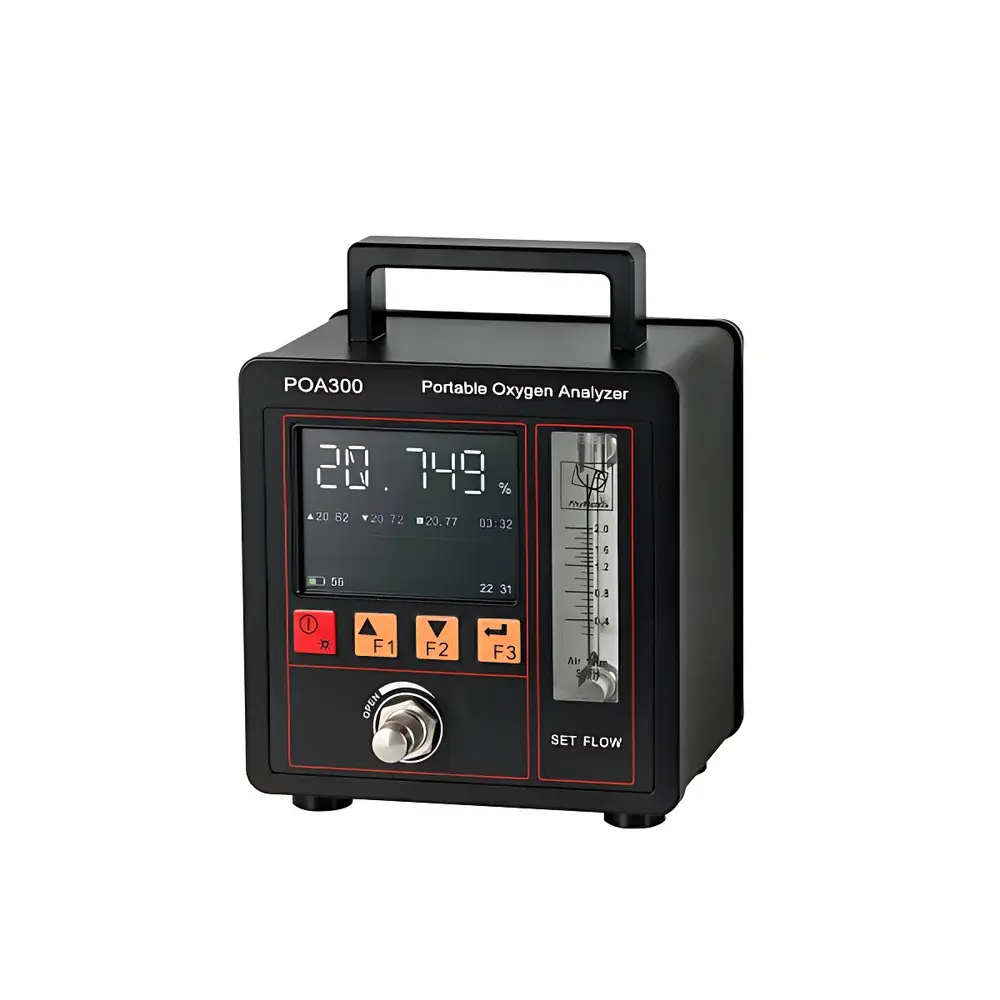
PhyMetrix POA300 Portable Paramagnetic Oxygen Analyzer
| Brand | PhyMetrix |
|---|---|
| Origin | USA |
| Model | POA300 |
| Sensor Type | Electrochemical |
| Measurement Accuracy | ±1% FS |
| Response Time | T90 < 15 s, T95 < 25 s |
| Resolution | 0.001% |
| Measurement Ranges | 0–1%, 0–5%, 0–10%, 0–25%, 0–100% O₂ (auto-ranging) |
| Operating Temperature | 0–45 °C with full-range temperature compensation |
| Power Supply | Rechargeable Li-ion battery (USB-C charging) |
| Ingress Protection | IP67 |
| Hazardous Area Certification | ATEX/IECEx compliant — Class I, Div. 1, Groups A, B, C, D |
| Maximum Pressure Rating (Needle Valve) | 1 MPa |
| Weight | 2.0 kg |
| Dimensions (W×D×H) | 138 × 185 × 112 mm |
Overview
The PhyMetrix POA300 is a field-deployable, intrinsically safe electrochemical oxygen analyzer engineered for high-reliability quantitative measurement of gaseous oxygen concentrations across industrial process streams, safety monitoring zones, and laboratory environments. Unlike paramagnetic or zirconia-based analyzers, the POA300 utilizes a temperature-compensated, long-life electrochemical sensor cell that operates on the principle of galvanic oxygen reduction—generating a current proportional to O₂ partial pressure. Its auto-ranging architecture enables seamless switching between five calibrated ranges (0–1%, 0–5%, 0–10%, 0–25%, and 0–100% v/v O₂), eliminating manual range selection errors and ensuring optimal signal-to-noise ratio across trace to atmospheric oxygen levels. Designed for operation in Class I, Div. 1 hazardous locations (Groups A–D), the instrument features complete electrical isolation between the measurement chamber and electronics, fulfilling stringent intrinsic safety requirements per IEC 60079-0 and UL 913. All critical components—including the integrated needle valve and mass flow meter—are housed within a single sealed sampling module, minimizing dead volume and eliminating external tubing-induced drift or leakage artifacts.
Key Features
- Intrinsically safe design certified for Class I, Div. 1, Groups A, B, C, D—suitable for petrochemical, pharmaceutical, and confined-space applications
- Integrated needle valve (rated to 1 MPa) and precision laminar flow meter—ensures consistent sample flow rate and eliminates repeatability errors caused by variable inlet pressure or flow
- Long-life electrochemical sensor with >5-year operational lifetime under typical industrial conditions; factory-calibrated and field-verifiable using certified span gases
- Monolithic sampling cell architecture—reduces internal volume to <1.2 mL, enabling T90 response <15 s and minimizing cross-contamination between sequential measurements
- Rechargeable lithium-ion battery with USB-C interface—compatible with standard 5 V/3 A chargers (e.g., smartphone adapters); supports continuous operation >12 h at 25 °C
- High-brightness, adjustable-backlight TFT display (320 × 240 pixels)—optimized for readability under direct sunlight or low-illumination conditions
- Multi-mode data visualization: real-time concentration, time-series trend plot, moving average (1–120 s window), delta mode, and statistical summary (min/max/mean/std dev)
- Onboard memory capacity: 10,000 timestamped records (date/time/O₂ value/temperature/pressure flag); configurable logging interval from 1 s to 24 h
- User-configurable password lock (4–8 digit alphanumeric) for instrument setup, calibration, and data export functions—supports GLP-compliant audit trails when paired with optional PC software
Sample Compatibility & Compliance
The POA300 is compatible with dry, non-corrosive gas matrices including air, nitrogen, argon, helium, CO₂, and natural gas blends. It is not recommended for use with reducing gases (e.g., H₂, CO, NH₃) above 100 ppm, halogenated compounds, or condensable vapors without optional chemical scrubbers. The analyzer meets ISO 9001 manufacturing standards and complies with electromagnetic compatibility requirements per IEC 61326-1 (industrial environment). For regulated industries, its data logging and user access control features align with FDA 21 CFR Part 11 principles when used with validated firmware (v3.2+). Calibration certificates are traceable to NIST-standard reference gases (±0.05% uncertainty), and routine verification follows ASTM D6250 practice for electrochemical gas analyzers.
Software & Data Management
Data export is supported via USB-C connection to Windows/macOS systems using the PhyMetrix DataLink Utility (v2.4), which provides CSV export, calibration history archiving, and configurable report generation (PDF/Excel). Firmware updates are delivered through signed binary packages with SHA-256 checksum validation. The onboard real-time clock maintains accurate timestamps independent of host connection, and all logged entries include ambient temperature and battery voltage metadata. Optional Bluetooth 5.0 module (POA300-BT add-on) enables wireless telemetry to mobile devices running the PhyMetrix FieldView app—supporting remote configuration, live streaming, and geotagged measurement logs.
Applications
- Process safety monitoring in hydrocarbon processing units (e.g., inerting systems, flare gas analysis, catalyst regeneration off-gas)
- Quality assurance in modified atmosphere packaging (MAP) lines—verifying O₂ residual levels in food, pharmaceutical, and electronics packaging
- Environmental chamber validation and controlled-atmosphere storage facilities
- Confined space entry pre-checks (OSHA 1910.146 compliance) and emergency response gas screening
- Lab-scale reaction monitoring—tracking O₂ consumption in catalytic oxidation studies or bioreactor headspace analysis
- Calibration verification of fixed-mount oxygen analyzers in distributed control systems (DCS)
FAQ
What calibration gases are required for routine verification?
Certified zero gas (N₂ ≥99.999%) and span gas (O₂ in N₂ at 20.9% or application-specific concentration) traceable to NIST SRM 2659a or equivalent.
Does the POA300 support analog output for integration into PLC systems?
No—this model is digital-only (USB-C interface). Analog output (4–20 mA) is available on the POA300-IO variant.
Can the instrument operate continuously while charging?
Yes—USB-C power delivery supports concurrent operation and battery charging without interruption to measurement or logging.
Is temperature compensation applied across the full operating range?
Yes—dual-point thermal sensing (sensor cell + ambient) enables real-time correction per ASTM D6250 Annex A2 algorithms.
How is sensor drift managed during extended deployments?
The firmware implements automatic baseline stabilization during power-up and supports scheduled zero calibration (user-initiated or timed) with audible/visual confirmation.
Related Products