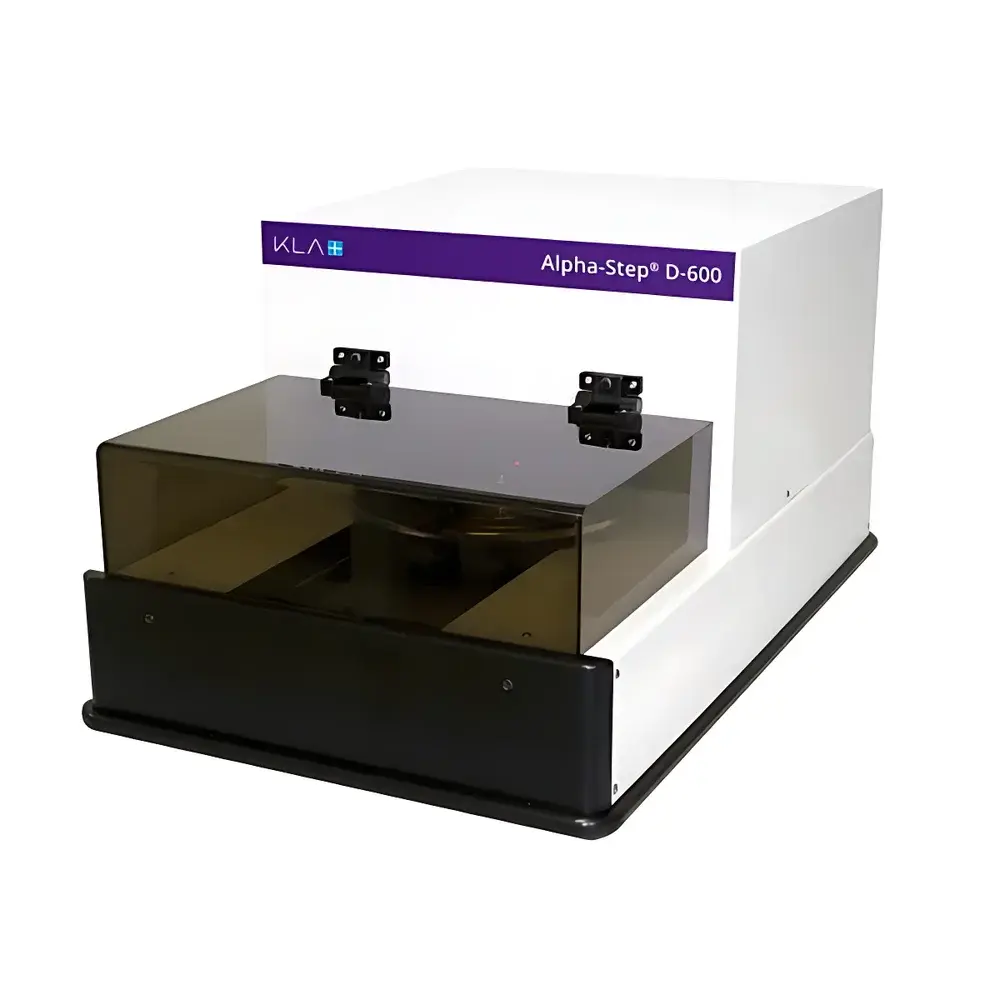
KLA Alpha-Step D-600 Contact Profilometer
| Brand | KLA |
|---|---|
| Origin | USA |
| Model | Alpha-Step D-600 |
| Measurement Principle | Stylus-based mechanical profilometry with optical lever amplification |
| Vertical Range | Up to 1200 µm |
| Vertical Resolution | Sub-nanometer (typical) |
| Stylus Normal Force | Adjustable from 0.03 mg to 15 mg |
| Optical System | Integrated 5 MP color camera with trapezoidal distortion correction and arc trajectory compensation |
| Footprint | Compact desktop configuration |
| Compliance | Designed for ISO 25178, ISO 4287, ASTM E1077, ASTM E1316, and semiconductor industry metrology workflows (SEMI, JEDEC) |
| Software | Alpha-Step Analysis Suite with audit trail, user access control, and export compliance per FDA 21 CFR Part 11 requirements |
Overview
The KLA Alpha-Step D-600 Contact Profilometer is a high-precision, benchtop stylus-based surface metrology instrument engineered for quantitative characterization of surface topography in research, development, and production environments. It operates on the principle of mechanical contact profilometry enhanced by an optical lever displacement sensor—where vertical deflection of a diamond-tipped stylus is optically amplified and converted into high-fidelity analog voltage signals. This architecture delivers exceptional signal-to-noise ratio, sub-nanometer vertical resolution, and robust repeatability across wide dynamic ranges (from <1 nm to 1200 µm vertical range). Unlike optical interferometric or confocal methods, stylus profiling provides direct, material-independent height measurement—critical for characterizing opaque, low-reflectivity, or multi-layered thin-film structures common in semiconductor fabrication, MEMS packaging, and advanced photovoltaic R&D.
Key Features
- Optical lever sensor technology enabling high-resolution vertical displacement detection with minimal mechanical loading on delicate samples.
- Programmable stylus normal force from 0.03 mg to 15 mg, supporting measurements on soft polymers, photoresists, brittle oxides, and hard metallic films without deformation or damage.
- Integrated 5-megapixel color camera with real-time video overlay, calibrated field-of-view, and hardware-accelerated trapezoidal distortion correction for accurate lateral coordinate registration.
- Automated arc trajectory compensation algorithm that corrects for geometric error induced by the stylus’s circular scanning path—ensuring traceable step height accuracy per ISO 25178-602.
- Compact footprint (under 0.4 m²), vibration-isolated granite base, and modular Z-stage design optimized for cleanroom integration and space-constrained lab environments.
- Comprehensive calibration suite including certified step height standards, tip radius verification artifacts, and NIST-traceable linearity checks—fully documented in system qualification reports.
Sample Compatibility & Compliance
The Alpha-Step D-600 accommodates wafers up to 200 mm diameter, diced dies, substrates, and irregularly shaped components mounted on vacuum chucks or mechanical clamps. Its low-force capability enables reliable profiling of spin-coated polymer layers (e.g., SU-8, PMMA), ALD-deposited dielectrics, and sputtered metal stacks without creep or ploughing artifacts. The system meets functional requirements for ISO/IEC 17025-compliant laboratories and supports full GLP/GMP documentation workflows—including electronic signatures, change control logs, and 21 CFR Part 11–compliant audit trails. Measurement protocols align with ASTM E1077 (thickness of thin films), ASTM E1316 (nondestructive evaluation standards), and SEMI MF1530 (step height metrology for microelectronics).
Software & Data Management
The Alpha-Step Analysis Suite provides intuitive workflow-driven operation—from automated scan setup and focus alignment to ISO-compliant roughness parameter extraction (Ra, Rq, Rz, Rsk, Rku) and 3D areal analysis (Sa, Sq, Sz). All raw profilometry data are stored in vendor-neutral HDF5 format with embedded metadata (timestamp, operator ID, calibration status, environmental conditions). Batch processing, statistical process control (SPC) charting, and cross-tool correlation modules support Fab-wide metrology integration. Software validation packages include IQ/OQ documentation, cybersecurity hardening per IEC 62443-3-3, and configurable role-based access control (RBAC) for multi-user facilities.
Applications
The D-600 delivers traceable dimensional metrology for critical process control in multiple high-tech domains: quantifying etch depth and deposition uniformity in CMOS and compound semiconductor fabrication; evaluating wafer-level packaging warpage and interfacial stress in fan-out WLP; measuring mask CD bias and resist profile fidelity in lithography development; characterizing textured surfaces in PERC solar cells; validating release etch performance in MEMS inertial sensors; and assessing coating integrity in implantable medical device substrates. Its ability to resolve nanoscale steps on micron-scale features makes it indispensable for failure analysis labs conducting root-cause investigations of delamination, cracking, or planarization defects.
FAQ
What stylus tip radii are supported?
Standard configurations include 2 µm, 5 µm, and 12.5 µm radius diamond tips; custom radii down to 0.5 µm are available upon request.
Can the D-600 measure transparent multilayer stacks?
Yes—stylus profilometry is insensitive to optical properties, enabling accurate step height measurement across SiO₂/SiNₓ/TiN stacks without interference fringes or ambiguity in layer boundaries.
Is thermal drift compensation included?
The system integrates dual-point temperature monitoring and real-time Z-axis offset correction algorithms to maintain sub-50 nm thermal stability over 8-hour continuous operation.
Does the software support automated recipe-based metrology?
Yes—users can define and deploy fully parameterized measurement recipes with conditional logic, pass/fail thresholds, and automatic report generation compliant with internal quality management systems.
What maintenance intervals are recommended?
Stylus inspection every 200 hours of operation; full mechanical calibration annually or after relocation; optical lever alignment verification quarterly using built-in reference targets.