
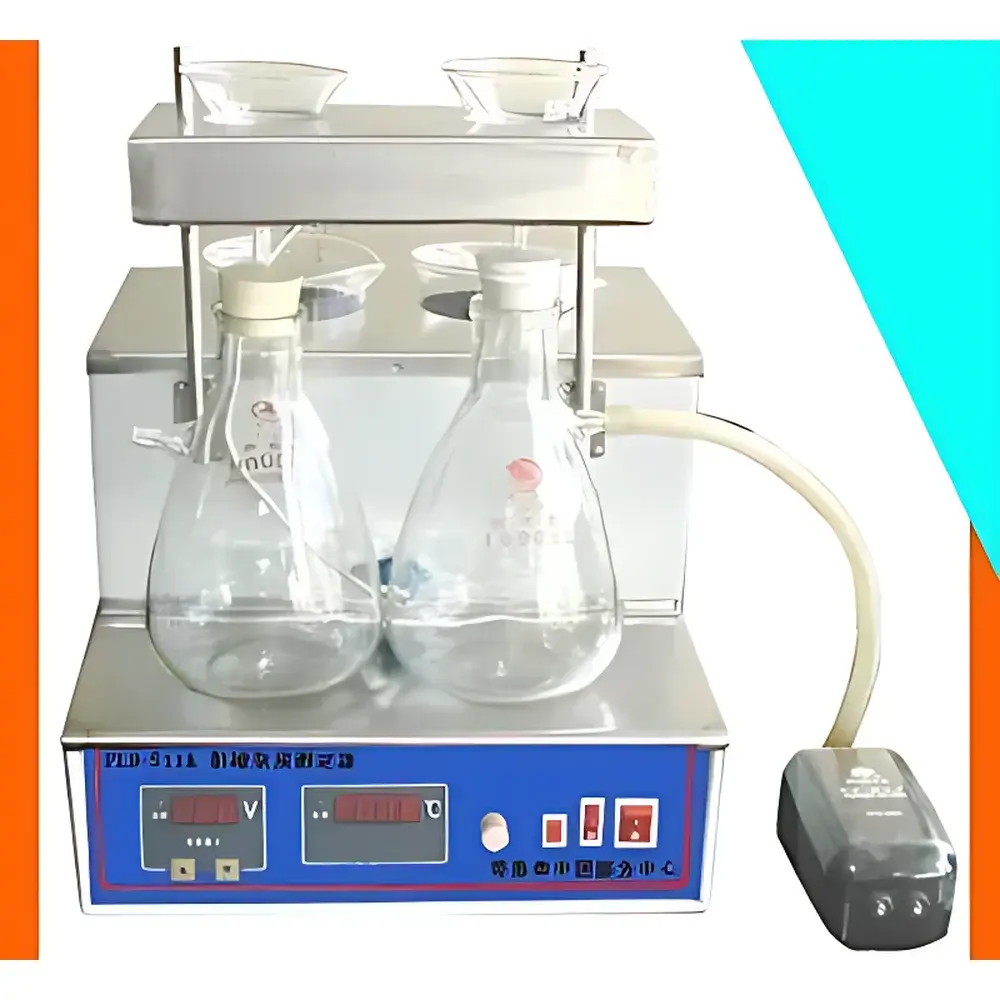
PULUODY PLD-511A Mechanical Impurities Tester for Petroleum Products and Additives
| Brand | PULUODY |
|---|---|
| Origin | Shaanxi, China |
| Manufacturer Type | Direct Manufacturer |
| Country of Origin | China |
| Model | PLD-511A |
| Power Supply | 220 V AC, 50 Hz |
| Input Power | 500 W (Heating: 2 × 100 W) |
| Ultimate Vacuum | ≥0.09 MPa |
| Air Extraction Rate | ≥20 L/min |
Overview
The PULUODY PLD-511A Mechanical Impurities Tester is a dedicated laboratory instrument engineered for the quantitative determination of mechanically insoluble particulate matter in petroleum products—including lubricating oils, base stocks, fuel oils, and additive packages—according to the methodology specified in GB/T 511–2010, “Petroleum Products and Additives — Determination of Mechanical Impurities”. This gravimetric filtration-based system operates on the principle of vacuum-assisted hot filtration through standardized filter media (typically ashless qualitative filter paper or membrane filters), followed by drying, cooling, and precise mass measurement of retained residue. The test provides critical data for assessing contamination levels, evaluating refining efficiency, verifying filtration performance, and ensuring compliance with product specifications in both production QC and third-party verification labs.
Key Features
- Integrated constant-temperature water bath (adjustable range: ambient to 95 °C) ensures controlled sample temperature during filtration, minimizing volatility loss and preventing wax precipitation in waxy distillates.
- Dual independent 100 W heating elements within the filter funnel assembly maintain uniform thermal conditions across the filtration surface—critical for viscous samples such as heavy-duty engine oils or gear lubricants.
- High-efficiency, low-noise vacuum pump delivers stable ultimate vacuum ≥0.09 MPa and continuous air extraction ≥20 L/min, enabling rapid and reproducible filtration even with high-residue or gel-prone samples.
- Front-panel vacuum pressure regulator with analog gauge allows real-time adjustment and monitoring of applied negative pressure—essential for optimizing filtration rate without filter rupture or sample splashing.
- Modular design facilitates easy disassembly, cleaning, and calibration; all wetted parts are constructed from borosilicate glass and stainless steel to resist chemical attack from hydrocarbons and solvents.
- Compliant with core operational requirements of ASTM D4378 (Standard Practice for Sampling and Handling Lubricating Oils for Analysis) and aligned with ISO 3733:2021 (Petroleum products — Determination of water and mechanical impurities — Gravimetric method).
Sample Compatibility & Compliance
The PLD-511A accommodates a broad spectrum of petroleum-based fluids per GB/T 511, including but not limited to: mineral and synthetic lubricating oils, hydraulic fluids, turbine oils, transformer oils, diesel fuels, residual fuel oils, and additive concentrates. It supports standard test masses (typically 100 g for oils, 25 g for fuels) and accepts both 11 cm and 9 cm diameter filter papers. The system meets essential safety and electromagnetic compatibility requirements per GB 4793.1–2007 (Safety requirements for electrical equipment for measurement, control, and laboratory use). While GB/T 511 remains the primary reference method, results generated using this instrument are routinely accepted in GLP-compliant laboratories and referenced in internal quality control protocols aligned with API RP 541 and ISO 4406:2017 (for particulate contamination classification).
Software & Data Management
The PLD-511A is a benchtop manual instrument with no embedded microprocessor or digital interface. All operational parameters—including water bath setpoint, vacuum pressure, heating duration, and filtration time—are manually controlled and recorded by the operator. Data integrity is maintained through adherence to documented SOPs, with raw mass measurements entered into laboratory notebooks or LIMS platforms. For full traceability in regulated environments (e.g., ISO/IEC 17025-accredited labs), users are advised to implement audit-trail-enabled electronic records systems that capture analyst ID, date/time stamps, balance calibration logs, and environmental conditions (e.g., lab temperature/humidity). The instrument’s mechanical simplicity ensures long-term reliability and minimal maintenance dependency—key attributes for routine QC workflows requiring high uptime.
Applications
- Quality assurance of finished lubricants prior to shipment, verifying conformance to mechanical impurity limits stipulated in OEM specifications (e.g., Caterpillar EC-1, MAN 3277).
- Monitoring filter performance in circulating oil systems during field trials or refinery commissioning.
- Root cause analysis of bearing wear failures where particulate contamination is suspected.
- Verification of additive package stability under thermal stress conditions.
- Supporting regulatory submissions for industrial lubricants under REACH or TSCA frameworks where physical contaminant profiles must be declared.
- Teaching laboratories demonstrating fundamental principles of gravimetric analysis and petroleum product purity assessment.
FAQ
What filter media are recommended for use with the PLD-511A?
Standard ashless qualitative filter paper (11 cm diameter, Whatman Grade 41 or equivalent) is specified in GB/T 511. Membrane filters (e.g., 0.45 µm mixed cellulose ester) may be used for specialized particulate sizing studies, though gravimetric reporting must account for inherent filter mass variability.
Can the PLD-511A be used for water-contaminated samples?
No. GB/T 511 explicitly excludes samples containing free water or emulsified water. Pre-drying via anhydrous sodium sulfate or centrifugation is required before mechanical impurity testing.
Is the instrument compatible with USP or ASTM methods?
While designed for GB/T 511, its functional configuration aligns closely with ASTM D2276 (for jet fuels) and ASTM D2709 (for distillate fuels), provided procedural adaptations—such as solvent selection and drying protocols—are validated per method requirements.
What maintenance intervals are recommended for the vacuum pump?
Oil-lubricated pumps require oil changes every 500 operating hours; dry diaphragm pumps (optional upgrade) require only periodic valve inspection every 1,000 hours.
Does the PLD-511A support GLP audit readiness?
Yes—when operated within a documented QA framework including equipment logbooks, preventive maintenance records, balance calibration certificates, and analyst training documentation, it satisfies core GLP infrastructure requirements for non-automated analytical instrumentation.




