
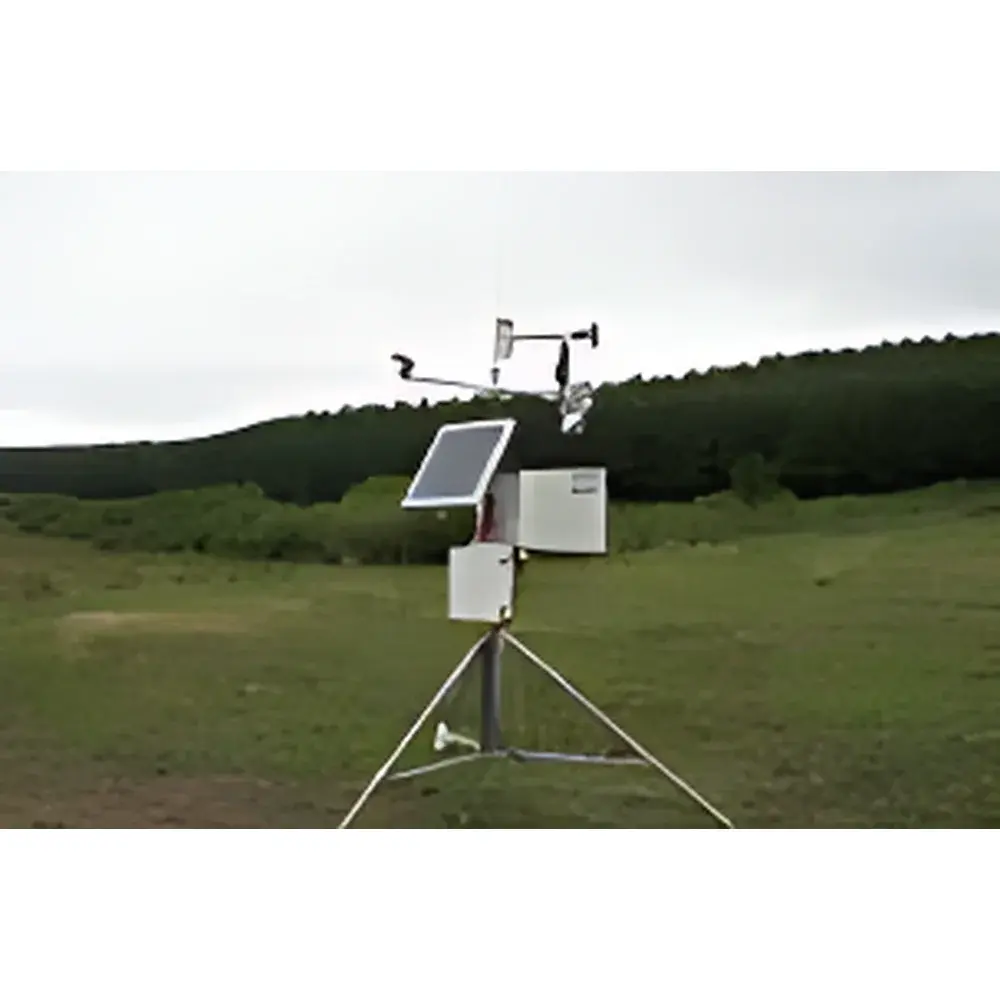
Dynamax Dynamet Series Research-Grade Wireless Weather Station
| Brand | Dynamax |
|---|---|
| Origin | USA |
| Model | Dynamet |
| Sensor Core | Gill MaxiMet™ 500 (Dynamet 2 & 5) / MaxiMet™ 600 (Dynamet 6) |
| Wind Measurement | Ultrasonic |
| Data Capacity | 100,000 records |
| ETP Calculation | Penman–Van Bavel (PENV) algorithm |
| Communication | Optional 2G/3G DTU or VPN-based cellular transmission |
| Compliance | ASTM D5098, ISO 17025-aligned sensor validation protocols, WMO Guide to Instruments and Methods of Observation (CIMO) reference-class deployment |
Overview
The Dynamax Dynamet Series is a research-grade, fully integrated wireless weather station engineered for long-term, unattended environmental monitoring in field-based agricultural, ecological, and hydrological applications. Designed and assembled in the United States, each unit ships as a factory-calibrated, pre-integrated system—complete with sensor wiring, firmware configuration, hardware stress testing, and embedded PENV (Penman–Van Bavel Evapotranspiration Potential) software. The core meteorological sensing architecture relies on Gill Instruments’ MaxiMet™ series intelligent sensors: the MaxiMet™ 500 powers the Dynamet 2 and Dynamet 5 configurations, while the Dynamet 6 integrates the higher-specification MaxiMet™ 600. These sensors implement a true monolithic design—housing ultrasonic wind speed and direction measurement, precision thermohygrometry, barometric pressure transduction, and pyranometry within a single, compact, aerodynamically optimized housing. This eliminates inter-sensor mounting errors and thermal cross-talk, ensuring traceable, high-reproducibility measurements aligned with World Meteorological Organization (WMO) CIMO guidelines for Class I reference stations.
Key Features
- Ultrasonic wind sensing: Contactless, icing-resistant wind speed (0.1–60 m/s) and wind direction (0–359°) measurement with no moving parts—enabling continuous operation in freezing conditions and reducing long-term maintenance requirements.
- Integrated PENV software: Embedded real-time calculation of hourly and daily potential evapotranspiration (ETP) using the Penman–Van Bavel model, validated against FAO-56 and ASCE-EWRI standards. Input parameters include net radiation, air temperature, relative humidity, wind speed, and atmospheric pressure—all acquired synchronously at 1 Hz sampling resolution.
- Multi-parameter environmental capture: Simultaneous measurement of air temperature (±0.3°C), relative humidity (±2% RH, 10–90% range), dew point, barometric pressure (±0.5 hPa), global solar irradiance (400–1100 nm spectral response), and precipitation—with optical tipping-bucket (Dynamet 2/5) or heated magnetic tipping-bucket (Dynamet 6) configurations.
- Robust data acquisition architecture: High-stability datalogger with non-volatile memory supporting up to 100,000 timestamped records; auto-start on power-up; configurable logging intervals from 1 minute to 24 hours; dual USB and RS-232 interfaces for local retrieval.
- Field-deployable enclosure: IP66-rated aluminum housing with integrated desiccant chamber, passive thermal management, and optional heater elements—validated for continuous operation across -40°C to +70°C ambient extremes.
Sample Compatibility & Compliance
The Dynamet Series meets the physical and metrological requirements for deployment in GLP-compliant environmental research, USDA ARS field trials, and NSF-funded ecosystem observatories. Sensor-level calibration certificates conform to ISO/IEC 17025 practices, with traceability to NIST standards where applicable. Rainfall sensors are certified per ASTM D5098 for tipping-bucket accuracy under dynamic flow conditions. Solar irradiance measurements adhere to ISO 9060:2018 Class C specifications for secondary standard pyranometers. All units support audit-ready metadata tagging—including sensor serial numbers, calibration dates, firmware revision, and GPS-derived location stamps—facilitating compliance with EPA Method 125 and USGS NWIS data submission protocols.
Software & Data Management
Dynamet systems ship with Windows-compatible communication utilities enabling direct USB or serial connection for configuration, firmware updates, and bulk data export in CSV or NetCDF format. The embedded PENV engine logs both raw sensor values and derived ETP outputs in parallel, preserving full traceability for peer-reviewed publication. Optional cellular telemetry modules (2G/3G DTU or carrier-agnostic VPN tunneling) enable secure, encrypted remote access via HTTPS or MQTT endpoints—fully compatible with cloud platforms including AWS IoT Core, Azure IoT Hub, and custom SCADA integrations. All remote transmissions include SHA-256 integrity checks and TLS 1.2 encryption, satisfying baseline cybersecurity requirements for federally funded infrastructure projects.
Applications
- Irrigation scheduling: Hourly ETP output enables dynamic deficit irrigation models for vineyards, orchards, and row crops—reducing water use by 12–22% without yield penalty in peer-validated field studies.
- Pest and disease forecasting: Integration of dew point duration, leaf wetness proxies (via RH and Td), and solar radiation thresholds supports early-warning models for Botrytis, Phytophthora, and spider mite outbreaks.
- Micrometeorological flux studies: Synchronized 1-Hz sampling supports eddy covariance preprocessing workflows when co-located with CO2/H2O analyzers and sonic anemometers.
- Climatological benchmarking: Long-term stability and WMO-aligned siting compliance make Dynamet installations suitable for NOAA Climate Reference Network (CRN) augmentation and IPCC AR6 regional validation datasets.
FAQ
What distinguishes the MaxiMet™ 500 from the MaxiMet™ 600 in the Dynamet platform?
The MaxiMet™ 600 adds integrated heating for precipitation sensor de-icing, enhanced barometric drift compensation over extended temperature cycles, and improved solar irradiance linearity below 100 W/m²—making it optimal for high-latitude or alpine deployments.
Can the PENV software be customized with site-specific crop coefficients?
Yes—the embedded algorithm accepts user-defined canopy resistance (rc) and albedo inputs via configuration file upload, enabling alignment with FAO-56 dual-crop coefficient methodology.
Is cellular telemetry module certification available for FCC and CE regulatory domains?
All optional DTU modules carry full FCC ID and CE RED certification, with documented SAR testing and EMC immunity reports available upon request.
How is data integrity maintained during extended network outages?
Local datalogger memory retains full-resolution data for ≥120 days at 15-minute intervals; automatic gap-filling occurs upon reconnection without timestamp interpolation.
Does the system support integration with third-party SCADA or GIS platforms?
Yes—standard Modbus RTU/ASCII and JSON-over-HTTP APIs are provided, with documented register maps and RESTful endpoint schemas for seamless ingestion into Ignition, Mango Automation, or QGIS TimeManager workflows.
Related Products







