
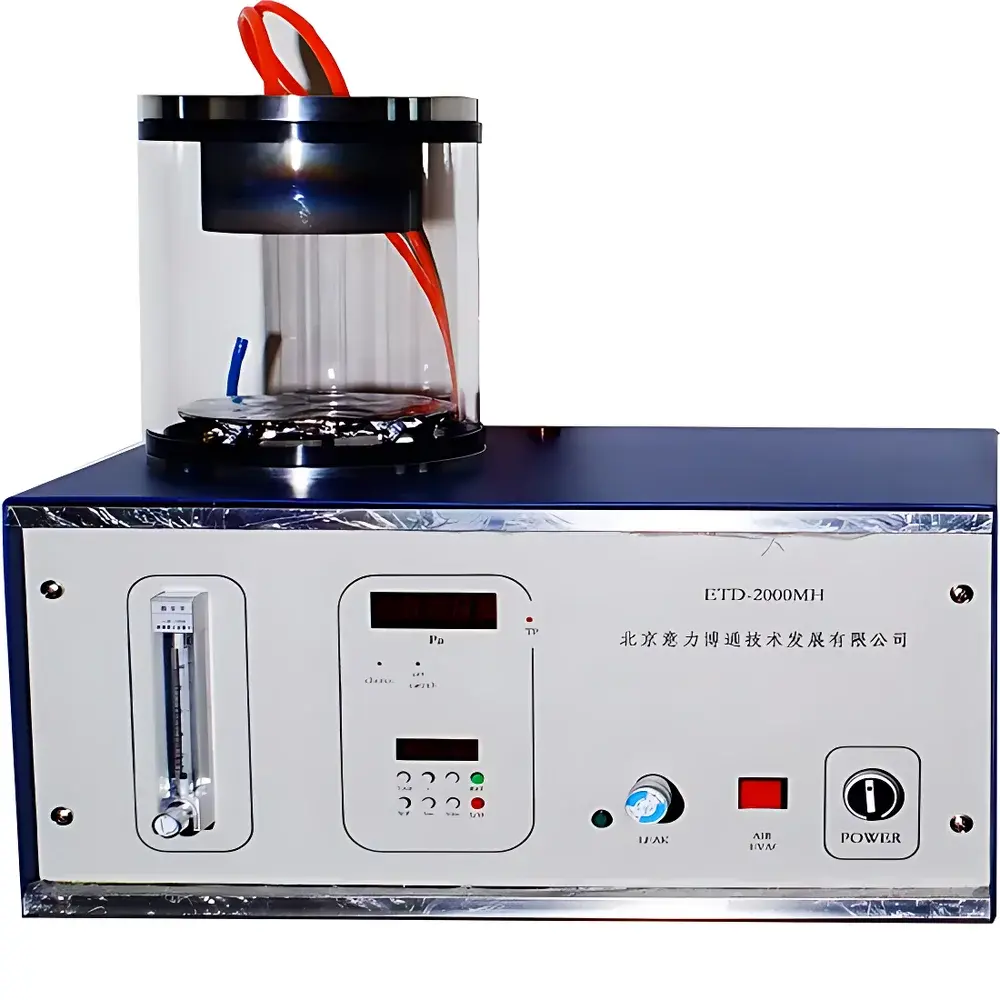
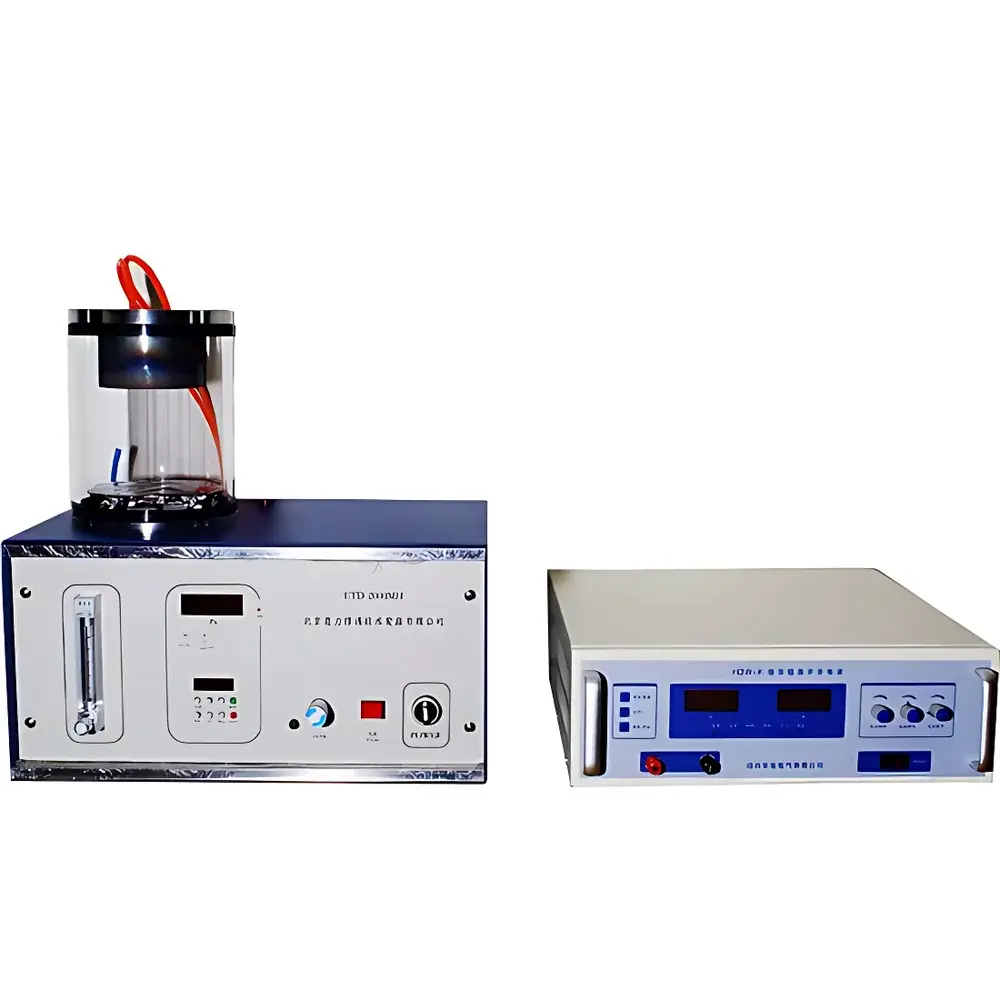
Elaborate ETD-2000MH Miniature High-Vacuum Magnetron Sputter Coater
| Brand | Elaborate |
|---|---|
| Origin | Beijing, China |
| Model | ETD-2000MH |
| Target Material | Multiple weak-magnetic targets (e.g., Au, Ag, Pt) |
| Target Diameter | 60–80 mm |
| Control Mode | Manual |
| Chamber Dimensions | Borosilicate glass, Ø180 mm × H240 mm |
| Sample Stage Diameter | 180 mm |
| Sputtering Gases | Ar, N₂, O₂, or custom gas mixtures |
| Ultimate Vacuum | ≤5×10⁻⁵ Pa |
| Pumping System | Turbo-molecular pump (80 L/s) + Two-stage rotary vane backing pump |
| Operating Voltage | 220 V, 50 Hz |
| Sputtering Current Range | 0–500 mA |
| Standard Target | Au (60 mm Ø × 0.1 mm thick) |
| Optional Targets | Ag, Pt, Cr, NiCr, C, etc. |
Overview
The Elaborate ETD-2000MH Miniature High-Vacuum Magnetron Sputter Coater is a compact, benchtop plasma deposition system engineered for high-fidelity conductive coating of non-conductive and beam-sensitive specimens prior to scanning electron microscopy (SEM), energy-dispersive X-ray spectroscopy (EDS), or focused ion beam (FIB) analysis. It operates on the principle of magnetron sputtering — a physical vapor deposition (PVD) technique in which a plasma discharge is sustained in low-pressure argon (or reactive) gas, and a magnetic field confines electrons near the target surface to enhance ionization efficiency. This confinement extends electron path length via E×B drift motion, increasing plasma density and enabling stable, low-energy sputtering at reduced substrate heating (<30 °C rise under standard conditions). The system achieves ultimate vacuum levels down to 5×10⁻⁵ Pa using a dual-stage pumping architecture: an 80 L/s turbo-molecular pump backed by a two-stage rotary vane pump — ensuring rapid pump-down, minimal hydrocarbon contamination, and long-term vacuum stability essential for reproducible thin-film morphology and stoichiometry.
Key Features
- Compact borosilicate glass chamber (Ø180 mm × H240 mm) with front-loading door and integrated viewport for real-time process observation
- Manually adjustable magnetron head with interchangeable weak-magnetic targets (60–80 mm diameter), compatible with Au, Ag, Pt, Cr, NiCr, carbon, and custom alloys
- Dual-pump vacuum system: high-speed turbo-molecular pump (80 L/s) + oil-free two-stage rotary vane pump — optimized for clean, hydrocarbon-minimized base pressure
- Manual current control (0–500 mA) with analog metering and over-current protection circuitry
- Uniform sample stage (Ø180 mm) with centering alignment marks and optional tilt/rotation adapters for angled deposition
- No external water cooling required; thermal management achieved via passive conduction and chamber geometry
- Compliant with IEC 61000-6-3 (EMC) and IEC 61010-1 (electrical safety) standards for laboratory instrumentation
Sample Compatibility & Compliance
The ETD-2000MH is routinely deployed for preparing biological tissues (e.g., plant epidermis, insect cuticles), polymers (PET, PMMA, PDMS), ceramics, and fragile geological specimens. Its low-temperature sputtering regime preserves ultrastructural integrity in electron-beam-sensitive materials, minimizing carbonization or topographical collapse during SEM imaging. Conductive coatings mitigate charging artifacts in insulating samples while maintaining nanoscale edge fidelity — critical for high-resolution backscattered electron (BSE) contrast and quantitative EDS mapping. All vacuum components conform to ASTM F2733-21 (Standard Practice for Cleaning and Handling Vacuum Components) and are assembled using metal gasketed CF-63 flanges to ensure leak-tight integrity. The system supports GLP-compliant operation when paired with external loggers for vacuum pressure, current, and time-stamped process records.
Software & Data Management
As a manually operated instrument, the ETD-2000MH does not include embedded firmware or proprietary software. However, its analog interface allows seamless integration with third-party data acquisition systems (e.g., National Instruments DAQ, LabVIEW) for logging sputtering current, chamber pressure (via optional Pirani/cold cathode gauge), and elapsed time. Users may implement audit-trail-capable workflows aligned with FDA 21 CFR Part 11 requirements by coupling the coater with timestamped electronic lab notebooks (ELNs) such as LabArchives or Benchling. Calibration certificates for vacuum gauges and current meters are provided upon request and traceable to NIM (National Institute of Metrology, China).
Applications
- Preparation of conductive coatings for SEM/TEM sample analysis of non-conductive materials (biological, polymeric, ceramic)
- Fabrication of reference electrodes and microelectrode arrays in electrochemical research
- Deposition of seed layers for subsequent electron-beam evaporation or ALD processes
- Controlled metallization of MEMS/NEMS devices requiring sub-5 nm thickness uniformity
- Routine quality control in failure analysis labs for cross-sectional imaging of PCB laminates and encapsulated ICs
- Teaching laboratories: demonstration of plasma physics, thin-film growth kinetics, and surface modification principles
FAQ
What vacuum level is required before initiating sputtering?
A base pressure ≤1×10⁻⁴ Pa is recommended prior to gas introduction; final working pressure during sputtering typically ranges from 0.5–5 Pa depending on gas type and current setting.
Can the system deposit oxide or nitride films?
Yes — by introducing reactive gases (O₂, N₂) into the argon plasma, compound films such as TiO₂, SiO₂, or TiN can be synthesized; precise stoichiometry requires mass flow controller integration (optional upgrade).
Is the glass chamber resistant to thermal shock during extended runs?
The borosilicate glass construction (Schott D263-type equivalent) withstands thermal gradients up to 120 °C; chamber wall temperature remains below 45 °C during 10-minute sputtering at 300 mA.
How often should the turbo pump oil be changed?
The turbo-molecular pump is oil-free; only the backing pump requires oil replacement every 2,000 operating hours or annually, whichever occurs first.
Does the system support automated process recipes?
Not natively — it is a manual-control platform. For programmable sequences (e.g., multi-target sputtering, timed gas switching), users may integrate external PLCs or relay controllers via the system’s dry-contact interlock ports.



