
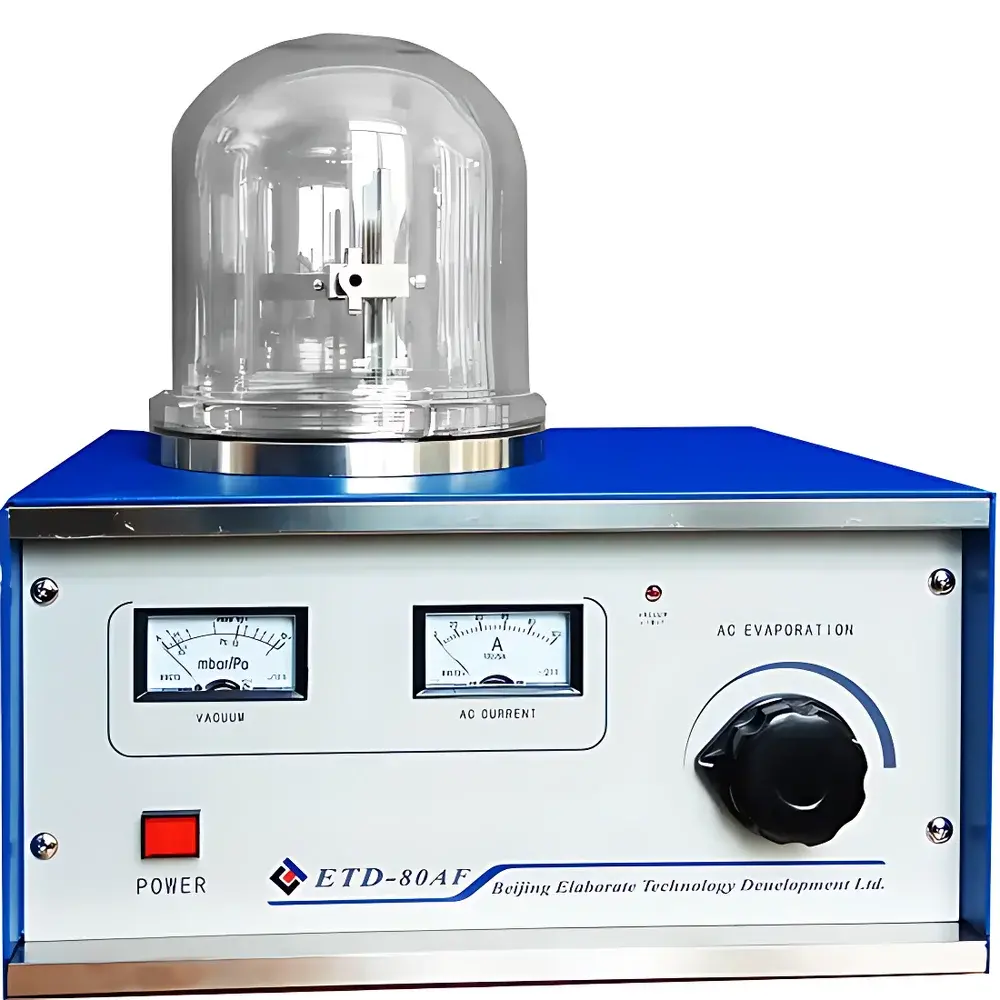
Elaborate ETD-80AF Benchtop Thermal Evaporation Coater
| Brand | Elaborate |
|---|---|
| Origin | Beijing, China |
| Model | ETD-80AF |
| Target Material | Carbon Rod |
| Control Method | Manual |
| Chamber Dimensions (D×H) | 170 mm × 200 mm |
| Sample Stage Diameter | 170 mm |
| Base Pressure | 2×10⁻² mbar |
| Operating Voltage | 220 V, 50 Hz |
| Maximum Evaporation Current | 100 A |
| Adjustable Evaporation Current Range | 0–80 A |
| Vacuum Pump | High-Performance Two-Stage Rotary Vane Pump (2 L/s) |
| Compatible Substrates | Non-conductive, beam-sensitive specimens (e.g., biological tissues, polymers, ceramics) |
Overview
The Elaborate ETD-80AF Benchtop Thermal Evaporation Coater is a compact, manually operated vacuum deposition system engineered for routine conductive coating of electron microscopy (EM) specimens. It operates on the principle of resistive thermal evaporation: a high-purity carbon rod is electrically heated under high vacuum to generate a directional vapor flux, which condenses uniformly onto substrates placed on a rotating or stationary stage. Unlike ion sputtering—where energetic ions physically dislodge target atoms—the ETD-80AF relies on thermal energy transfer to achieve sub-monolayer to micrometer-thick carbon films with minimal substrate heating and no plasma-induced damage. This makes it particularly suitable for beam-sensitive, non-conductive, or thermally fragile samples such as freeze-dried biological sections, polymer films, soft hydrogels, and nanocomposite powders. The system achieves stable base pressures down to 2×10⁻² mbar using a dedicated two-stage rotary vane pump (2 L/s pumping speed), ensuring consistent film nucleation and low contamination risk during deposition.
Key Features
- Benchtop footprint (W×D×H ≈ 450×400×380 mm) optimized for space-constrained EM labs and teaching facilities
- Manually adjustable DC power supply (0–80 A continuous, up to 100 A peak) with analog current meter and coarse/fine current regulation dials
- Stainless-steel vacuum chamber with borosilicate viewport (Ø100 mm), O-ring sealed lid, and quick-release clamping mechanism
- Centered sample stage (Ø170 mm) with optional rotation capability (mechanical drive, non-motorized) for improved thickness uniformity
- Carbon rod evaporation source mounted on water-cooled copper electrodes; compatible with standard Ø6 mm graphite rods (length up to 150 mm)
- Integrated vacuum gauge (Pirani type) with analog readout and pressure interlock to prevent evaporation at unsafe pressures
- No RF generator, no magnetron, no gas inlet—eliminates complexity, maintenance overhead, and argon consumption
Sample Compatibility & Compliance
The ETD-80AF supports a broad range of non-conductive and beam-sensitive specimens commonly encountered in SEM, TEM sample preparation, and materials characterization workflows. These include but are not limited to: lyophilized tissue sections, plant cuticles, bacterial biofilms, polymer microspheres, insulating ceramic particles, and organic thin-film transistors. Carbon coatings deposited via thermal evaporation provide excellent electrical conductivity (sheet resistance <10⁴ Ω/□ for 10 nm films), high secondary electron yield, and minimal topographic masking—critical for high-resolution backscattered electron (BSE) imaging and energy-dispersive X-ray spectroscopy (EDS) quantification. While the instrument itself does not carry CE or UL certification, its mechanical and electrical design conforms to IEC 61010-1 safety requirements for laboratory equipment. Vacuum components comply with ISO 8573-1 Class 4 compressed air purity standards when used with external filtration (recommended for pump exhaust lines). All operation protocols align with ASTM E1558 and ISO/IEC 17025 documentation practices for EM sample preparation traceability.
Software & Data Management
As a manually controlled system, the ETD-80AF does not incorporate digital controllers or proprietary software. However, its operational parameters—including evaporation current, duration, and observed chamber pressure—are fully recordable in laboratory notebooks or LIMS-compatible spreadsheets. Users may integrate external data loggers (e.g., USB-based thermocouple readers or pressure transducers) for time-stamped process monitoring. For GLP/GMP-regulated environments, laboratories routinely implement standardized SOPs (e.g., SOP-EM-007 “Carbon Coating by Thermal Evaporation”) that mandate operator signature, batch number, carbon rod lot ID, and post-coating SEM verification images—ensuring full auditability without embedded firmware. No FDA 21 CFR Part 11 compliance is required, as the device performs no analytical measurement or automated decision-making.
Applications
- Routine SEM sample preparation for biological, polymeric, and geological specimens requiring charge dissipation without structural alteration
- Deposition of ultra-thin carbon support films on TEM grids (via shadow evaporation mode with mask)
- Preparation of reference standards for EDS calibration (e.g., carbon-coated NIST SRM particles)
- Electrode fabrication for flexible electronics research—carbon layers serve as transparent, low-resistance interconnects
- Surface passivation of hygroscopic or reactive samples prior to cryo-SEM transfer
- Teaching lab demonstrations of vacuum physics, thin-film growth kinetics, and electron–matter interactions
FAQ
What types of carbon rods are compatible with the ETD-80AF?
Standard high-purity graphite rods (diameter 6 mm, length ≤150 mm) with resistivity ≤10 µΩ·m are recommended. Pre-sintered rods minimize outgassing; avoid binder-containing grades.
Can the ETD-80AF deposit metals such as gold or platinum?
No. The system is configured exclusively for carbon rod evaporation. Its electrode geometry, cooling capacity, and current delivery profile are not rated for metallic filament operation or higher-melting-point targets.
Is rotation of the sample stage motorized?
No. Rotation is optional and manually driven via an external crank; no built-in motor or encoder is provided.
What vacuum pump oil maintenance schedule is advised?
With typical usage (2–3 coatings/day), change the rotary vane pump oil every 200 operating hours or quarterly—whichever occurs first—to maintain base pressure stability and prevent backstreaming.
How is film thickness estimated without in-situ monitoring?
Thickness is inferred from empirical calibration curves correlating current × time product (A·s) with nominal thickness on silicon wafers, verified by cross-sectional TEM or stylus profilometry. Typical deposition rates range from 0.1 to 0.5 nm/s at 60 A.



