
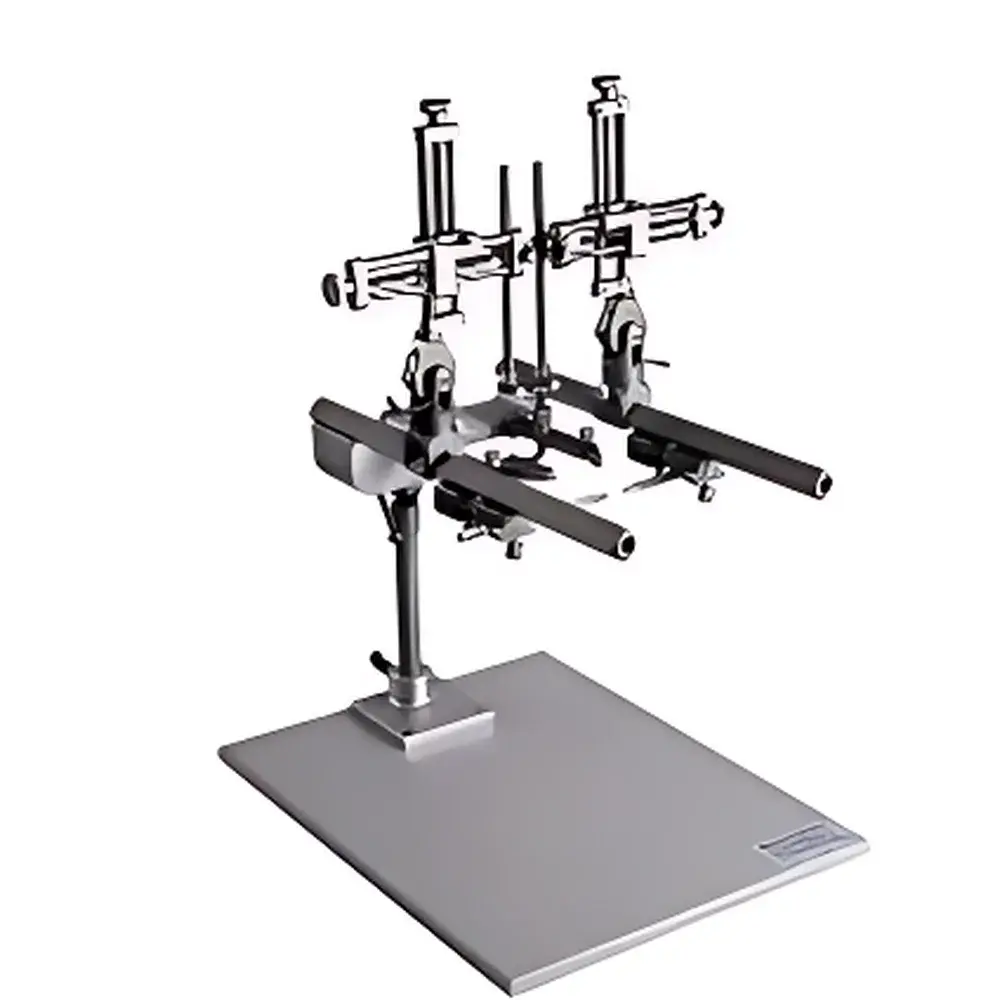
English Product Name
| Origin | Guangdong, China |
|---|---|
| Manufacturer Type | Authorized Distributor |
| Origin Category | Domestic (China) |
| Model | 68902 |
| Pricing | Upon Request |
Overview
The Neurostar 68902 Large-Animal Stereotaxic Instrument is an engineered precision platform for neurosurgical and electrophysiological interventions in non-rodent species—including dogs, non-human primates (NHP), and cats. Designed around a dual parallel-rail structural architecture, it enables simultaneous multi-site targeting within a single subject using up to six independently adjustable manipulators. Its core principle relies on stereotactic coordinate mapping relative to standardized anatomical landmarks (e.g., bregma, interaural line, external auditory meatus), ensuring spatial reproducibility across longitudinal studies. The system integrates mechanical rigidity with rotational flexibility: the rail assembly mounts directly to laboratory benches or custom baseplates and rotates freely through full 360° in all three orthogonal axes (pitch, yaw, roll), accommodating oblique surgical approaches and multi-angle electrode trajectories common in deep brain stimulation (DBS), optogenetic fiber implantation, and chronic recording protocols.
Key Features
- Dual parallel rail framework supporting up to six standard stereotaxic manipulators—enabling concurrent stimulation, recording, infusion, or ablation at distinct brain regions
- Three-axis rotational mounting system: 360° continuous rotation in X-, Y-, and Z-planes for adaptive positioning under fluoroscopic, MRI-guided, or freehand alignment workflows
- High-resolution manual positioning: ±100 µm resolution in vertical (dorsoventral) and horizontal (mediolateral/anteroposterior) axes via vernier-calibrated scale readouts
- Modular two-dimensional manipulator arms (model 68941/68942) with 180° vertical tilt and 360° azimuthal rotation—compatible with microdrive integration
- Dedicated primate and canine adapter (model 68080) engineered for stable cranial fixation across wide size ranges (e.g., rhesus macaque to beagle)
- Interchangeable ear bars (18° or 45° inclination, models 68303/68304) for optimized skull alignment and reduced tissue stress during prolonged procedures
- Standardized mounting interface compliant with widely adopted stereotaxic accessories—including hydraulic microdrives, optical cannulas, and silicon probe carriers
Sample Compatibility & Compliance
The Neurostar 68902 supports in vivo neuroscience applications across species requiring high-mass head stabilization and extended procedural duration. It accommodates subjects weighing 3–30 kg, including adult cynomolgus and rhesus macaques, domestic dogs (beagle, Labrador), and domestic cats. All components are constructed from anodized aluminum and stainless steel to ensure chemical resistance during repeated sterilization (autoclave-compatible up to 134°C, ISO 17664-compliant cleaning validation). The mechanical design conforms to ISO 13485-aligned manufacturing practices and meets mechanical safety requirements per IEC 61000-6-2 (EMC immunity) and IEC 61000-6-3 (EMC emissions). While not a medical device, its dimensional repeatability and structural stability support GLP-compliant preclinical study execution under OECD Principles of Good Laboratory Practice.
Software & Data Management
The Neurostar 68902 is a fully manual, hardware-only stereotaxic platform—no embedded electronics or proprietary software. This design eliminates electromagnetic interference (EMI) risks during electrophysiology, fMRI, or PET imaging sessions. All positional data are recorded manually using calibrated vernier scales; users integrate coordinates into third-party surgical planning tools (e.g., Paxinos & Watson atlases, MonkeyCARE, PRIME-DE templates) or DICOM-based neuronavigation systems (e.g., Brainstorm, SPM12, AFNI). For auditability, researchers document manipulator settings, adapter configurations, and landmark registration parameters in electronic lab notebooks (ELNs) compliant with 21 CFR Part 11 when used in regulated pharmacology/toxicology studies.
Applications
- Chronic intracranial electrode array implantation in non-human primates for motor decoding and closed-loop neuroprosthetics
- Multi-target DBS lead placement in canine models of Parkinson’s disease and epilepsy
- Stereotactic delivery of AAV vectors or stem cells into subcortical nuclei (e.g., substantia nigra, thalamus, hippocampus)
- Simultaneous optrode insertion and local field potential (LFP) recording in awake-behaving macaques
- Validation of MRI-guided targeting accuracy using post-procedural histological reconstruction
- Development and calibration of intraoperative navigation algorithms for translational neurosurgery
FAQ
Is the Neurostar 68902 compatible with microdrives from other manufacturers?
Yes—the manipulator arms feature standardized 1/4″-20 threaded mounting interfaces and accept third-party microdrives (e.g., NAN Instruments, FHC, Kopf) with appropriate adapters.
Can the rail system be mounted directly to a stereotaxic frame baseplate?
Yes—model 68951 includes M6 threaded inserts and adjustable clamping brackets for secure attachment to both commercial (e.g., David Kopf, Stoelting) and custom-machined baseplates.
What is the maximum load capacity per manipulator arm?
Each 68941/68942 arm supports up to 1.2 kg static load without perceptible deflection, verified per ASTM E2921-21 standard test method for stereotaxic frame rigidity.
Does the system include digital position feedback or motorized control?
No—it is a purely mechanical instrument designed for EMI-free operation; digital tracking requires external optical encoders or camera-based pose estimation systems.
Are replacement parts such as ear bars or adapters available separately?
Yes—all listed accessories (models 68201, 68303/68304, 68080) are stocked and sold individually for modular system expansion or maintenance.



