
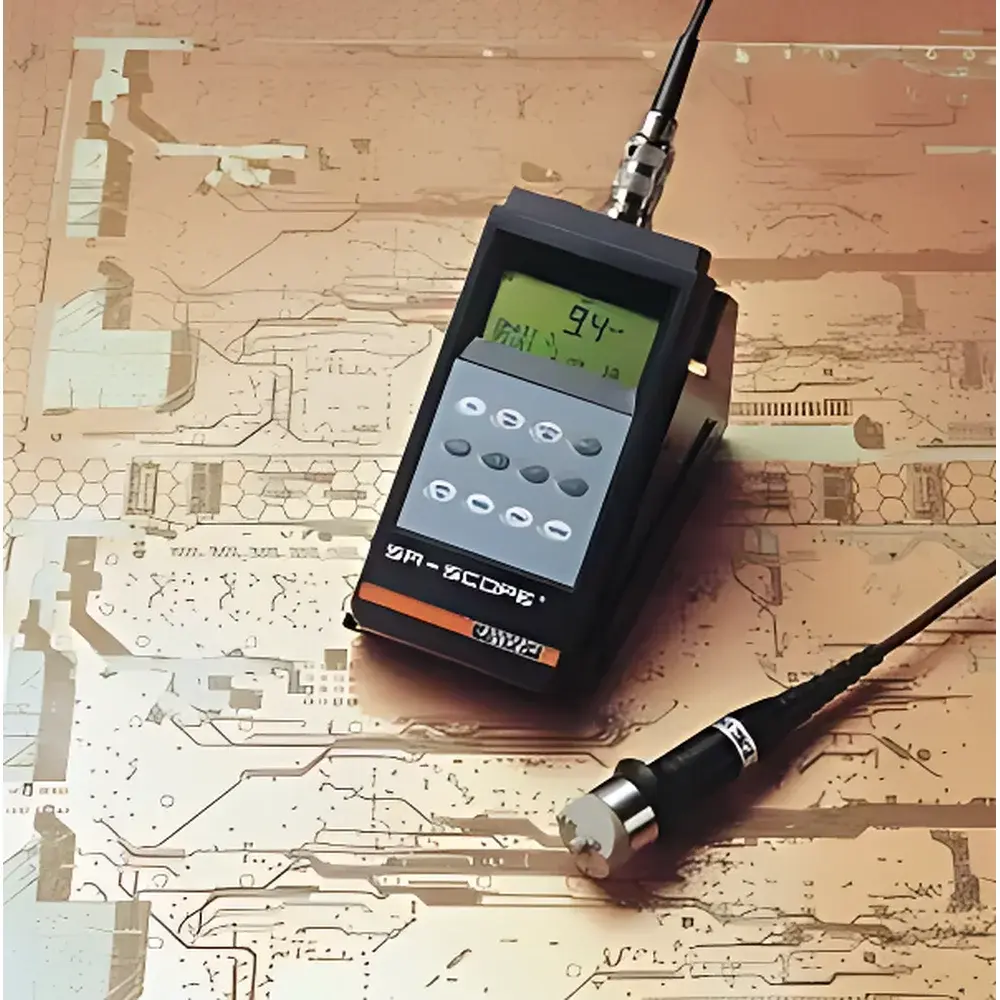
Fischer SR-SCOPE RMP30-S Electromagnetic Eddy Current Thickness Gauge for Copper Foil
| Brand | Fischer |
|---|---|
| Origin | Germany |
| Model | RMP30-S |
| Measurement Principle | Micro-resistive Method per EN 14571:2004 |
| Display | Dual-line, 16-character LCD (2 × 16) |
| Memory Capacity | Up to 100 application setups |
| Data Storage | Up to 10,000 measurements across 1,000 data blocks with timestamp (date/time stamping) |
| Interface | Bidirectional RS232 port |
| Probe Recognition | Automatic probe identification |
| Audio Feedback | Audible limit alarm |
| Statistical Functions | Mean, Std. Dev., Min/Max, Cp/Cpk, histogram generation |
| Compatible Probes | ERCU-N, ERCU-D10 |
| Power Supply | Rechargeable battery or AC adapter |
Overview
The Fischer SR-SCOPE RMP30-S is a portable, microprocessor-controlled thickness gauge engineered specifically for non-destructive measurement of copper foil thickness on non-conductive substrates—such as polyimide (PI), polyester (PET), and FR-4 laminates—using the micro-resistive principle defined in EN 14571:2004. Unlike conventional eddy current or magnetic induction gauges, this instrument applies a low-frequency alternating current to generate a controlled micro-resistive field between the probe tip and the conductive copper layer. The resulting voltage drop correlates directly with foil thickness in the range typical for PCB and flexible circuit manufacturing (typically 5 µm to 140 µm), delivering high reproducibility and minimal substrate interference. Its handheld ergonomics, integrated real-time calibration logic, and dual-line alphanumeric display enable rapid, operator-independent verification at production line checkpoints, incoming inspection stations, and R&D laboratories.
Key Features
- Compliance with EN 14571:2004 for standardized copper foil thickness assessment on non-magnetic, non-conductive base materials.
- Dual-line 16-character LCD display providing simultaneous visibility of measured value and contextual operation prompts (e.g., “CALIBRATE”, “PROBE OK”, “OUT OF SPEC”).
- Onboard memory supporting up to 100 user-defined application configurations—each storing unique calibration curves, tolerance limits, and unit preferences.
- Dynamic data management architecture enabling storage of up to 10,000 individual measurements distributed across 1,000 timestamped data blocks (YYYY-MM-DD HH:MM:SS).
- Full post-measurement data editing capability: users may selectively review, annotate, delete, or reassign measurements within stored blocks without data corruption.
- Automatic probe recognition via embedded EEPROM—ensures correct parameter loading when switching between ERCU-N (standard resolution) and ERCU-D10 (high-resolution, 10 MHz optimized) probes.
- Bidirectional RS232 interface compliant with standard PC COM port protocols; supports direct export to Excel-compatible .CSV files or real-time printing via compatible thermal or dot-matrix printers.
- Configurable audio alerts triggered upon deviation from user-specified upper/lower specification limits—critical for pass/fail decision-making in high-throughput QA environments.
- Integrated statistical engine computing mean, standard deviation, min/max, process capability indices (Cp, Cpk), and frequency distribution histograms—fully traceable per ISO 9001 and IATF 16949 documentation requirements.
Sample Compatibility & Compliance
The RMP30-S is validated for use on rolled annealed (RA) and electrodeposited (ED) copper foils bonded to electrically insulating substrates. It is not suitable for ferromagnetic backing layers (e.g., steel-backed foils) or multi-layer stacks where underlying conductive planes interfere with field penetration. Measurement accuracy is maintained under ambient conditions of 10–40 °C and ≤80% RH. Device firmware and calibration routines conform to metrological traceability requirements outlined in ISO/IEC 17025:2017. All factory calibrations are performed using NIST-traceable copper foil standards certified by PTB (Physikalisch-Technische Bundesanstalt). The instrument supports GLP-compliant audit trails when paired with Fischer’s optional DataTransfer software (v4.2+), including electronic signature capture and change-log history per FDA 21 CFR Part 11 Annex 11 guidelines.
Software & Data Management
DataTransfer PC software (Windows 10/11 compatible) provides secure bidirectional communication, automated report generation (PDF/Excel), and database synchronization with enterprise MES or LIMS platforms. Raw measurement logs include metadata: operator ID, probe serial number, calibration date, environmental temperature, and GPS-tagged location (when used with optional Bluetooth GPS module). Audit-ready export formats support ISO 10012 and ASTM E2655 compliance. Firmware updates are delivered via encrypted USB stick or authenticated HTTPS download—no internet connection required during field operation.
Applications
- Quality assurance of copper foil thickness in flexible printed circuit board (FPCB) fabrication lines.
- Incoming material inspection per IPC-4562A and JIS C 5012 standards.
- Process validation for electroplating, roll-to-roll lamination, and etch compensation studies.
- R&D characterization of ultra-thin (<12 µm) copper foils used in high-density interconnects and advanced packaging.
- Supplier qualification audits requiring documented repeatability (≤1.5% RSD) and reproducibility (≤2.5% RSD) per Gage R&R protocols.
FAQ
What substrate materials are compatible with the RMP30-S?
Non-conductive, non-magnetic substrates only—including polyimide (PI), polyester (PET), epoxy-glass (FR-4), and ceramic carriers. Metallic or carbon-filled substrates will invalidate measurement.
Does the instrument require annual recalibration?
Yes. Fischer recommends traceable recalibration every 12 months or after 10,000 measurements—whichever occurs first—using certified reference foils and documented uncertainty budgets.
Can the RMP30-S measure copper on aluminum carrier foils?
No. Aluminum is conductive and introduces eddy current interference that violates EN 14571:2004 measurement assumptions. Dedicated dual-frequency instruments are required for such configurations.
Is the RS232 interface compatible with modern laptops lacking legacy serial ports?
Yes—via industrially rated USB-to-RS232 adapters (FTDI chipset recommended); driver installation and COM port mapping are fully supported in Windows Device Manager.
How is measurement uncertainty quantified for audit purposes?
Uncertainty budget includes contributions from probe repeatability (±0.3 µm), temperature drift (±0.02 µm/°C), calibration standard uncertainty (k=2, ±0.15 µm), and operator influence (±0.2 µm), yielding a combined expanded uncertainty of ±0.8 µm (k=2) for 18–35 µm nominal thicknesses.



