
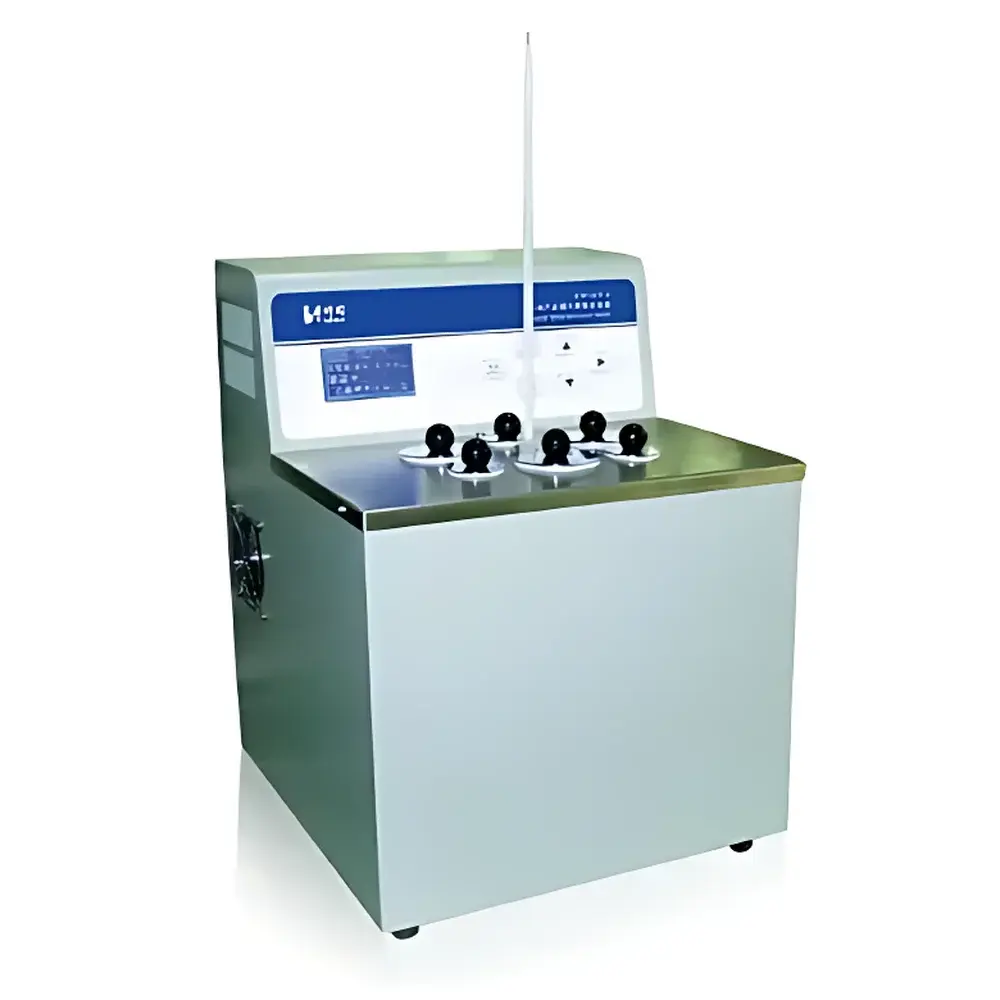
Shenkai SYP1017-II Petroleum Product Copper Strip Corrosion Tester
| Brand | Shenkai |
|---|---|
| Origin | Shanghai, China |
| Model | SYP1017-II |
| Heating Medium | Aluminum Block Metal Bath |
| Temperature Range | 40–200 °C |
| Setpoint Accuracy | ±0.2 °C |
| Inter-hole Temperature Uniformity | ≤1 °C (max gradient across six wells) |
| Heating Power | 800 W |
| Test Capacity | 6 simultaneous tests (3 pressure bombs + 3 cylindrical test tubes) |
| Timer Range | 0–599 min (1-min increments) |
| Max Pressure Rating | 0.7 MPa |
| Compliance | GB/T 5096, ASTM D130, ISO 2160, IP 154 |
Overview
The Shenkai SYP1017-II Petroleum Product Copper Strip Corrosion Tester is a precision-engineered benchtop instrument designed to evaluate the corrosive activity of hydrocarbon-based fuels and lubricants toward polished copper strips under standardized thermal and pressurized conditions. It operates on the principle of controlled immersion: a cleaned, polished copper strip is placed inside a sealed test bomb or open tube, immersed in the sample, and heated to a specified temperature for a defined duration. Following exposure, the strip’s surface discoloration—ranging from bright metallic to dark brown, black, or iridescent tarnish—is visually assessed against the ASTM D130 color standard chart to assign a corrosion rating (Class 1a to 4). This qualitative yet highly reproducible method is universally adopted for quality control in refinery operations, fuel blending facilities, and third-party testing laboratories, where early detection of active sulfur compounds (e.g., mercaptans, sulfides, elemental sulfur) is critical to preventing downstream equipment degradation.
Key Features
- Aluminum block metal bath with six precisely machined test wells—engineered for rapid thermal response and exceptional spatial uniformity (≤1 °C inter-well deviation at 100 °C)
- Digital microprocessor-based temperature controller with auto-calibration capability and real-time offset correction to maintain ±0.2 °C setpoint accuracy
- Integrated safety logic: automatic audible/visual alarm triggers when bath temperature exceeds 220 °C; hardware-limited thermal cutoff prevents uncontrolled overheating
- Intuitive front-panel interface with high-contrast LCD display showing real-time bath temperature, elapsed time, remaining time, and system status—all in English-language prompts
- Configurable timer with 1-minute resolution (0–599 min), supporting both single-run and batch-mode scheduling with end-of-test acoustic alert
- Robust mechanical design accommodating both pressurized test bombs (rated to 0.7 MPa) and open-tube configurations per ASTM D130 Annex A1 and ISO 2160 Clause 7
Sample Compatibility & Compliance
The SYP1017-II is validated for use with aviation gasoline, jet fuel (Jet A/A-1), automotive gasoline, naphtha, kerosene, diesel fuel, distillate heating oils, lubricating base oils, natural gasoline, and other hydrocarbons exhibiting a vapor pressure ≤124 kPa (930 mmHg) at 37.8 °C. Its operational envelope aligns strictly with the procedural requirements of GB/T 5096–2010, ASTM D130–22, ISO 2160:2020, and IP 154. All thermal and timing parameters are traceable to NIST-traceable reference standards. The instrument supports GLP-compliant workflow documentation when paired with external lab information management systems (LIMS), and its deterministic control architecture enables audit-ready record generation for regulatory submissions under FDA 21 CFR Part 11 when integrated with compliant electronic signature modules.
Software & Data Management
While the SYP1017-II operates as a standalone instrument with embedded firmware, its serial RS-232 port (optional USB-to-serial adapter available) enables bidirectional communication with laboratory PCs running Windows-based data acquisition software. Users may export timestamped temperature logs, start/stop events, and operator ID metadata in CSV format for integration into LIMS or ELN platforms. Firmware includes built-in self-diagnostics: power-on system check verifies sensor integrity, heater continuity, and display functionality prior to enabling test initiation. Parameter entry incorporates input validation—temperature values outside 40–200 °C or timer entries beyond 599 min are rejected with on-screen error notification.
Applications
- Refinery QC labs performing routine copper strip corrosion screening on finished gasoline and diesel batches prior to pipeline shipment
- Fuel additive compatibility assessment—verifying that detergent or antioxidant packages do not induce copper corrosion under accelerated aging conditions
- Contract testing laboratories conducting ASTM D130-compliant certification for marine diesel (ISO 8217) and aviation turbine fuel (DEF STAN 91-91)
- R&D departments evaluating sulfur scavenger efficacy in low-sulfur fuel formulations
- Regulatory compliance verification for EN 590 (automotive diesel) and ASTM D975 (diesel fuel oils), both of which mandate copper strip corrosion testing as a mandatory specification
FAQ
What standards does the SYP1017-II fully support?
It is designed and verified for full conformance with GB/T 5096, ASTM D130, ISO 2160, and IP 154—including all specified temperature ramp rates, dwell times, and visual assessment protocols.
Can the instrument run multiple test types simultaneously?
Yes—the six-well aluminum bath allows concurrent execution of up to three pressurized bomb tests and three open-tube tests, enabling comparative analysis of different sample matrices or treatment conditions within a single thermal cycle.
Is calibration traceability provided with the unit?
Each unit ships with a factory calibration certificate referencing NIST-traceable temperature standards; users may perform field verification using certified RTD probes and digital thermometers per ASTM E74.
How is operator error minimized during setup?
The system enforces parameter validation on entry, blocks out-of-range inputs, displays real-time feedback during test progression, and requires explicit confirmation before initiating thermal ramping.
What maintenance is required for long-term reliability?
Routine cleaning of the aluminum bath wells with non-abrasive solvents, periodic inspection of O-rings in test bombs, and annual verification of temperature sensor drift using a calibrated reference thermometer are recommended per IEC 61000-4-30 maintenance guidelines.




