
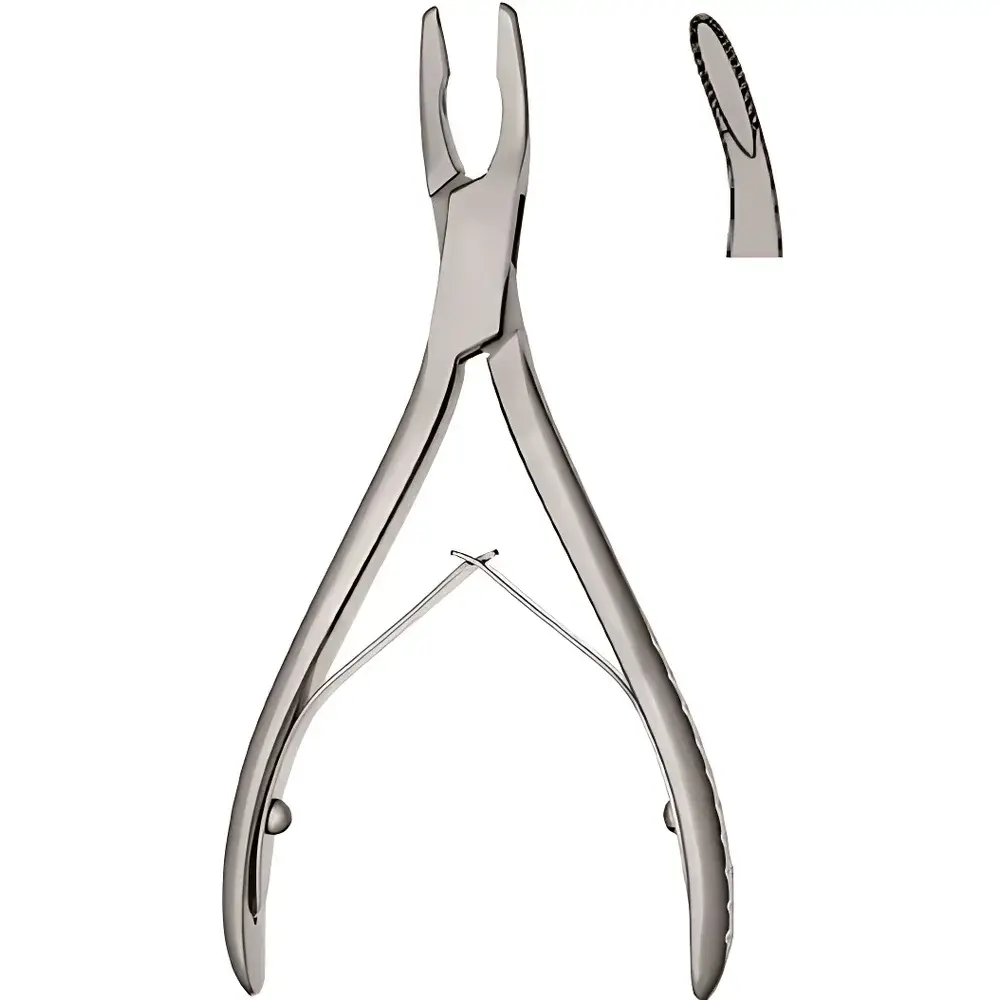
FRIEDMAN S21015-14 Single-Joint Curved Rongeur Forceps
| Brand | RWD |
|---|---|
| Origin | Shenzhen, China |
| Manufacturer Type | Direct Manufacturer |
| Country of Origin | China |
| Model | S21015-14 |
| Price | USD 78 (approx.) |
Overview
The FRIEDMAN S21015-14 Single-Joint Curved Rongeur Forceps is a precision surgical instrument engineered for controlled bone and calcified tissue removal in neurosurgical, orthopedic, and spinal procedures. Designed according to classical Friedman geometry, this rongeur features a single-joint articulation mechanism that delivers direct mechanical coupling between handle and jaw—minimizing energy loss and maximizing tactile feedback during bone trimming or laminectomy preparation. Its 14 cm overall length and 2 mm jaw opening provide optimal ergonomics for deep-field access while maintaining fine control in confined anatomical spaces. The instrument operates on a lever-based cutting principle: compression of the handles drives the upper jaw downward against the fixed lower jaw, generating high localized shear stress at the tip to fracture and excise small fragments of cortical or cancellous bone without excessive crushing.
Key Features
- Single-joint pivot design ensures consistent force transmission and eliminates play or wobble during repetitive use.
- Curved jaw profile (15° upward bend) facilitates sublaminar and intracanal approaches, especially in cervical and thoracic spine exposure.
- Hardened stainless steel construction (AISI 420 or equivalent) with mirror-finish passivation meets ISO 7153-1 requirements for surgical instruments.
- Micro-textured finger grips and ergonomic handle contour reduce hand fatigue during prolonged procedures.
- Autoclavable up to 134°C (273°F) for 18 minutes per EN 285; compatible with standard hospital sterilization cycles including steam, ethylene oxide, and low-temperature hydrogen peroxide plasma.
- Tip geometry optimized for clean bone nibbling—minimal tissue drag and reduced risk of dural tear compared to straight or double-joint variants.
Sample Compatibility & Compliance
This rongeur is intended for manual use on human osseous tissue—including laminae, spinous processes, vertebral pedicles, and cranial bone flaps—under sterile conditions. It is not designed for use on metal implants, ceramic scaffolds, or synthetic bone substitutes. The device complies with ISO 13485:2016 quality management system requirements for medical device manufacturers. As a Class I non-sterile, reusable surgical instrument under EU MDR 2017/745 and FDA 21 CFR Part 878.4100, it requires user-initiated reprocessing per AAMI ST79 and ANSI/AAMI ST58 standards. Documentation includes material biocompatibility data (ISO 10993-1, -5, -10), corrosion resistance testing (ASTM F2129), and dimensional traceability to NIST-traceable gauges.
Software & Data Management
No embedded electronics or software components are present in this mechanical instrument. All usage records—including sterilization logs, maintenance intervals, and visual inspection results—must be maintained manually or integrated into institutional asset tracking systems compliant with ISO 15189 and CAP accreditation guidelines. For institutions operating under GLP or GCP frameworks, instrument calibration history and reprocessing validation reports must be retained for minimum periods defined by local regulatory authorities (e.g., FDA 21 CFR Part 11 does not apply to non-electronic devices, but audit trails for reuse documentation remain mandatory).
Applications
- Laminectomy and laminoplasty preparation in decompressive spinal surgery.
- Cranial burr hole expansion and bone flap contouring in neurosurgery.
- Transnasal sphenoid sinus ostium enlargement in endoscopic skull base procedures.
- Removal of osteophytes or ossified ligament fragments in stenotic spinal canals.
- Preparation of bony bed for cranioplasty or bone graft placement.
- Orthopedic foot and ankle surgery requiring precise metatarsal or tarsal bone shaping.
FAQ
Is this instrument supplied sterile?
No. The FRIEDMAN S21015-14 is provided non-sterile and must undergo validated pre-use sterilization.
What is the recommended sharpening protocol?
Sharpening shall only be performed by certified biomedical technicians using diamond-coated files or CNC-controlled sharpening systems calibrated to original factory angles (12° ± 1° bevel). Re-sharpening voids warranty if deviating from OEM specifications.
Can this rongeur be used on pediatric patients?
Yes—its 2 mm jaw opening and 14 cm length make it suitable for adolescent and adult anatomy; however, use in infants or neonates requires alternative instrumentation with smaller dimensions.
Does RWD provide instrument tracking or UDI support?
Yes. Each unit carries a permanent laser-etched alphanumeric identifier enabling integration into hospital ERP or RFID-based instrument tracking systems compliant with GS1 UDI-DI standards.
What is the expected service life under routine reprocessing?
When maintained per AAMI TIR12 and inspected after every 100 sterilization cycles, the instrument demonstrates ≥5 years of functional service life with no measurable degradation in jaw alignment or spring tension.




