
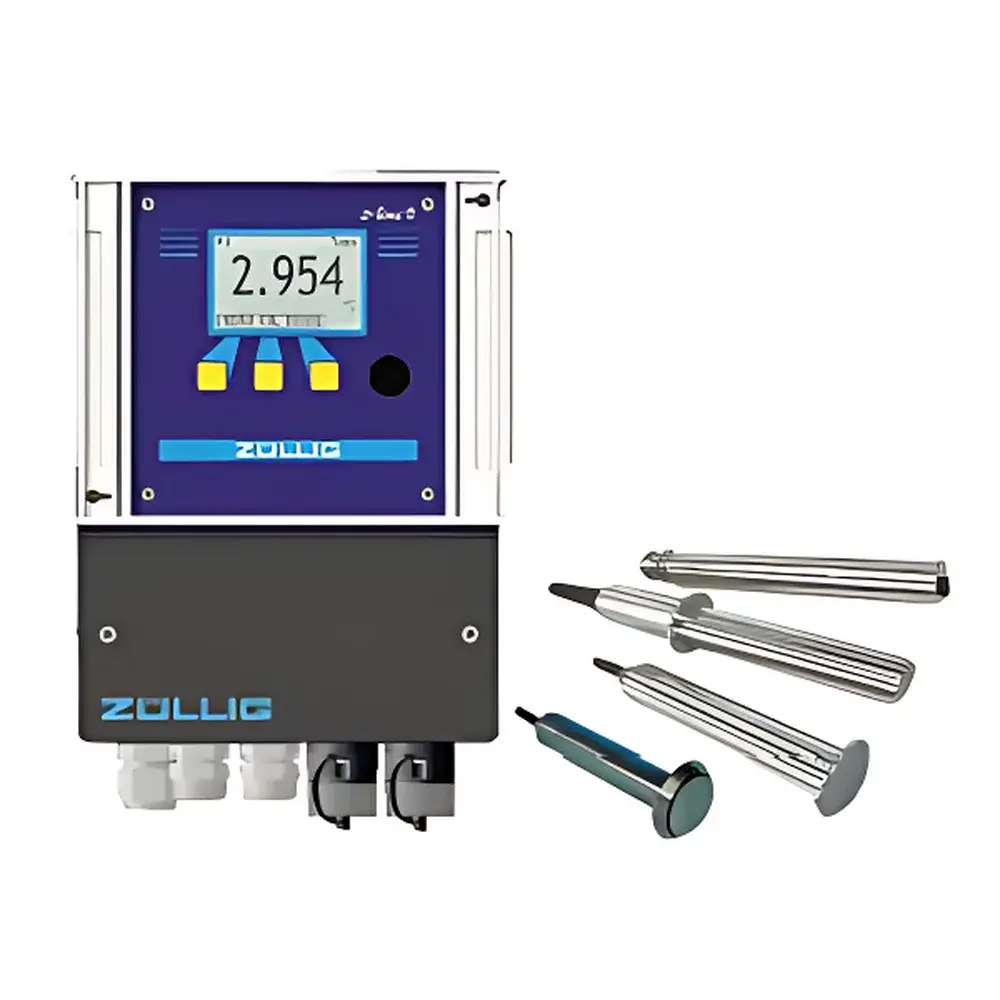
HACH COSMOS-25 Turbidity and Suspended Solids Analyzer
| Brand | HACH |
|---|---|
| Origin | Imported |
| Manufacturer Type | Manufacturer |
| Model | COSMOS-25 |
| Turbidity Measurement Principle | Dual-channel 90° scattered light (DIN/EN 27027 & ISO 7027 compliant, 860 nm) + 8-angle multi-angle scattering verification |
| SS Measurement Principle | Enhanced multi-angle absorbance (8-channel, 860 nm) |
| Turbidity Range | 0.001–10,000 NTU |
| Turbidity Resolution | 0.001 NTU (0–0.999 FNU), 0.01 NTU (1–9.99 FNU), 0.1 NTU (10–99.9 FNU), 1 NTU (>100 FNU) |
| Turbidity Accuracy | < ±3% of reading |
| Turbidity Repeatability | < ±4% of reading |
| SS Range | ≥0.001 g/L (upper limit medium-dependent |
| SS Resolution | 0.001 g/L (0–0.999 g/L), 0.01 g/L (1–9.99 g/L), 0.1 g/L (10–99.9 g/L), 1 g/L (>100 g/L) |
| SS Accuracy | Medium- and calibration-dependent |
| SS Repeatability | Dependent on sample homogeneity |
| Cleaning | Integrated mechanical self-positioning wiper |
| Signal Transmission | Long-distance analog/digital output without intermediate transmitter |
| Architecture | Modular, field-expandable design |
Overview
The HACH COSMOS-25 Turbidity and Suspended Solids Analyzer is an in-line, dual-parameter optical sensor engineered for continuous, real-time monitoring of turbidity (NTU/FNU) and suspended solids concentration (g/L) in heterogeneous aqueous matrices. It operates on two complementary photometric principles: standardized 90° forward-scattered light detection per DIN/EN 27027 and ISO 7027 (using an 860 nm infrared LED) for turbidity, and enhanced multi-angle absorbance analysis across eight discrete optical paths at the same wavelength for suspended solids quantification. Unlike conventional single-angle or single-wavelength analyzers, the COSMOS-25 leverages its patented 8-channel angular measurement architecture to decouple optical interference from particle size distribution, color, bubble entrainment, and refractive index variation—enabling robust performance in highly variable industrial and municipal streams where traditional sensors exhibit drift or saturation.
Key Features
- Patented dual-parameter optical engine: Simultaneous, co-located measurement of turbidity and suspended solids using a single probe—eliminating inter-sensor alignment errors and reducing installation footprint.
- Multi-angle photometric compensation: Eight independent optical channels enable real-time correction for non-ideal scattering behavior, improving accuracy in colored, aerated, or high-solids media such as activated sludge, digestate, and pulp suspensions.
- Self-positioning mechanical wiper: Integrated cleaning mechanism with precise angular retraction ensures consistent optical window exposure without manual intervention or compressed air dependency.
- Modular signal architecture: Supports 4–20 mA analog output, Modbus RTU/ASCII, and optional HART or Profibus PA interfaces—designed for direct integration into PLCs, DCS, or SCADA systems without external signal conditioners.
- Extended dynamic range: Turbidity measurement spans six orders of magnitude (0.001–10,000 NTU); suspended solids quantification remains stable up to >200 g/L in biological sludge and >400 g/L in mineral suspensions—covering raw influent, secondary clarifier underflow, and dewatered cake applications.
- Field-expandable platform: Optional modules include temperature compensation, pressure-rated housings (up to 10 bar), explosion-proof enclosures (ATEX/IECEx), and digital diagnostics for predictive maintenance logging.
Sample Compatibility & Compliance
The COSMOS-25 is validated for use in potable water distribution networks, surface water intake monitoring, wastewater treatment plants (influent, bioreactors, secondary clarifiers, and effluent discharge points), and industrial process streams including pulp & paper whitewater, dairy whey processing, and brewing fermentation tanks. Its optical design complies with ISO 7027:2016 for turbidity and aligns with the measurement principles referenced in ASTM D6508 (standard guide for turbidity measurement in wastewater) and EN 872 (water quality — determination of suspended solids). While not intrinsically certified for GLP or FDA 21 CFR Part 11 environments, its data integrity features—including configurable audit trails, calibration lockout, and timestamped event logs—support validation under GMP-aligned QA frameworks when deployed with HACH’s AquaSuite software.
Software & Data Management
The analyzer interfaces natively with HACH’s AquaSuite™ platform, enabling centralized configuration, remote calibration validation, and trend-based diagnostic alerts (e.g., lens fouling rate estimation, signal-to-noise ratio decay). All measurements are timestamped and stored with metadata including ambient temperature, cleaning cycle status, and optical path health indicators. Raw channel-level data (eight absorbance and two scatter signals) is accessible via Modbus register mapping for custom algorithm development—supporting site-specific compensation models for unique matrix effects. Firmware updates are delivered over standard Ethernet or RS-485, with version rollback capability and cryptographic signature verification.
Applications
- Municipal drinking water: Real-time detection of filter breakthrough, source water variability, and disinfection byproduct precursor correlation.
- Wastewater treatment: Optimization of return activated sludge (RAS) flow control, waste activated sludge (WAS) wasting rate, and membrane bioreactor (MBR) flux management.
- Pulp & paper industry: Monitoring of fiber loss in whitewater circuits and consistency control in stock preparation systems.
- Fermentation & beverage production: Tracking yeast viability and sedimentation kinetics in beer lagering tanks and dairy ultrafiltration retentate streams.
- Industrial cooling water: Early detection of biofilm detachment events and corrosion particulate generation.
FAQ
Does the COSMOS-25 require periodic recalibration?
Yes—calibration frequency depends on application severity. For potable water, annual verification against formazin or AMCO AEPA standards is recommended; for activated sludge applications, quarterly span calibration using site-specific slurries is advised.
Can it measure in highly aerated or foaming streams?
Its multi-angle architecture significantly reduces bubble-induced scatter noise compared to single-angle sensors; however, sustained foam layers >5 mm thickness may require mechanical foam removal upstream.
Is the sensor suitable for submersible or insertion-style mounting?
It is available in both flow-cell (for pressurized pipe applications) and submersible (IP68-rated, 10 m depth) configurations, with optional retractable mounting brackets for dry-well access.
How does it handle colored or UV-absorbing samples?
The 860 nm infrared wavelength minimizes interference from humic substances and dye-based contaminants; multi-angle absorbance modeling further isolates true particle-related attenuation from chromophore absorption.
What communication protocols are supported out-of-the-box?
Standard firmware includes 4–20 mA (HART-enabled), Modbus RTU/ASCII over RS-485, and optional factory-installed Profibus PA or Foundation Fieldbus modules.







