
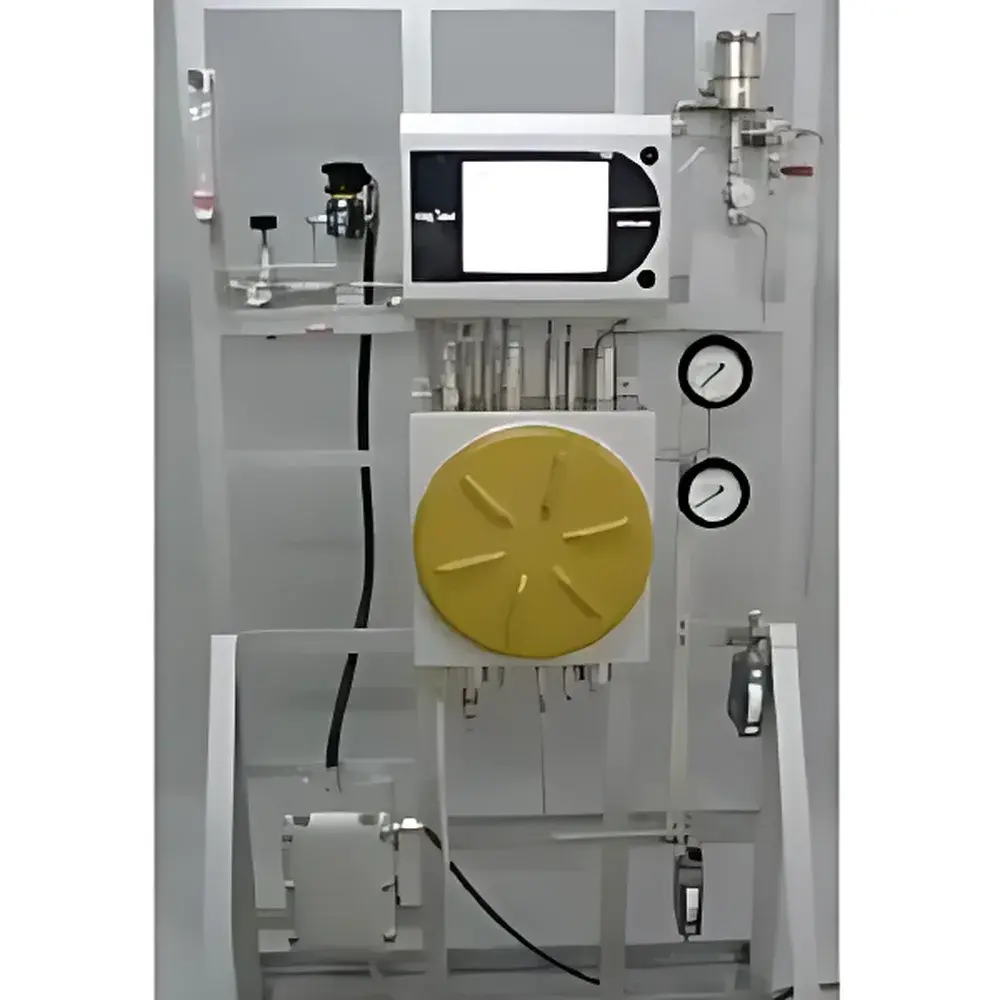
HACH DKK BPM-2000 ASTM D86/D1160 Automated Distillation Analyzer
| Brand | HACH |
|---|---|
| Manufacturer | DKK Toa Corporation |
| Model | BPM-2000 |
| Origin | Japan |
| Compliance | ASTM D86, ASTM D1160, GB/T 6536, GB/T 9168 |
| Explosion Protection | NEPSI Ex dpx IIB+H2 T4 Gb (Cert. No. GYJ14.1186x) |
| Operating System | Windows XP/7 Embedded |
| Display | 10" Color Touchscreen Interface |
| Communication | RS485 MODBUS RTU (up to 15 addresses, baud rates up to 115.2 kbps) |
| Sample Volume | 50 mL |
| Resolution | 0.15 vol% per temperature point |
| Vacuum Option | Optional ASTM D1160-compliant vacuum distillation module |
| Specialized Components | Coated stainless-steel distillation flask, explosion-proof sample cooler (SCU-02), sample conditioning unit, waste recovery unit, voltage stabilizer |
Overview
The HACH DKK BPM-2000 Automated Distillation Analyzer is an industrial-grade, on-line or at-line analytical system engineered for precise determination of boiling range distribution in petroleum fractions and organic chemical liquids. It operates on the standardized Engler (or ASTM D86) atmospheric distillation principle—where a defined 50 mL sample is heated under controlled conditions, and vapor-phase temperature is continuously monitored via high-stability platinum resistance thermometers (PRTs), while condensate volume is measured with sub-0.2 vol% resolution using optical or capacitive liquid-level sensing technology. The instrument delivers quantitative distillation curves mapping temperature versus cumulative volume percent distilled, enabling accurate identification of key specification points including Initial Boiling Point (IBP), Final Boiling Point (FBP), and intermediate recovery temperatures (e.g., 10%, 50%, 90% points). When equipped with the optional vacuum module, it fully complies with ASTM D1160 and GB/T 9168 for high-boiling materials such as lubricating oils, heavy fuel oils, and residual hydrocarbons—extending operational applicability beyond conventional atmospheric limits.
Key Features
- Full compliance with ASTM D86 (atmospheric) and ASTM D1160 (vacuum) test methods, as well as corresponding Chinese national standards GB/T 6536 and GB/T 9168
- Explosion-proof certified design (NEPSI Ex dpx IIB+H2 T4 Gb, Certificate No. GYJ14.1186x), validated for direct installation in hazardous Zone 1/2 process environments within refineries and petrochemical plants
- Stainless-steel distillation flask with proprietary internal coating to minimize coking and fouling—reducing maintenance frequency and improving long-term measurement reproducibility
- Integrated 10-inch color touchscreen interface running embedded Windows XP or Windows 7 OS, supporting bilingual operation (English/Chinese) and real-time graphical display of distillation curves, temperature profiles, and volumetric recovery trends
- High-resolution data acquisition: temperature recorded at ≤0.1°C intervals; volume detection at 0.15 vol% increments across the full 0–100% range
- Modular architecture supporting field-upgradable options: explosion-proof sample cooler (SCU-02), sample conditioning unit (for pressure/temperature stabilization and water/suspended solids removal), waste oil recovery system, and dedicated AC voltage stabilizer
Sample Compatibility & Compliance
The BPM-2000 is validated for routine analysis of light to medium petroleum cuts—including naphtha, gasoline, aviation turbine fuel (Jet A-1), kerosene, and diesel—as well as common organic solvents such as methanol, benzene, toluene, xylene, and solvent naphthas. Its mechanical and thermal design accommodates samples with initial boiling points as low as 30°C and final boiling points exceeding 400°C (under vacuum). All measurement protocols adhere to internationally recognized quality frameworks: raw data logs include timestamped sensor readings, operator ID, calibration status, and environmental ambient parameters. The system supports audit-ready documentation required under GLP and refinery-specific QA/QC programs, and its digital output conforms to industry-standard MODBUS RTU protocol for seamless integration into DCS, SCADA, or LIMS platforms.
Software & Data Management
Embedded firmware performs real-time curve fitting using polynomial regression algorithms to interpolate IBP and FBP from raw temperature/volume datasets, minimizing manual interpretation bias. Output includes ASCII-exportable CSV files containing full distillation curves plus user-selectable recovery points (1–8 points configurable per analysis). All measurement sessions are stored locally with automatic backup capability. Software architecture supports electronic signature functionality and configurable user access levels—enabling alignment with FDA 21 CFR Part 11 requirements where applicable. Data integrity is preserved through cyclic redundancy check (CRC)-protected communication and non-volatile memory storage resistant to power interruption.
Applications
- Real-time monitoring of crude distillation unit (CDU) and vacuum distillation unit (VDU) side-stream cuts for process optimization
- Final product certification testing in blending facilities for gasoline, jet fuel, and diesel meeting ASTM D439, D1655, and D975 specifications
- In-process quality control during catalytic reforming, hydrotreating, and alkylation operations
- Raw material verification for chemical feedstocks entering synthesis units (e.g., BTX extraction, olefin production)
- Regulatory compliance reporting for environmental emissions inventories requiring volatility characterization (e.g., EPA Method IP-15)
FAQ
What distillation standards does the BPM-2000 support?
It natively executes ASTM D86 and GB/T 6536 for atmospheric distillation, and—when fitted with the vacuum accessory—fully satisfies ASTM D1160 and GB/T 9168 for high-boiling-point materials.
Can the analyzer operate in hazardous area classifications?
Yes. It carries NEPSI Ex dpx IIB+H2 T4 Gb certification, permitting installation in classified Zones 1 and 2 without additional barrier systems.
How is sample introduction and disposal handled?
A dedicated 50 mL volumetric dosing mechanism ensures consistent sample loading; spent residue and condensate are routed to an integrated waste collection tank, optionally connected to a recovery pump for return to process lines.
Is remote diagnostics or software update capability available?
While the embedded OS does not support over-the-air updates, firmware upgrades are performed via secure USB media under technician supervision, with version-controlled change logs archived per ISO/IEC 17025 traceability requirements.
What maintenance intervals are recommended for optimal performance?
Daily visual inspection of condenser flow and flask cleanliness; quarterly calibration verification using NIST-traceable reference standards; annual full-system validation including temperature sensor drift assessment and level sensor linearity testing.







