
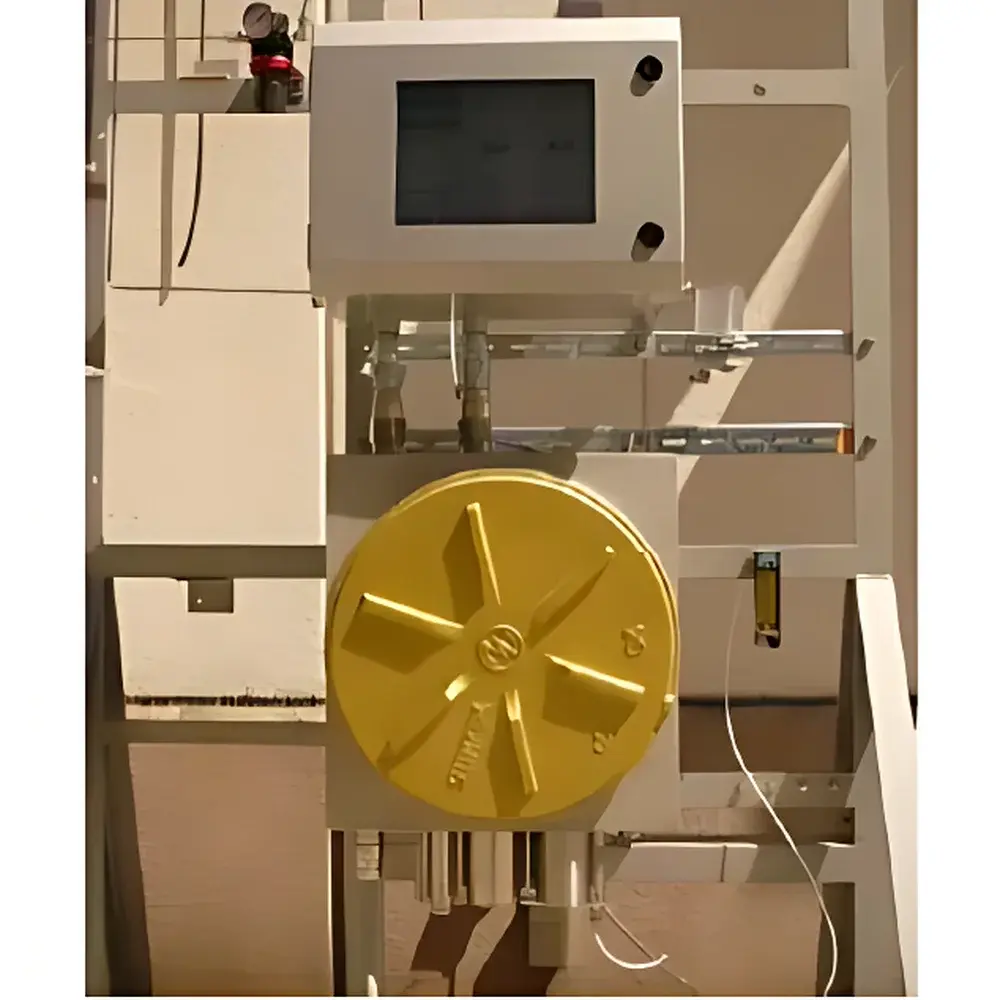
HACH DKK HSCA-2000 Total Sulfur Analyzer
| Brand | HACH |
|---|---|
| Manufacturer Origin | Japan (DKK Corporation) |
| Manufacturer Type | Original Equipment Manufacturer (OEM) |
| Country of Origin | Imported |
| Model | HSCA-2000 |
| Measurement Principle | Energy-Dispersive X-Ray Fluorescence (EDXRF) |
| Detection Range | 0–10 ppm to 0–1000 ppm (user-selectable) |
| Repeatability | ±2% of full scale |
| Linearity | ±2% of full scale |
| Sample Temperature Limit | ≤60°C |
| Sample Pressure Limit (inlet to flow cell) | ≤0.5 MPa |
| Flow Cell Material | SUS304 stainless steel, Viton seals, coated beryllium window |
| X-ray Source | Low-power end-window micro-focus X-ray tube (9.9 W) |
| Detector | High-sensitivity low-background proportional counter |
| Measurement Cycle | 10–999 s (adjustable) |
| Enclosure Rating | IP55 |
| Explosion Protection | NEPSI Ex dpx IIB+H2 T4 Gb (Cert. No. GYJ11.1655) |
| Power Supply | 90–240 VAC, 50/60 Hz, 70 VA |
| Ambient Operating Conditions | 0–50°C, ≤85% RH |
| Analog Output | 4–20 mA DC (600 Ω load) |
| Alarm Output | 1 dry contact (NC, 0.5 A / 30 VAC or DC) |
| Communication Options | MODBUS RTU/TCP, HART, Ethernet (optional) |
| Utility Requirements | Instrument air (0.4–1.0 MPa, 20 NL/min), helium purge gas (0.5–1.0 MPa, 10–20 NmL/min), optional cooling water |
Overview
The HACH DKK HSCA-2000 Total Sulfur Analyzer is a benchtop or skid-mounted analytical instrument engineered for precise, non-destructive quantification of total sulfur in liquid hydrocarbon streams and organic chemical feedstocks. It employs Energy-Dispersive X-Ray Fluorescence (EDXRF) spectroscopy — a physically robust, calibration-stable technique that eliminates combustion, chemical digestion, or sample derivatization. Unlike combustion-based methods (e.g., ASTM D5453) or wavelength-dispersive XRF (WDXRF), the HSCA-2000 requires no vacuum pumps, moving mechanical parts, temperature-sensitive monochromators, or replaceable X-ray window films. This architecture delivers high operational uptime, minimal consumables, and long-term measurement consistency — critical for continuous process monitoring in refineries, petrochemical plants, and fuel blending facilities.
Key Features
- Non-destructive EDXRF detection with end-window micro-focus X-ray tube (9.9 W) and low-background proportional counter — optimized for sub-ppm sulfur sensitivity in low-Z matrices.
- No vacuum system or dynamic mechanical components: eliminates routine maintenance associated with pumps, filters, or crystal alignment.
- Explosion-proof certified to NEPSI Ex dpx IIB+H2 T4 Gb (Cert. No. GYJ11.1655), enabling safe deployment in Zone 1 hazardous areas including hydrotreating units, distillation overheads, and storage tank farms.
- Adjustable measurement cycle (10–999 s) supports both rapid QC checks and high-precision compliance verification per regulatory time windows.
- IP55-rated enclosure ensures reliable operation in industrial environments with dust, moisture, and incidental splashing.
- Integrated 10-inch color touchscreen PC running Windows Embedded Standard (XP or Win7) provides intuitive local control, real-time spectral visualization, trend graphs, and diagnostic logs — all accessible without external PCs.
- Multi-standard method compliance: fully aligned with ASTM D4294-2008, ASTM D6445, GB/T 17040, and SH/T 0742 for sulfur determination in gasoline, diesel, naphtha, kerosene, methanol, benzene, esters, ketones, and ethers.
Sample Compatibility & Compliance
The HSCA-2000 accepts liquid samples with viscosity ≤20 cSt at 40°C and temperature ≤60°C. Compatible matrices include finished transportation fuels (gasoline, diesel, jet fuel), refinery intermediates (naphtha, kerosene), lubricant base oils, and polar organics such as alcohols, ethers, esters, and aromatic solvents. The flow cell — constructed from SUS304 stainless steel, Viton wetted seals, and a coated beryllium window — resists corrosion from aggressive sulfur compounds and halogenated species. Sample inlet pressure is rated to 0.5 MPa; upstream sample conditioning systems may handle up to 2 MPa. All measurement protocols adhere to ISO/IEC 17025 traceability principles, and the analyzer’s digital audit trail supports GLP/GMP-aligned data integrity requirements when integrated with compliant LIMS or DCS platforms.
Software & Data Management
The embedded Windows-based software provides full instrument control, calibration management (including multi-point linear and quadratic calibration curves), spectral acquisition, and real-time interference correction for chlorine and silicon. Raw spectra and processed results are timestamped and stored locally with configurable retention policies. Data export options include CSV, PDF reports, and OPC UA-compatible tags. Optional communication modules support MODBUS RTU/TCP, HART 7, and Ethernet/IP for seamless integration into distributed control systems (DCS) or SCADA networks. Alarm states — including X-ray source fault, detector saturation, helium flow loss, or window contamination — trigger discrete relay outputs and on-screen notifications with event logging. Firmware updates are performed via USB or network, preserving configuration and historical datasets.
Applications
- Real-time sulfur monitoring in hydrotreater product streams to ensure compliance with China VI, Euro 6, and U.S. EPA Tier 3 fuel specifications.
- In-line quality assurance during gasoline and diesel blending operations — reducing lab turnaround time and enabling closed-loop process adjustments.
- Verification of ultra-low-sulfur diesel (ULSD) and marine fuel (IMO 2020-compliant) shipments prior to custody transfer.
- QC testing of biofuels (FAME, HVO), ethanol blends (E10, E85), and specialty solvents where sulfur impurities affect catalyst life or emission performance.
- Supporting refinery-wide sulfur balance studies and environmental reporting under national emissions inventories (e.g., China MEP Order No. 36).
FAQ
Does the HSCA-2000 require daily calibration or standardization?
No — the EDXRF platform exhibits excellent long-term stability. A single multi-point calibration validated against CRM materials (e.g., NIST SRM 2724b) remains valid for ≥30 days under stable operating conditions. Daily verification using a check standard is recommended but not mandatory.
Can the analyzer measure sulfur in high-boiling or viscous samples like heavy fuel oil?
No — the HSCA-2000 is designed for low-viscosity liquids (<20 cSt at 40°C). Heavy fuel oils, bitumen, or residues require sample dilution or alternate methods (e.g., ASTM D2622 WDXRF or D5453 UV fluorescence).
Is helium consumption critical to performance?
Yes — helium purging minimizes atmospheric absorption of low-energy sulfur Kα X-rays (2.307 keV). Typical consumption is 10–20 NmL/min; one 40-L helium cylinder lasts 4–6 months under continuous operation.
How is data integrity ensured for regulatory submissions?
The system supports electronic signatures, user access levels (admin/operator), and immutable audit trails. When configured with optional 21 CFR Part 11-compliant software modules, it meets FDA and CNCA requirements for electronic records in quality-critical applications.







