
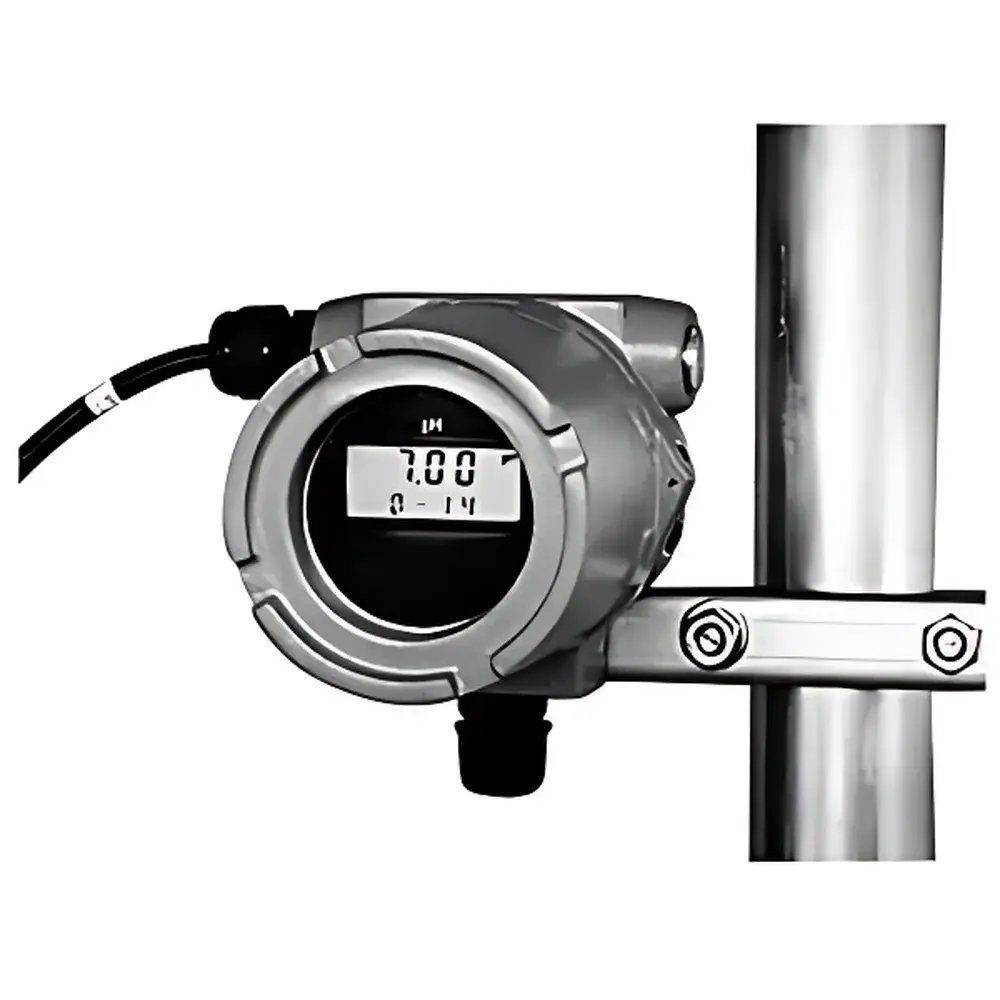
HACH DKK SPCP-20 Two-Wire pH Transmitter
| Brand | HACH |
|---|---|
| Origin | Imported |
| Manufacturer | DKK TOA Corporation |
| Model | SPCP-20 |
| Explosion Protection | IEC Ex ia IIC T4 Ga (Cert. Nos. C12661–C12664) |
| Temperature Compensation Range | 0–100 °C (manual, via external thermistor) |
| Temp. Coefficient Adjustment Range | −0.100 to +0.100 pH/°C |
| Output Signal | 4–20 mA DC (two-wire loop-powered) |
| Housing | Die-cast aluminum, adjustable mounting angle |
| Diagnostic Capabilities | Electrode fracture detection, thermistor open/short, hardware fault monitoring |
| Operating Mode Options | Measurement mode / Maintenance mode (output hold: last value, user-defined setpoint, or live reading) |
| Compliance | IEC 60079-0, IEC 60079-11, NEMA 4X equivalent ingress protection |
Overview
The HACH DKK SPCP-20 is a two-wire, intrinsically safe pH transmitter engineered for continuous, high-reliability measurement in demanding industrial water and wastewater applications. Designed around the fundamental electrochemical principle of potentiometric pH sensing—where the voltage difference between a glass pH electrode and a reference electrode is converted into a standardized 4–20 mA analog output—the SPCP-20 delivers stable, drift-resistant signal conditioning without requiring external power at the field device. Its intrinsic safety certification (IEC Ex ia IIC T4 Ga, Cert. Nos. C12661–C12664) enables deployment in hazardous areas classified under Zone 0/1 per IEC 60079 standards, including boiler feedwater systems, desalination pretreatment, chemical dosing control loops, and effluent monitoring stations where explosive atmospheres may be present. The transmitter features an embedded microprocessor that performs real-time electrode diagnostics, automatic calibration validation, and configurable temperature compensation algorithms—ensuring measurement integrity across variable process conditions.
Key Features
- Dual-certified intrinsically safe design compliant with IEC 60079-0 and IEC 60079-11 for Zone 0 operation
- Robust die-cast aluminum housing rated to NEMA 4X equivalent (IP66), with adjustable mounting bracket for optimal sensor alignment
- Front-access terminal block and intuitive front-panel operation—no need to remove cover for routine configuration or maintenance
- Programmable manual temperature compensation using external thermistor probes (0–100 °C range)
- Adjustable temperature coefficient (−0.100 to +0.100 pH/°C) for accurate compensation in ultrapure water, boiler feed, or low-conductivity samples
- Comprehensive self-diagnostic suite: detects glass electrode fracture, reference junction failure, thermistor open/short circuits, and internal hardware anomalies
- Configurable alarm behavior: upon fault detection, output can be driven to user-defined high-limit (22 mA), low-limit (3.6 mA), or hold-last-value mode
- Maintenance mode allows continued display of live pH while freezing analog output to a preconfigured value—supporting safe instrument servicing without disrupting control logic
Sample Compatibility & Compliance
The SPCP-20 is optimized for aqueous matrices with conductivity ≥50 µS/cm, including municipal drinking water, cooling tower makeup, steam condensate, reverse osmosis permeate, and neutral-to-alkaline industrial effluents. It supports standard combination pH electrodes with integrated or separate temperature elements. For low-conductivity applications (<100 µS/cm), proper grounding and shielded cable routing (per manufacturer guidelines) are essential to minimize noise-induced drift. The transmitter conforms to electromagnetic compatibility requirements per IEC 61326-1 (industrial environment), meets RoHS Directive 2011/65/EU, and supports traceability under GLP/GMP-aligned operational procedures when paired with calibrated reference electrodes and documented calibration logs. While not FDA 21 CFR Part 11–certified as a standalone unit, its analog output architecture integrates seamlessly into validated SCADA and DCS platforms meeting regulatory data integrity requirements.
Software & Data Management
As a dedicated two-wire analog transmitter, the SPCP-20 does not incorporate embedded firmware-upgradable software or digital communication protocols (e.g., HART, Modbus). Configuration is performed exclusively via DIP switches and front-panel push-button interface, ensuring deterministic behavior and immunity to cyber vulnerabilities associated with networked devices. All parameter settings—including temperature coefficient, alarm thresholds, and maintenance-mode output behavior—are retained through power cycling. Calibration data (date, buffer values, slope, offset) must be manually recorded per facility SOPs. When integrated into larger automation ecosystems, the 4–20 mA signal is logged by PLCs or DCS historians; audit trails and electronic signatures are maintained at the system level—not within the transmitter itself—aligning with ISO/IEC 17025 and ASTM D1129 practices for laboratory and field instrumentation.
Applications
- Continuous pH monitoring in high-purity steam generation cycles, where temperature-compensated accuracy below ±0.05 pH is critical for corrosion control
- Neutralization control in chemical wastewater treatment plants handling acidic or alkaline influents
- Feedwater quality assurance in membrane filtration and ion exchange systems
- Regulatory compliance monitoring for NPDES discharge permits requiring documented pH stability over time
- Hazardous-area applications in petrochemical refineries, pharmaceutical manufacturing utilities, and offshore platform water treatment skids
- Redundant backup measurement in safety-critical pH control loops where SIL-2 capability is achieved via voting logic with multiple transmitters
FAQ
What type of pH electrode is compatible with the SPCP-20?
The transmitter accepts standard combination pH electrodes with BNC or DIN connectors, including those with built-in Pt1000 or thermistor temperature elements. For optimal performance in low-conductivity water, use electrodes specifically designed for ultrapure applications (e.g., double-junction, low-resistance glass membranes).
Can the SPCP-20 perform automatic temperature compensation?
No—it supports only manual temperature compensation via external thermistor input. Automatic compensation requires a probe-integrated temperature sensor and is not implemented in this model.
Is it permissible to extend the electrode cable using third-party wiring?
HACH DKK strongly recommends using only original EC-10 shielded coaxial cable for extensions. Non-compliant cabling introduces capacitive loading and EMI susceptibility, degrading measurement stability and diagnostic reliability.
How is output signal fault behavior configured?
Using DIP switches on the main board, users select between high-alarm (22 mA), low-alarm (3.6 mA), or hold-last-value modes during diagnostic faults such as electrode breakage or thermistor failure.
Does the SPCP-20 support HART or other digital communication?
No. It is strictly a 4–20 mA two-wire analog transmitter with no digital overlay or smart protocol support.
Related Products







