
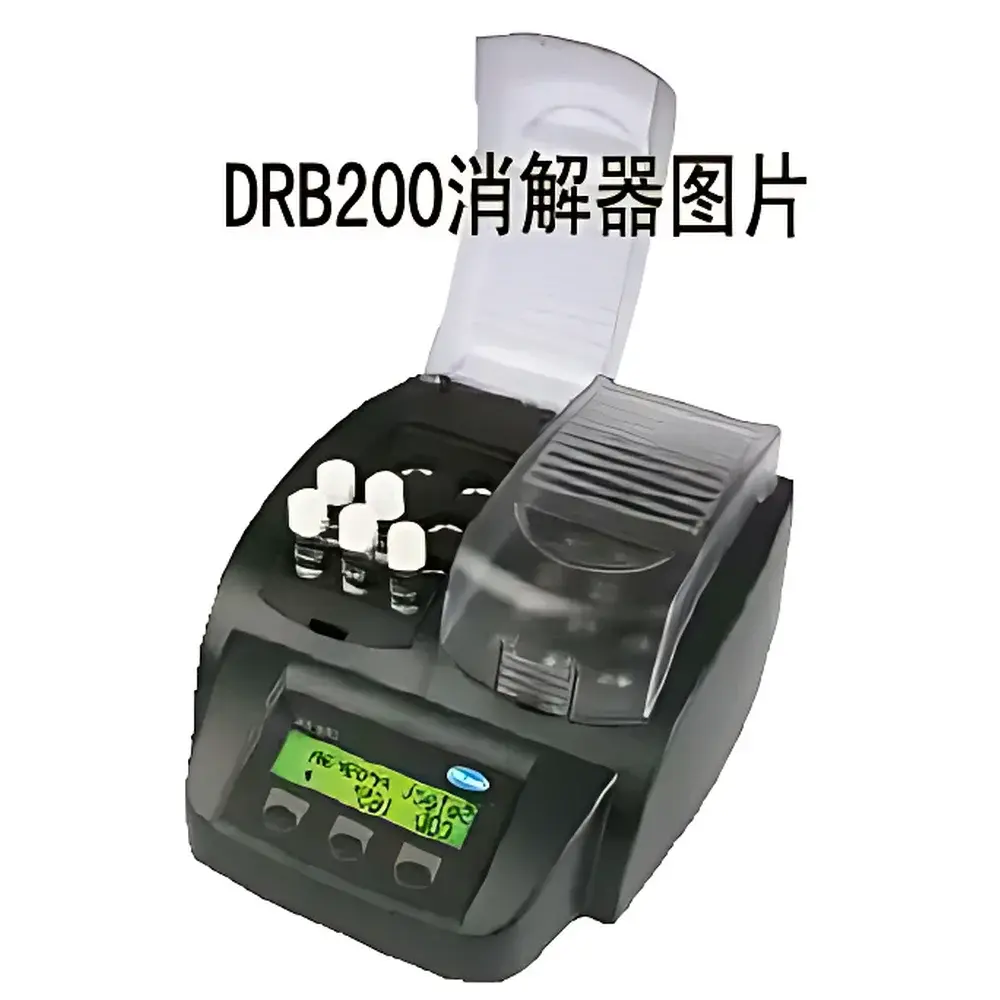
Hach DRB200 COD Digestion System
| Brand | Hach |
|---|---|
| Origin | USA |
| Type | Laboratory Digestion Block |
| Model | DRB200 |
| Wavelength | 610 nm |
| Measurement Ranges | 0.7–40, 3–150, 20–1500, 200–15000 mg/L COD |
| Accuracy | ≤ ±10% |
| Repeatability | ≤ ±5% |
| LOD | 0.7 mg/L |
| Digestion Time | 20 min or 2 h (programmable) |
| Batch Capacity | 15 or 30 samples (configurable via heating block options) |
| Temperature Range | 37–165 °C |
| Temp Stability | ±2 °C |
| Pre-stored Programs | COD (150 °C, 120 min), plus multiple fixed-temp/time profiles (100/105/150/165 °C, 30/60/120/240/480 min) |
| Power | 100–240 V, 50/60 Hz |
| Operating Environment | 10–45 °C, ≤90% RH (non-condensing) |
Overview
The Hach DRB200 COD Digestion System is a precision-engineered laboratory digestion block designed for standardized chemical oxygen demand (COD) analysis in accordance with EPA Method 410.4 and ISO 6060. It implements the Hach-developed micro- reflux digestion protocol — a closed-tube, high-efficiency alternative to traditional open-reflux methods — wherein water samples are oxidized by potassium dichromate under strong acidic conditions at elevated temperature (typically 150 °C for 2 hours). The system quantifies residual dichromate spectrophotometrically at 610 nm post-digestion, enabling direct calculation of oxygen demand expressed as mg/L O₂. Unlike classical reflux setups requiring condensers, cooling water, and fume hoods, the DRB200 operates as a compact, dry-block thermal unit compatible with Hach TNTplus® and LCK® pre-filled COD vials. Its design minimizes operator exposure to hazardous reagents (e.g., concentrated H₂SO₄ and Cr⁶⁺), reduces acid vapor emissions, and eliminates glassware cleaning cycles — thereby supporting safer, more reproducible, and audit-ready environmental testing workflows.
Key Features
- Modular dual-heating-block architecture: Supports independent temperature and time control per block; accommodates up to 30 samples simultaneously (15 per block) using optional 13 mm, 16 mm, or 20 mm well configurations.
- Precision thermal management: Heats from ambient to 150 °C in ≤10 minutes; maintains setpoint stability within ±2 °C across all wells — critical for method compliance and inter-laboratory comparability.
- Pre-programmed digestion protocols: Includes validated COD method (150 °C, 120 min), plus customizable programs for TOC, total nitrogen, and total phosphorus digestion per ASTM D5257, ISO 11908, and ISO 11909.
- Reagent compatibility: Optimized for Hach’s certified TNTplus® COD vials (LTV082.52.xxxx series), eliminating manual reagent preparation and reducing analyst error and variability.
- Robust construction: Aluminum heating blocks with corrosion-resistant anodized finish; integrated overtemperature protection and automatic shutdown for unattended operation.
- Electrical safety & regulatory alignment: Complies with IEC 61010-1 for laboratory electrical equipment; CE-marked; suitable for use in GLP and ISO/IEC 17025-accredited laboratories.
Sample Compatibility & Compliance
The DRB200 accepts standard 13 mm, 16 mm, and 20 mm diameter digestion vials — including Hach TNTplus® (16 mm), LCK® (13 mm), and custom OEM tubes — via interchangeable heating blocks or optional 16-to-13 mm adapters (Order No. 2895805). It supports wastewater, surface water, industrial effluent, and treated sewage matrices per U.S. EPA, APHA Standard Methods 5220D, and ISO 6060. All digestion procedures align with quality system requirements for traceability and data integrity: each run logs timestamp, temperature profile, and duration internally (when paired with Hach’s DataStream™ software), satisfying FDA 21 CFR Part 11 electronic record criteria when used with compliant instruments and audit-trail-enabled software.
Software & Data Management
While the DRB200 operates as a standalone hardware module, it integrates seamlessly into Hach’s full analytical ecosystem. When connected via USB or RS-232 to compatible Hach spectrophotometers (e.g., DR5000, DR2800), digestion metadata (start time, setpoint, duration) auto-syncs with absorbance readings in Hach’s LabStation™ or DataStream™ software. This enables full chain-of-custody reporting, calibration verification logging, and automated QC flagging (e.g., out-of-range temperature excursions). All exported datasets include instrument ID, operator ID, sample ID, digestion parameters, and photometric results — structured for import into LIMS platforms or regulatory submission templates (e.g., EPA CDX, NetDMR).
Applications
The DRB200 serves as the core digestion engine in regulated environmental monitoring programs, including municipal wastewater treatment plant compliance reporting (NPDES permits), industrial pretreatment verification, drinking water source assessment, and research-grade organic load characterization. Its programmability extends utility beyond COD to total organic carbon (TOC) persulfate oxidation, Kjeldahl nitrogen digestion, and orthophosphate liberation — making it a multi-parameter platform for water quality labs operating under tight budget and space constraints. Field-deployable variants (with portable power options) support rapid-response testing during spill events or watershed surveys where on-site digestion is required prior to spectrophotometric analysis.
FAQ
Does the DRB200 require calibration or routine thermocouple verification?
Yes — Hach recommends annual verification of block temperature uniformity and accuracy using a NIST-traceable digital thermometer (e.g., Fluke 1523) per manufacturer guidelines. Calibration certificates are available upon request.
Can the DRB200 be used with non-Hach COD reagents?
It may physically accommodate third-party vials, but Hach does not validate performance or compliance for non-certified reagents. Use of Hach TNTplus® or LCK® vials ensures adherence to EPA and ISO method specifications.
Is the DRB200 compatible with GLP/GMP documentation requirements?
When operated with Hach’s audit-trail-enabled software and properly maintained logbooks, the DRB200 meets core GLP documentation expectations for equipment use, maintenance, and calibration history.
What safety certifications does the DRB200 hold?
It conforms to IEC 61010-1:2010 (Safety Requirements for Electrical Equipment for Measurement, Control, and Laboratory Use) and carries CE marking for EMC and Low Voltage Directive compliance.
How is cooling managed after digestion?
The DRB200 does not include active cooling; users must remove vials and allow passive air-cooling to ambient temperature (~30–45 min) before spectrophotometric measurement — consistent with EPA 410.4 protocol requirements.
Related Products







